
What's inside
As an Amazon Associate I earn from qualifying purchases. This post may contain affiliate links at no extra cost to you.
The best mini band saw for small projects is the one that fits your stock and bench: choose a compact 3–5-inch-throat model for thin craft pieces and tight spaces, or step up to a 9-inch benchtop saw if you need more cutting height and room to guide work. Before buying, compare throat depth, capacity under the guides, blade dimensions, and the machine’s actual footprint—not just its name or motor rating.
As an Amazon Associate we earn from qualifying purchases at no extra cost to you.
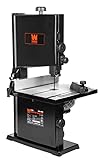


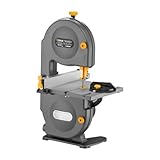
Mini band saws at a glance
“Mini” is not a standardized size category. It can mean a small hobby saw with a roughly 3-inch throat, or a benchtop machine with a 9-inch throat that is compact compared with a floor-standing saw. The figures below are representative specifications for established models; verify the current manual before purchase, since specifications can vary by version and market.
| Model | Throat | Maximum cutting height | Blade | Approx. footprint | Best fit |
|---|---|---|---|---|---|
| Proxxon MBS 240/E | Approx. 5.3 in. | Approx. 3.1 in. | Approx. 41.3 in. long; 0.02 in. thick | Approx. 11 × 11 in. | Small, detailed work where bench space is scarce |
| WEN 3959 | 9 in. | 3-1/2 in. | 62 in. long; 1/8–3/8 in. wide | Approx. 12-1/4 × 16-3/4 in. | General hobby use and occasional curves in wider stock |
| RYOBI BS904G | 9 in. | 3-1/2 in. | 62 in. long; 1/8–3/8 in. wide | Approx. 13 × 16 in. | A small-shop saw with a useful capacity-to-footprint balance |
| Record Power BS9 9-inch bandsaw | 9 in. | Approx. 3-1/2 in. | Varies by supplied blade and version | Check the specific model and stand configuration | Buyers comparing compact 9-inch machines in its market |
Footprints are rounded planning estimates, not clearance requirements. Allow additional room for the table, fence, dust extraction, and the longest workpiece you intend to handle. Confirm blade specifications and maximum capacity in the manufacturer’s current documentation.
Choose by the work you actually do
For miniature parts, thin stock, and a crowded bench: Proxxon MBS 240/E
The Proxxon is the more specialized choice in this group. Its smaller throat and narrow blade suit delicate curves, model-making, and small parts that would be awkward on a larger table. Its compact body is useful when a permanent machine station is not available.
The trade-off is limited capacity: a 5.3-inch throat gives less room to rotate a broad panel, and a roughly 3.1-inch cutting height rules out thicker work. This is a precision-oriented small saw, not a scaled-down substitute for a full-size resawing machine. Check that its small blade format is readily available where you live before committing.
For an all-purpose hobby bench: WEN 3959
The WEN 3959 offers a 9-inch throat and 3-1/2-inch cutting height, giving it more room for drawer parts, small signs, toys, and curved furniture components than a micro-format saw. It uses a common 62-inch blade length and accepts widths from 1/8 to 3/8 inch, which makes it easier to select a blade for either tighter curves or straighter cuts.
Its capacity does not make it a production machine. Small benchtop saws have less mass and often less power than larger models, so feed slowly and let the blade do the work. Treat the listed cutting height as a maximum clearance, not a promise that the saw will cut thick hardwood quickly or cleanly.
For a compact 9-inch alternative: RYOBI BS904G
The RYOBI BS904G occupies a similar size class, with a 9-inch throat and 3-1/2-inch capacity. It is a reasonable option when you want the versatility of a 62-inch blade without moving up to a larger saw. Compare the machine’s current price, included accessories, warranty, and local blade availability with the WEN rather than assuming the shared capacity means they are identical in use.
For shoppers outside the U.S.: compare the Record Power BS9
The Record Power BS9 is a compact 9-inch class bandsaw worth considering in markets where it is readily supported. Compare the exact version’s blade, table, guide arrangement, and footprint with the alternatives available locally. For a small machine, convenient access to replacement blades and service can matter more than a small difference in nominal capacity.
How to match capacity to your workspace
Use these measurements before you order:
- Throat depth: Measure from the blade to the inside frame. As a practical rule, a workpiece wider than this distance cannot be turned freely to cut an unrestricted curve.
- Cutting height: Measure the thickness of your thickest planned stock. Leave margin below the maximum so you can guide the piece without forcing it.
- Blade width: Narrow blades turn more readily around tight curves; wider blades generally track better on straighter cuts. A narrow blade cannot make a sharp turn if the workpiece geometry does not allow it.
- Bench space: Measure the saw’s base and add working clearance. A 12-by-17-inch base, for example, needs more than 204 square inches of usable bench area once you account for the table and stock movement.
- Storage and setup: A light machine may be easier to stow, but repeatedly clamping and realigning it can discourage use. Include the space for a stable mounting board or dedicated bench position.
Decision matrix: which size suits you?
| Your situation | What to prioritize | Likely fit |
|---|---|---|
| Very little permanent bench space; mostly small craft parts | Small base, narrow blade, easy storage | Proxxon-style micro bandsaw |
| Beginner cutting toys, curves, and small furniture parts | 9-inch throat, common blade length, straightforward setup | WEN 3959 or RYOBI BS904G |
| Frequent work in hardwood or near maximum capacity | Greater mass, motor capacity, and stable guides | Consider a larger bandsaw rather than forcing a mini model |
| Occasional use and tight budget | Blade availability, table stability, and included fence or miter gauge | Compare current compact 9-inch models by total setup cost |
Ownership details that affect cut quality
On a small bandsaw, the blade is a wear item, and it is often the first thing to replace when cuts wander, burn, or require unusual force. A dull or damaged blade can make a sound machine seem underpowered. Keep a spare compatible blade on hand, and choose tooth spacing appropriate to the material thickness: the blade should engage several teeth in the work rather than having only one tooth doing the cutting.
Dust and pitch can build up around the guides, wheels, and table slot. Unplug the saw before cleaning or changing a blade; remove accumulated debris with a brush or vacuum, then check that the blade tracks correctly and the guides support it without pinching. Follow the manual’s tensioning and tracking procedure, because over-tensioning can strain a small machine while poor tracking can lead to blade drift or derailment.
Do not use maximum cutting height as a routine target. Thick stock and tight curves together place extra demands on the blade. For a clean curve, cut just outside the layout line and sand to final shape; make relief cuts where appropriate so narrow waste sections can fall away rather than binding the blade. Use eye protection, keep hands clear of the cutting path, and do not cut stock that cannot sit securely on the table.
Final recommendation
Choose the Proxxon MBS 240/E when the work is genuinely miniature and saving bench space matters more than capacity. Choose a 9-inch model such as the WEN 3959 or RYOBI BS904G for the broader range of small-shop projects, provided its footprint and blade supply suit your setup. If you regularly cut thick hardwood, wide panels, or long stock, the better purchase may be a larger bandsaw: a mini model’s small footprint is useful only when its limits match the work.