
What's inside
- Milwaukee M18 Band Saw Review: Is It Worth Buying?
- Capacity: match the saw to the stock
- Runtime: plan by cuts, not by a promised number of hours
- Blade changes and cut quality
- Portability and durability in daily use
- Which M18 band saw makes sense for your situation?
- Verdict: buy it for portable stock cutting, not general woodworking
- Related Guides
As an Amazon Associate I earn from qualifying purchases. This post may contain affiliate links at no extra cost to you.
Milwaukee M18 Band Saw Review: Is It Worth Buying?
The Milwaukee M18 band saw is worth buying if you regularly cut metal stock, threaded rod, conduit, or small plastic parts away from a fixed workshop saw; for woodworking curves, resawing, or frequent cuts through wide boards, a benchtop or larger bandsaw is the better choice. Its main advantage is portable, relatively controlled cutting—not replacing a full-size wood-cutting bandsaw.
“M18 band saw” covers several Milwaukee models, and their capacities and weights differ. The comparison below focuses on the compact and deep-cut portable versions commonly encountered in the M18 range. Confirm the exact model number before buying, especially if cutting capacity is close to your limit.
As an Amazon Associate we earn from qualifying purchases at no extra cost to you.

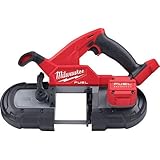

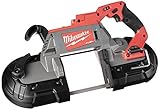
Capacity: match the saw to the stock
The compact M18 models are intended for smaller-diameter stock. Deep-cut versions have a larger throat and can handle material up to about 5 inches by 5 inches, depending on the specific model. That distinction matters more than the M18 name: a compact saw may be handy for conduit and smaller tube but cannot make the same cut as a deep-cut frame.
For woodworking, capacity needs a second interpretation. A deep-cut portable saw may fit around a thick piece of stock, but that does not make it a good tool for furniture parts. Its narrow blade, frame geometry, and handheld feed are designed primarily for controlled cuts through stock such as metal pipe and threaded rod. Use a wood bandsaw for curved profiles, repeatable joinery cuts, and resawing boards.
| Consideration | Compact M18 band saw | Deep-cut M18 band saw | What it means in a workshop |
|---|---|---|---|
| Typical maximum cut capacity | About 2-1/2 in. × 2-1/2 in. | About 5 in. × 5 in. | Check both dimensions against the widest stock you actually cut. |
| Tool weight, bare | Roughly 7–8 lb | Roughly 13–15 lb | Battery and blade add weight; the deep-cut model is less comfortable overhead. |
| Blade length | About 35-3/8 in. | About 44-7/8 in. | Buy the length specified for the exact saw, not just a blade with a similar width. |
| Best-fit work | Small tube, conduit, rod, and light service cuts | Larger pipe, channel, and bundled stock within its capacity | Neither is a substitute for a stationary wood bandsaw. |
These are approximate model-family figures, not a guarantee that every generation shares the same specification. Check Milwaukee’s current product documentation for the model number, blade dimensions, and capacity before ordering.
Runtime: plan by cuts, not by a promised number of hours
There is no useful universal runtime figure for an M18 band saw. Battery size, blade condition, material, stock thickness, and how hard the operator feeds the saw all change how long a pack lasts. A fresh blade cutting thin-wall tube may deliver many short cuts; a dull blade forced through thick solid stock can drain the battery much faster.
If your shop already uses M18 batteries, that shared platform makes the saw more attractive. For occasional work, one charged battery may be enough. For repeated production cuts or a day of installation work, keep a charged spare available. A larger-capacity pack can extend time between swaps, but it also adds weight—noticeable on a handheld tool.
To estimate whether it suits your workload, record the number of cuts you make in a typical session and the pack size you plan to use. Then allow a margin for difficult material and battery aging rather than treating a best-case runtime claim as a schedule.
Blade changes and cut quality
Blade changes are a normal ownership task, not a reason to avoid the tool. Match the replacement to the saw’s specified length and width, and select tooth pitch for the material and thickness. As a practical rule, choose a pitch that keeps several teeth engaged in the work; a blade that is too coarse can snag thin stock, while one that is too fine can cut slowly and load up in thick material.
- Remove the battery first. This prevents an accidental trigger pull while your hands are near the blade.
- Open the blade cover as directed in the manual. Remove debris and check that the wheels and guides are clear.
- Fit the correct blade and orient its teeth. The teeth should face in the cutting direction specified by the manufacturer.
- Seat the blade fully on the wheels. Follow the model’s tensioning and tracking instructions; do not assume a loose blade will track itself.
- Close the cover and make a brief test run. Watch for the blade drifting off a wheel or making unusual noise before returning to work.
For straighter cuts, support the work securely, mark the line clearly, and let the blade establish its path without twisting the saw. Forcing a turn or pushing hard to make up for a dull blade can damage the blade and produce a wandering cut.
Portability and durability in daily use
The compact model’s lower weight makes it the easier choice for a tool bag, ladder work, and cuts in cramped spaces. The deep-cut frame earns its keep when larger stock will not fit a compact throat, but its extra bulk is tiring during extended one-handed or overhead work. If most cutting happens at a bench, a stationary saw or a securely supported workpiece may be more comfortable and accurate.
Durability depends as much on maintenance as on the housing. Blades are the main consumable: cutting dirty or abrasive stock, running a dull blade, or twisting during a cut shortens their life. Metal chips can also collect around the blade path and moving parts. Disconnect the battery before cleaning, brush away chips with a suitable brush, and follow the manual’s guidance on lubrication and service. Avoid directing compressed air into the tool unless the manufacturer recommends it; it can push debris deeper inside.
Common avoidable problems include using the wrong blade pitch, cutting stock that exceeds capacity, letting unsupported material pinch the blade, and storing the saw with metal debris packed around the guides. If tracking repeatedly goes out of adjustment or the saw develops persistent abnormal noise, stop using it and consult the manual or an authorized service provider rather than continuing to cut.
Which M18 band saw makes sense for your situation?
| Your situation | Best direction | Why |
|---|---|---|
| You already own M18 batteries and often cut small conduit or rod | Compact M18 model | Portable capacity without carrying a larger frame than the work requires. |
| You regularly cut stock approaching 5 in. across | Deep-cut M18 model | Its larger capacity addresses a real limitation of compact saws. |
| You make a few cuts a month and have no M18 batteries | Compare kit cost with a corded or manual alternative | The battery system can make the purchase less economical for infrequent use. |
| You need curves, furniture parts, or board resawing | Stationary woodworking bandsaw | A portable metal-cutting saw is the wrong geometry and setup for those jobs. |
| You cut repetitive lengths at a fixed bench | Consider a supported, dedicated cutting setup | Workholding and repeatability may matter more than cordless portability. |
Verdict: buy it for portable stock cutting, not general woodworking
The Milwaukee M18 band saw is a sensible purchase when portability, cordless operation, and the right capacity solve a recurring cutting problem. The compact version is easier to carry for smaller stock; the deep-cut version is the practical pick when larger material must fit through the frame. Shared M18 batteries strengthen the value for existing users, while buyers starting a battery platform should compare the full kit cost with alternatives.
For woodworking tasks such as cutting curves, shaping furniture components, or resawing lumber, choose a proper wood bandsaw instead. The M18 is worth buying when its specific job is cutting stock cleanly in places a larger saw cannot conveniently reach.