
What's inside
- What Makes a Gas Cooktop Fast and Flexible
- Gas Cooktop Comparison: Concrete Specs
- Decision Matrix: Which Cooktop Fits Your Kitchen
- Burner Output and Real-World Speed
- Grate Materials, Cleaning Effort, and What Wears First
- Dimensions, Cutouts, and Installation Requirements
- Picks by Situation
- Durability and Ownership Realities
- FAQ
As an Amazon Associate I earn from qualifying purchases. This post may contain affiliate links at no extra cost to you.
Best gas cooktops for fast, flexible cooking are 30-inch models with at least one 18,000-20,000 BTU power burner, continuous cast-iron grates, and a dedicated low simmer burner under 5,000 BTU, with 36-inch models making sense only if you regularly use 5 burners or wide griddles.
As an Amazon Associate we earn from qualifying purchases at no extra cost to you.


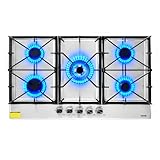
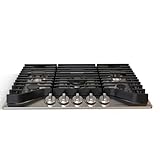
What Makes a Gas Cooktop Fast and Flexible
Speed comes from high BTU output and burner design, while flexibility comes from the range between the hottest and lowest burner. A cooktop that can sear at 19,000 BTU and hold a delicate sauce at 3,500 BTU without cycling off gives you more control than one with five mid-range burners at 12,000 BTU each. Grate design matters just as much because continuous grates let you slide pans between burners, while individual grates force you to lift.
Key Specs to Compare Before You Choose
- Power burner output: 18,000 to 22,000 BTU is ideal for wok cooking, searing, and boiling large pots quickly. Below 15,000 BTU will feel slow if you cook with cast iron or large stockpots.
- Simmer burner output: Look for a true simmer at 3,000 to 5,000 BTU with precise valve control. Some brands achieve this with a dual-ring burner that can run on just the inner ring.
- Grate material: Matte cast iron is standard for stability and heat retention. Enameled cast iron is easier to wipe clean, while raw cast iron is heavier and more durable but can discolor. Stamped steel or lightweight grates are common on budget models and tend to wobble under heavy pans.
- Ignition and flame control: Electronic sealed burners with automatic re-ignition are now standard. Better valves offer a wider turndown range instead of just high/medium/low.
- Cooktop dimensions: 30-inch is the standard replacement size for most kitchens and fits a 28.5 to 30-inch cutout. 36-inch requires a 33.5 to 36-inch cutout and 36 inches of counter width, plus more ventilation.
Gas Cooktop Comparison: Concrete Specs
This table compares common 30-inch and 36-inch configurations you will find in 2026. Use it to match burner layout to how you actually cook rather than just counting burners.
| Model Type / Example | Width / Cutout Required | Burners / Layout | Power Burner (BTU) | Simmer Burner (BTU) | Grate Material & Style | Weight (approx.) |
|---|---|---|---|---|---|---|
| 30-in Standard 4-Burner (e.g., Bosch 500 Series, GE Profile) | 30 in / 28.75 x 19.5 in | 4 – 1 power, 2 mid, 1 simmer | 18,000 | 5,000 | Enameled cast iron, continuous 2-piece | 32-38 lbs |
| 30-in 5-Burner Performance (e.g., KitchenAid, Cafe) | 30 in / 28.5 x 19.6 in | 5 – 1 power, 1 dual-ring, 3 mid/simmer | 19,000 – 20,000 | 3,500 dual-ring | Matte cast iron, continuous 3-piece | 38-45 lbs |
| 36-in 5-Burner Pro-Style (e.g., Thermador, Wolf, Viking) | 36 in / 33.75 x 19.25 in | 5 – 2 power, 2 mid, 1 simmer | 18,000 – 22,000 | 3,000 – 5,000 | Cast iron, continuous with center griddle option | 50-65 lbs |
| 36-in 6-Burner (e.g., Bertazzoni, Frigidaire Professional) | 36 in / 34 x 19 in | 6 – 2 power, 3 mid, 1 simmer | 19,000 | 4,500 | Enameled cast iron, continuous 3-piece | 55-70 lbs |
| 30-in Budget 4-Burner (e.g., Frigidaire, LG) | 30 in / 28.5 x 19.5 in | 4 – 1 power, 3 mid | 15,000 – 16,000 | 5,000 (no true simmer) | Lightweight cast iron, 2-piece non-continuous | 28-33 lbs |
Decision Matrix: Which Cooktop Fits Your Kitchen
Match your situation to the format that will cause the fewest compromises.
| Your Situation | Best Fit | Why |
|---|---|---|
| Small kitchen, standard cabinets, replacing old 30-in cooktop | 30-in 4-burner with 18K power burner | Fits existing cutout and ventilation, no countertop modification. Continuous grates still allow sliding pans. |
| Cook daily for 3-4 people, use large pans and wok | 30-in 5-burner with dual-ring burner | Central oval or dual-ring burner handles large bases, 19K-20K BTU cuts boil time, fifth burner gives buffer space. |
| Large island, frequent entertaining, canning or griddle work | 36-in 5 or 6-burner pro-style | Extra width prevents crowding, griddle accessory sits level, two power burners let you boil and sear at once. |
| Rental or tight budget, light to moderate cooking | 30-in budget 4-burner | Lower upfront cost, simpler installation, weight is easier for single-person install in laminate counters. |
| Precision cooking, sauces, chocolate, simmering for hours | Any model with dedicated 3,000-3,500 BTU simmer and wide valve range | True simmer prevents scorching and does not cycle on/off like mid-range burners turned low. |
Burner Output and Real-World Speed
BTU is not just a marketing number. A 20,000 BTU burner will bring 6 quarts of water to a rolling boil about 25-35% faster than a 15,000 BTU burner under the same conditions, which matters when blanching vegetables or cooking pasta. However, pan contact matters more than peak output for searing. A high-BTU burner with a small flame pattern will scorch the center of a 12-inch skillet while leaving the edges cold. Look for dual-ring or star-shaped burners that spread flame evenly.
Turndown ratio is the other half of flexibility. A cooktop advertised as 20,000 BTU high / 3,500 BTU low has a 5.7:1 turndown ratio, which is excellent. A model that is 15,000 BTU high / 5,000 BTU low only gives you 3:1 control, so low will still bubble aggressively.
Grate Materials, Cleaning Effort, and What Wears First
Gas cooktops are more durable than glass electric, but they are not maintenance-free.
- Enameled cast iron: Most 30-inch models from Bosch, GE, KitchenAid, and Samsung use this. It resists rust, wipes clean with a damp cloth, but the enamel can chip if you drop a grate. Chips expose raw iron which can then rust around burner ports.
- Matte or raw cast iron: Found on pro-style Thermador, Wolf, and Viking units. Heavier and more stable for cast-iron skillets, but requires more scrubbing and occasional oiling if the finish is not enameled. It will develop a patina that is cosmetic, not a defect.
- Sealed vs. open burners: Sealed burners keep spills on the surface. Open pro burners offer higher heat but allow crumbs and grease under the burner tray, requiring removal of the entire grate and burner cap to clean.
- Caps and igniters: The burner cap is the first part to discolor from high heat. Porcelain caps chip less than brass but discolor faster. Igniters fail most often from moisture after aggressive cleaning. Never soak igniters and always dry caps fully before relighting.
Common cleaning mistake is using abrasive pads on stainless steel surrounds. It leaves micro-scratches that trap grease. Use a non-abrasive degreaser and a microfiber cloth. For baked-on spills on grates, let them cool completely, then soak grates in hot soapy water rather than running a self-clean cycle with grates inside, which can warp lighter grates.
Dimensions, Cutouts, and Installation Requirements
Gas cooktops have stricter installation rules than electric because of gas supply and combustion air.
- Counter cutout: Always measure the existing cutout, not the old cooktop’s outer edge. A 30-inch cooktop typically needs 28-1/2 to 28-3/4 inches wide and 19-1/2 to 20 inches deep. A 36-inch needs 33-3/4 to 34 inches wide. Countertop material determines how much you can enlarge the hole – laminate and wood can be trimmed on site, quartz and granite need professional cutting.
- Clearance: Most codes require 30 inches minimum from cooktop to unprotected cabinets above, and 24 inches to a range hood. Side-wall clearance is typically 6 inches from the edge of the cooktop.
- Gas and electrical: You need a 1/2-inch gas line with a shutoff valve within 6 feet, and a standard 120V grounded outlet for ignition. No 240V line is needed. If you are converting from electric, budget for a licensed plumber to run gas and check pressure. LP conversion kits are available for most models but must be installed at setup.
- Ventilation calculation: For pro-style cooktops with total output above 60,000 BTU, ventilation should be rated at 100 CFM per 10,000 BTU. A 36-inch 5-burner totaling 70,000 BTU needs at least 700 CFM. For standard 30-inch models around 45,000-50,000 BTU total, a 300-400 CFM hood or microwave hood is usually adequate if ducted outside.
Worked Example: Ventilation Sizing
If you choose a 36-inch model with burners rated at 22,000 + 18,000 + 12,000 + 12,000 + 6,000 = 70,000 BTU total, divide by 10,000 and multiply by 100: 7 x 100 = 700 CFM minimum hood rating. If you cannot duct to that level, choose a 30-inch model at 45,000 BTU total, which requires about 450 CFM, allowing a standard under-cabinet hood.
Picks by Situation
Best for Most Kitchens: 30-Inch 5-Burner With Dual-Ring
Models like the Cafe CGP95362 or KitchenAid KCGS350ESS offer a 19,000-20,000 BTU center burner that doubles as a high-power and simmer burner via a dual ring. You get fast boiling, even heating for large pans, and a true low simmer without moving to 36 inches. Continuous dishwasher-safe grates make cleanup realistic for daily use.
Best for Fast, High-Heat Cooking: 36-Inch Pro-Style
If you wok cook or sear frequently, 36-inch platforms from Thermador Masterpiece, Wolf, or Bertazzoni provide two high-output burners at 20,000-22,000 BTU plus brass or dual-stacked burners that maintain a low flame without blowing out. They are heavier and require stronger ventilation, but the burner spacing prevents handles from colliding.
Best Value for Simple Replacement
For straightforward replacement without new ducting, a 30-inch 4-burner from Bosch 500 Series, GE Profile, or Frigidaire Gallery covers the essentials with an 18,000 BTU power burner and sealed burners. You lose the dedicated simmer ring and some grate heft, but installation is usually drop-in.
Durability and Ownership Realities
Expect enameled grates to last the life of the cooktop if not chipped, while igniters and spark modules are the most common replacements after year 5 to 7, especially in humid kitchens. Valve stiffness over time is normal and can be eased with approved grease during service, not WD-40. Stainless steel surfaces will show heat discoloration around the power burner; this is cosmetic. Keep spare burner caps and grates level – a warped grate rocks and creates uneven heating, often caused by running a small pan on a very high burner for extended periods.
FAQ
Can I install a 36-inch cooktop in a 30-inch cutout?
No. You must enlarge the countertop cutout and verify base cabinet width. A 36-inch cooktop needs a 36-inch wide cabinet box. Enlarging stone counters requires professional cutting and may expose unfinished edges.
Do I need a high-BTU burner if I don’t use a wok?
Not necessarily. If you mostly cook with 10 to 12-inch skillets and saucepans, a single 18,000 BTU burner is enough. High BTU helps most for boiling large volumes and searing in cast iron. For sauces and slow cooking, prioritize low simmer control over peak BTU.
Are continuous grates worth it?
Yes for most cooks. They let you slide a heavy Dutch oven off heat without lifting, and they keep small pans stable over larger burners. The tradeoff is weight – each grate section can be 8 to 12 pounds, so cleaning takes more effort.