
What's inside
As an Amazon Associate I earn from qualifying purchases. This post may contain affiliate links at no extra cost to you.
Buying a countertop oven means committing to a machine that either earns its footprint or becomes the most expensive paperweight on your counter. The market splits into two camps: compact toaster ovens that handle toast and reheating, and larger convection or microwave hybrids that genuinely replace a wall oven for weeknight cooking. Most buyer frustration in best countertop ovens ratings stems from expecting one category’s capabilities at another category’s price.
What separates a worthwhile unit from a disappointing one comes down to three things: usable interior volume versus the cubic feet number on the box, how well the heat distribution holds up when the door is opened and closed repeatedly, and whether the controls make sense when your hands are covered in flour or oil. Owner feedback consistently flags units that advertise generous capacity but lose half of it to heating elements, racks, and door geometry. The eight products below represent a cross-section of the current market, from under forty dollars to over a thousand, and each solves a different problem.
As an Amazon Associate we earn from qualifying purchases at no extra cost to you.




Quick Picks
| Product | Best for | Price |
|---|---|---|
| Kratos Half-Size Convection | Serious home bakers | $429.99 |
| Toshiba 1.2 Cu.Ft Microwave | Small kitchens on a budget | $129.99 |
| Oster 42L French Door Air Fryer Oven | One-appliance households | $159.99 |
| Kratos Quarter Size Convection | Cafe-style prep at home | $295 |
| Elite Gourmet ETO2530M Double Door | Couples cooking two dishes at once | $84.99 |
| Cadco OV-003 Quarter-Size Commercial | Professional-grade reliability | $1032 |
| Elite Gourmet ETO490 4-Slice | Single-person toast and small reheats | $39.10 |
| Toshiba 1.6 Cu.Ft Smart Sensor Microwave | Reheating without guesswork | $164.45 |
How We Picked
We filtered these eight units on four criteria drawn from published specifications and recurring themes in owner reviews. First, interior geometry: capacity numbers on packaging often include dead space that racks and heating elements render unusable, so we looked at what owners actually fit inside. Second, heat consistency under repeated door cycles, a failure point that separates commercial-grade insulation from thin-walled consumer units. Third, control clarity at a glance during active cooking, not just in a product photo. Fourth, value relative to function — a $39 unit that toasts well is not a compromise; a $430 unit that bakes poorly is.
The 8 Best Countertop Ovens Ratings in 2026
Kratos Half-Size Electric Convection Oven
This is the oven for home cooks who have outgrown their wall oven’s temperament. The half-size footprint holds standard sheet pans without folding them in half, and the convection fan circulates heat evenly enough that owners report no need to rotate pans mid-bake. Build quality feels industrial, with a door that seals tightly and controls that click with authority.
- Pro: Fits full-size sheet pans and standard 9×13 dishes without compromise
- Pro: Commercial-grade insulation keeps exterior surfaces cooler than consumer rivals
- Con: Heavier than most households can easily move for cleaning, so it stays where you put it
Skip this if your kitchen counter depth is under twenty-four inches or if you only ever reheat leftovers.
Toshiba 1.2 Cu.Ft Countertop Microwave Oven
For anyone whose wall oven is broken or whose apartment forbids a full-size replacement, this microwave covers the reheating and basic cooking gap at a price that does not require justification. The 1000-watt output handles popcorn, frozen meals, and defrost cycles without the hot-spot complaints common at this tier. The black finish resists fingerprints better than stainless alternatives.
- Pro: Compact footprint suits apartments and dorm rooms where counter space is precious
- Pro: Simple control panel with one-touch defrost that owners call intuitive from day one
- Con: Interior turntable is smaller than average, limiting plate diameter to roughly eleven inches
Skip this if you regularly microwave large casseroles or need convection baking features.
Oster Extra-Large 42L French Door Countertop Toaster Oven
Oster’s 42-liter air fryer oven consolidates six functions into one box, which appeals to households trying to shed appliances rather than add them. The French door design opens both directions, making it easier to load wide dishes from the front without pulling the whole oven forward. Included accessories cover most common tasks without separate purchases.
- Pro: Air fry rack delivers results close to dedicated air fryers without occupying another outlet
- Pro: Generous interior accepts a 12-inch pizza and a whole chicken simultaneously
- Con: The six-function interface requires reading the manual once; owners note a learning curve for the air fry timing presets
Skip this if you want a single-purpose toaster that works without any menu navigation.
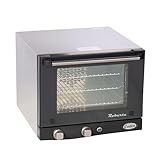
Kratos Quarter Size Electric Countertop Convection Oven
Positioned between the consumer toaster oven and the full commercial unit, this quarter-size convection oven suits people who bake in batches of two or three items and want consistent results without the half-size’s footprint. The convection fan tightens bake times noticeably compared to radiant-only alternatives at this price.
- Pro: Rapid preheat that owners describe as meaningfully faster than standard toaster ovens
- Pro: Stainless housing that wipes clean and does not discolor over years of use
- Con: Quarter-size means two standard sheet pans require two separate bake cycles, doubling total time for large batches
Skip this if you regularly cook for more than four people or need full sheet pan capacity.
Elite Gourmet ETO2530M Double French Door Oven
The double door concept is the star here: cook two different dishes at two different temperatures simultaneously, each side independently controlled. At under eighty-five dollars, it delivers a genuinely useful feature that costs far more in larger units. The twelve-inch pizza capacity handles family-sized rounds without folding.
- Pro: Two independent zones eliminate the oven-temperature-compromise problem that plagues single-chamber units
- Pro: Stainless and black exterior reads more premium than its price point suggests
- Con: Each zone is modest in height, so tall items like whole roasts do not fit either side
Skip this if you primarily cook one dish at a time and want maximum interior height instead.
Cadco OV-003 Quarter-Size Commercial Convection Oven
Three pans, one hundred and twenty volts, and Cadco’s reputation among small bakeries translate into a unit that survives daily professional use in a home setting indefinitely. This is the buy-once option for people who want a commercial oven without the three-phase power requirements of larger models.
- Pro: Three-pan capacity lets you bake cookies, roast vegetables, and reheat bread in a single cycle
- Pro: Built to commercial duty cycles that consumer units simply do not address
- Con: The thousand-dollar price tag demands a serious commitment, and the unit is physically substantial on a residential counter
Skip this if your budget is under five hundred dollars or if counter depth is limited.
Elite Gourmet ETO490 9L 4-Slice Oven
At thirty-nine dollars, this is the unit that answers the question “do I need an oven for toast?” with a flat yes. It fits four slices of bread side by side, has a thirty-minute mechanical timer, and adjustable temperature from warm to broil. Owners praise its simplicity and its willingness to disappear into a cabinet between uses.
- Pro: Price is so low that replacement or gifting carries zero risk
- Pro: Small footprint slides under standard upper cabinets without clearance issues
- Con: No convection, no presets, no air fry — it does one category of cooking and nothing else
Skip this if you want even occasional baking capability; the four-slice interior is genuinely limiting.
Toshiba Microwave Oven with Smart Sensor 1.6 Cu.Ft
The smart sensor is the differentiator here. Rather than guessing microwave time, the unit adjusts power and duration based on steam output from the food itself, which owners report reduces the overcooked-edges-icy-center problem. The 1200-watt output is the highest in this roundup’s microwave category, cutting reheating times noticeably.
- Pro: Sensor cooking handles most reheating without manual input, a genuine convenience upgrade
- Pro: Larger 1.6 cubic foot interior fits dinner plates with room and tall mugs without tilting
- Con: The sensor occasionally overshoots on small portions, requiring a quick stop and a reduced-time retry
Skip this if you want convection or air fry features combined with your microwave.
Buying Guide
Interior Geometry Matters More Than Advertised Liters
A forty-two-liter toaster oven does not give you forty-two liters of usable space. Heating elements, fan housings, and door seals consume a meaningful percentage of the advertised volume. When comparing best countertop ovens ratings, look at the actual dimensions of the wire rack or baking pan that ships in the box, not the exterior housing. A twelve-inch pizza that barely fits means your actual usable width is eleven inches, and items like whole chickens or large casserole dishes will not clear the top element. Measure your most common cookware before choosing a unit.
Convection Fan Design Separates Even Baking from Hot Spots
Not all convection fans perform equally. A single rear-mounted fan creates a warm column in the center and cooler zones at the sides, which explains why recipes say to rotate pans. Dual fans or side-mounted units with wider ducting distribute heat more uniformly, though they appear mainly on commercial-grade units like the Cadco. In consumer toaster ovens, check whether the fan runs continuously or only on a convection mode. Owners of budget convection ovens frequently report that the fan is too small to meaningfully shorten bake times over a radiant-only unit at the same temperature.
Control Interface and Cleaning Access Decide Long-Term Satisfaction
Touch panels look sleek but become unreliable once coated in grease or flour. Mechanical dials and buttons tolerate mess better and remain operable with gloved hands. For cleaning, French door designs open wider than pull-down doors and let you reach corners without removing the unit from the counter. A crumb tray that slides out completely, like the Oster includes, saves weekly maintenance time compared to units where the tray sticks or catches on the door gasket. These small design choices determine whether the oven gets used daily or abandoned after the novelty fades.
Our Verdict
Top pick: the Kratos Half-Size Electric Convection Oven. It delivers genuine wall-oven performance in a countertop form factor, and the sheet-pan capacity eliminates the batch-cooking bottleneck that makes smaller units frustrating for households cooking for four or more.
Budget pick: the Elite Gourmet ETO490 at thirty-nine dollars. It does exactly one job reliably and costs less than a single dinner out, making it the lowest-risk entry point for anyone who simply needs toast and reheated pizza without committing to a larger appliance.
Condition where another wins: if you need to cook two different dishes at two different temperatures without rotating trays or watching the clock, the Elite Gourmet ETO2530M’s independent double zones make it a smarter choice than any single-chamber oven, regardless of size.
FAQ
Can a countertop oven genuinely replace a wall oven?
For most weeknight cooking, a convection toaster oven or a unit like the Oster 42L handles roasting, baking, and broiling at temperatures that match a full-size oven. The limitation is capacity rather than performance; if you regularly cook two large items simultaneously or bake for more than six people, a countertop unit adds extra cycles that a wall oven eliminates.
Do convection toaster ovens use more electricity than a full-size oven?
They use less total energy for most tasks because the smaller cavity heats faster and requires fewer preheat minutes. However, if you need two or three batches to finish what one full-oven cycle handles, the cumulative energy cost narrows or erases that advantage.
What wattage matters most when choosing among these units?
For microwaves, higher wattage means faster and more even reheating, so the 1200-watt Toshiba outperforms the 1000-watt model on dense foods. For convection ovens, wattage is less of a deciding factor than fan design and insulation quality, since both units in this roundup’s convection tier reach target temperatures reliably regardless of their element rating.
How do I know if a countertop oven will fit under my upper cabinets?
Most upper cabinets are installed twelve inches above the counter, so measure the vertical clearance and subtract roughly one inch for ventilation. Pull-down door ovens need additional front clearance of eight to ten inches for the door swing, while French door designs open sideways and need only a few inches of depth clearance. Check the unit’s exterior height in the spec sheet, not just the interior capacity.