Key takeaways
- Compare five spokeshaves for chair making and curved work, with flat-sole picks for seats, legs and spindles, plus blade steel, adjuster and setup advice.
What's inside
- Quick Picks
- Table of Contents
- 1. STANLEY Hand Planer, SpokeShave, Flat Base (12-951)
- 2. Taytools 469560 Flat Bottom Spokeshave
- 3. Swpeet 10-Inch Adjustable SpokeShave with Flat Base
- 4. Glarks 10-Inch Adjustable Spokeshave, 2-Pack (GLLAPD-2P)
- 5. Mass Pro 9-Inch Adjustable Spokeshave with Flat Base
- How to Choose a Spokeshave for Chair Work
- FAQ
- Conclusion
As an Amazon Associate I earn from qualifying purchases. This post may contain affiliate links at no extra cost to you.
A spokeshave is the tool that turns a sawn chair blank into a finished part. It fairs the curve of a seat edge, rounds legs and spindles, and blends the transitions that a bench plane cannot follow. For chair making and curved work, the right pick is a shave with a blade that adjusts in small, repeatable steps and a sole that tracks a curve without digging in. The five spokeshaves below cover that ground at budget and mid-range tiers, from a classic cast-iron pattern that has been in production for decades to a two-pack that lets one tool stay set coarse while the other stays set fine. As an Amazon Associate, we earn from qualifying purchases. Every pick here is sold on Amazon, and the specifications quoted are the published figures from each listing and maker. All five are flat-base designs, which handle convex curves and gentle hollows well; the How to Choose section explains where a flat sole reaches its limit and when a round or concave sole earns a place in the kit.
Quick Picks
- Best overall: Taytools 469560 Flat Bottom Spokeshave. A thick tool-steel blade, a ductile cast-iron body and solid brass adjusters make it the most capable single shave on this list for seat and leg work.
- Best classic starter: STANLEY Hand Planer, SpokeShave, Flat Base (12-951). The long-running flat-base pattern, with fully adjustable cutters and a storage pouch included.
- Best budget single: Swpeet 10-Inch Adjustable SpokeShave. An SK2 carbon steel blade and double-screw depth adjustment in a cast-iron body, suited to first chairs and general shaping.
- Best for coarse and fine setups: Glarks 10-Inch Adjustable Spokeshave, 2-Pack. Two shaves plus extra blades, so one can be set for fast stock removal and the other for finishing passes.
- Best compact option: Mass Pro 9-Inch Adjustable Spokeshave. A shorter body that stays controllable on tight curves, small parts and short spindles.
Table of Contents
- Quick Picks
- Stanley 12-951
- Taytools 469560
- Swpeet 10-Inch
- Glarks 2-Pack
- Mass Pro 9-Inch
- How to Choose
- FAQ
- Conclusion
- Product and ASIN Reference
1. STANLEY Hand Planer, SpokeShave, Flat Base (12-951)
The Stanley 12-951 is the modern descendant of the classic flat-bottom spokeshave pattern, and it remains the default first shave for chair work. The flat sole smooths straight edges and outside curves, which covers most of what a chair asks for: the outer faces of legs, the sweep of an arm, and the front edge of a sculpted seat. The cutters are fully adjustable for depth of cut and for the thickness of the shaving, so the same tool can take a heavier shaping cut on a rough blank, then back off for final passes. The blade is replaceable, which keeps the tool in service for years, and a vinyl pouch comes in the box to protect the edge in a drawer or tool roll. Like most budget shaves, the casting benefits from a short tune-up: flatten the sole on abrasive paper over a flat surface, check that the blade seats without rocking, and hone the edge. It is a budget-tier tool backed by a limited lifetime warranty.
Specs:
- Sole: flat base
- Blade: 2-1/8 inch replaceable cutter
- Body: cast iron
- Adjustment: cutters fully adjustable for depth of cut and shaving thickness
- Included: vinyl storage pouch
- Warranty: limited lifetime warranty
- Tier: budget
2. Taytools 469560 Flat Bottom Spokeshave
The Taytools 469560 is the pick for chair makers who want one flat shave that needs the least compromise. Its blade is 2 inches wide and 0.075 inches thick, made from tool steel hardened and tempered to RC 55-60. Blade thickness matters because a thin iron flexes and chatters on reversing grain, and chair seats and arms are full of it. The body is ductile cast iron, a tougher casting than ordinary grey iron, and the twin adjustment knobs are solid brass with stainless steel screws, so the hardware resists rust and turns smoothly. Dual fine adjustment lets the edge be advanced evenly or skewed slightly, taking a heavier cut on one side and a finer cut on the other, a useful trick when fairing a long curve. The sole is 1 inch wide, short enough to follow the hollow of a chair seat and the outside of a leg without bridging. At 9-1/2 inches overall and 14.5 ounces, it has enough mass to stay planted through a cut without feeling clumsy on small parts, making it the list’s best option for regular chair production.
Specs:
- Sole: flat bottom, 1 inch wide
- Blade: 2 inches wide, 0.075 inches thick, tool steel at RC 55-60
- Body: ductile cast iron
- Adjustment: dual fine adjustment, solid brass knobs, stainless steel screws
- Overall length: 9-1/2 inches
- Weight: 14.5 ounces
- Tier: mid-range
3. Swpeet 10-Inch Adjustable SpokeShave with Flat Base
The Swpeet 10-inch spokeshave follows the same classic flat-base layout as the Stanley pattern, with a cast-iron body and a 46mm blade made from SK2 carbon steel, heat treated to a hardness of 58-60 HRC. That is a hard edge for the budget tier, and a hard edge holds up longer between honings when shaping dry hardwood legs and stretchers. Depth is set with a double-screw adjustment, which locks the planing thickness so the blade does not creep deeper mid-pass. The handles are contoured for a two-handed grip and finished with a corrosion-resistant epoxy coating, which keeps the casting from rusting in an unheated shop. For a first chair, a set of Windsor-style spindles, or general curved work, it covers the same ground as the name-brand pattern: outside curves, gentle hollows and edge work. Plan on an initial setup session to flatten the sole, seat the blade and hone the edge before judging the cut.
Specs:
- Overall length: 10 inches
- Blade: 46mm SK2 carbon steel, 58-60 HRC
- Body: cast iron
- Adjustment: double-screw depth adjustment
- Handles: contoured, corrosion-resistant epoxy coating
- Sole: flat base
- Tier: budget
4. Glarks 10-Inch Adjustable Spokeshave, 2-Pack (GLLAPD-2P)
Chair work goes faster when blade settings do not have to change mid-task, and that is the case for the Glarks two-pack. The set includes two 10-inch flat-base spokeshaves plus two extra blades, so one shave can be set coarse for roughing a seat blank or rounding a leg, while the second stays set fine for the finishing passes that follow. Swapping tools instead of resetting screws keeps both settings exactly where they were left, which matters when a curve is being faired by eye and feel. The bodies are built from alloy steel, brass and metal components in the traditional pattern, with screw adjustment for blade projection. Spare blades also soften the learning curve on sharpening, since one edge can serve as the reference while technique is practiced on another. The trade-off is two setup sessions, and neither casting matches the blade thickness or hardware of the mid-range Taytools. For shops that shape many curved parts, the pair is still a practical budget-tier answer.
Specs:
- Pack contents: 2 spokeshaves, 2 extra blades
- Size: 10 inches each
- Sole: flat base
- Materials: alloy steel, brass and metal
- Model number: GLLAPD-2P
- Adjustment: screw adjustment of blade projection
- Tier: budget
5. Mass Pro 9-Inch Adjustable Spokeshave with Flat Base
The Mass Pro spokeshave shortens the familiar pattern to 9 inches, and that shorter body is its reason to exist. A compact shave stays controllable where a full-size tool feels overlong: tight curves on small seats, short spindles, and the curved details on small furniture. The flat base keeps it stable on convex work and straight edges, and the blade is adjustable, so shaving thickness can be dialed from shaping cuts down to fine finishing passes. The body is alloy steel and metal, with a high-hardness steel blade and a wear-resistant bottom surface intended to reduce friction and extend sole life. It is a straightforward tool: set the blade, take test cuts on scrap, and shape. Chair makers who mostly build at full scale will reach for a 10-inch shave first, but as a second tool for small-scale and tight-radius work, the Mass Pro fills a gap at the budget tier.
Specs:
- Overall length: 9 inches
- Sole: flat base, wear-resistant bottom surface
- Blade: high-hardness steel, adjustable
- Body: alloy steel and metal construction
- Intended work: shaping, smoothing and refining irregular wood surfaces
- Tier: budget
How to Choose a Spokeshave for Chair Work
Start with the sole shape
The sole decides which curves a shave can follow. A flat sole is the all-rounder: it smooths straight edges and convex curves, such as the outside of a chair leg, and its short length still lets it work gentle concave hollows, such as a scooped seat. A round-bottom sole, curved from front to back, dips into tighter inside curves, such as the inner face of a curved arm or crest rail. A concave sole, hollowed across its width, cups round stock and is the specialist for spindles and rungs. Most chair makers start with a flat shave, add a round bottom when inside curves begin to frustrate, and add a concave shave if spindle work becomes routine. Every pick in this roundup is flat-based.
Blade steel and thickness
A spokeshave blade is small and lightly supported, so thickness and hardness do real work. Thicker irons, around 0.075 inches and up, resist the flex that causes chatter on reversing grain. Hardness in the high fifties on the Rockwell C scale holds an edge through a session of dry hardwood shaping, while softer blades need more frequent honing but are quicker to sharpen. Replaceable blades are a plus, since a nicked edge can be swapped rather than ground out.
Adjustment hardware
Twin screws or knobs that advance the blade are far easier to set than a blade positioned by tapping. Fine adjusters also allow a deliberate skew, with one side of the edge projecting slightly more than the other, which helps when a curve needs more stock removed on one side of the cut. Brass and stainless hardware is worth having in an unheated shop, where plain steel screws corrode and seize.
Body, weight and handles
Cast and ductile iron bodies give a shave the mass to carry through a cut without being pushed hard, which improves control on curves. Very light tools feel skittish on long sweeps; very heavy ones tire the hands on detail work. Handles should fill both hands comfortably, since a spokeshave is steered as much by wrist angle as by pressure.
Plan on a setup session
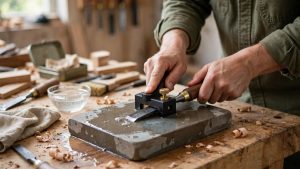
Almost every affordable spokeshave needs tuning before it cuts cleanly. The routine is short: flatten the sole on abrasive paper over a flat surface, check the blade beds without rocking, make sure the cap bears near the edge, then flatten the blade’s back and hone the bevel. A shave that still chatters after tuning usually needs a thicker blade or a finer depth setting, not more force.
FAQ
What sole shape is best for a first spokeshave for chair making?
A flat sole is the best first choice. It handles the outside curves of legs and arms, the edges of seats, and gentle hollows, which together make up most chair work. Add a round-bottom shave later for tight inside curves and a concave shave if spindles and rungs become a regular job.
Can a flat-bottom spokeshave shape concave curves?
Yes, within limits. The sole is short, so it can follow broad, gentle hollows such as a scooped chair seat without bridging. On tight inside radii the sole ends lift the blade off the work; that is where a round-bottom sole takes over.
How is the blade depth set on an adjustable spokeshave?
Loosen the cap, turn the twin adjustment screws or knobs to advance the edge evenly, then lock the cap and take a test cut on scrap. Advance in small steps: an edge that can be felt with a fingertip is usually projecting too far and will dig in or chatter on a curve.
How should a spokeshave blade be sharpened?
Flatten and polish the back first, then hone the bevel at its existing angle, which is about 25 degrees on most flat shaves, and remove the burr with a few flat strokes on the back. The blade is short, so clamp it in a holder or a slotted block of wood to keep fingers clear and the angle steady.
Conclusion
For most chair makers, the Taytools 469560 is the strongest single pick: its thick blade, ductile iron body and brass fine adjusters suit the reversing grain and long fair curves of seats and legs. The Stanley 12-951 remains the classic budget starting point, the Swpeet covers similar ground, the Glarks two-pack solves the coarse-and-fine setup problem in one box, and the compact Mass Pro handles small parts and tight curves. Whichever shave is chosen, an hour spent flattening the sole and honing the blade before the first chair part will do more for the quality of the cut than any other step.
Related guides
More from Amazon
Programs that pair well with the guide above. Offers and eligibility are set by Amazon and may change.
A free business account with business pricing and bulk-buying tools for work, shop or home office.
Create a business accountFree shipping on eligible items, Prime Video and more. Eligible new members can start with a free trial.
Start a Prime free trialAudiobooks and podcasts to listen to on the go. Eligible new members can start with a free trial.
Try Audible freeAd-free music streaming. Eligible new subscribers can start with a free trial.
Try Music Unlimited freeAs an Amazon Associate we earn from qualifying purchases.