As an Amazon Associate I earn from qualifying purchases. This post may contain affiliate links at no extra cost to you.
The real decision here is not how much dust a collector pulls off the saw. It is what the machine puts back into the room. A home shop is usually a closed garage or basement, and the fine fraction from sanding, routing and MDF work is the part that hangs in the air you breathe. A cyclone matters because it spins chips and most dust into a drum before the air reaches the filter, so suction stays steady. The filter rating then decides how much of that finest dust returns through the exhaust.
OUR TOP PICK
Oneida Air Systems Mini-Gorilla Portable HEPA-GFM Cyclone Dust Collector
This guide is for three kinds of home woodworkers: garage shops running one tool at a time on household power, basement shops ready to park a collector in a corner and run short ducts, and buyers eyeing a popular portable cyclone who want to know exactly what its filter does and does not promise. Every pick comes from its Amazon listing. Two are Oneida cyclones whose listings state HEPA-GFM filter media. The third is a strong Grizzly portable included deliberately, with its 1-micron canister rating stated plainly, because it is the machine many shoppers compare against true HEPA models.
Quick Picks
As an Amazon Associate we earn from qualifying purchases.
Product
Best for
Key spec from title
Oneida Air Systems Mini-Gorilla Portable HEPA-GFM Cyclone Dust Collector
Rolling from tool to tool in a one-car garage
1.5 HP, 120V, up to 600 actual CFM through a 5-inch inlet
Oneida Air Systems V-System 3000 35 Gal. HEPA-GFM Freestanding Cyclone Dust Collector
A fixed station feeding two machines through short duct runs
Cyclonic separation on a portable base when a 1-micron canister is acceptable
1.5 HP portable cyclone with a 1-micron canister filter, not HEPA
How to Choose
Airflow at the Tool, Not the Headline Number
Manufacturers quote airflow under different conditions, so the biggest number on a box rarely describes what arrives at your planer. What matters is delivered airflow through the hose or duct you actually run, at the port size your tools use. A collector rated around 600 actual CFM through a short flex hose serves one machine well. Long duct runs, elbows and small ports all eat into that figure. Match the machine to your worst tool, usually the planer or a wide sander, and treat any rating without a stated duct or port condition as a ceiling, not a promise.
Read the Filter Rating Before You Trust the Word HEPA
Listings use several different vocabularies, and they are not interchangeable. A canister rated at 1 micron is a good filter, but it is not HEPA, and it passes more of the sub-micron dust that sanding produces. Oneida lists its media as HEPA-GFM, meaning HEPA-grade filter media, and states the efficiency on its product data. When a listing says HEPA, look for the particle size and efficiency behind the claim, and be wary of product names that put HEPA in the headline while the specification table quietly lists a micron-rated canister instead.
Drum Size and How You Will Empty It
Cyclones fill drums faster than new owners expect, because the drum catches nearly everything, not just chips. A 22-gallon bin suits a portable that you empty after a weekend session. A 35-gallon bin stretches intervals in a shop that planes rough lumber weekly. Look for a liner bag holder and a fill window, since both turn emptying into a two-minute job instead of a dust cloud. Also check how the drum releases. One-handed or quick-release lids matter once the bin is full of dense, heavy shavings.
Placement, Power and Working Safely
Put the collector where its exhaust does not blow across your bench, and confirm the circuit before anything ships. The Mini-Gorilla listing requires a 20-amp receptacle even though the machine runs on 120 volts, and the V-System 3000 needs a 230-volt circuit, so breaker sizing is part of the purchase, not an afterthought. Two habits protect you more than any rating. Wear a fitted respirator whenever you open and empty the drum, because that is when concentrated fine dust escapes. And ground metal duct runs, or use anti-static hose on long flex runs, so static charge has a path away from the system.
The 3 Best Options
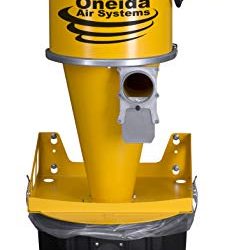
Oneida Air Systems Mini-Gorilla Portable HEPA-GFM Cyclone Dust Collector
Top Pick
Oneida Air Systems Mini-Gorilla Portable HEPA-GFM Cyclone Dust Collector
Best for: One-tool-at-a-time garage shops that want HEPA-grade filtration without giving up floor space.
Motor: 1.5 HP, 120V, 16A, U.S. motor
Airflow: up to 600 actual CFM through the 5-inch inlet; a 5-inch to 4-inch reducer is included
Filter: HEPA-GFM premium filter media
Collection: 22-gallon mobile bin with liner bag holder and fill-level viewing window
Small shops that move the collector to the tool, rather than ducting the shop to the collector, are exactly who this machine suits. It pairs a 1.5 HP motor with a genuine cyclonic separator and HEPA-GFM media, yet it rolls on lockable wheels and parks in a corner. The 22-gallon bin has a viewing window, so you can see the fill level before a planer session instead of guessing. For a one-car garage where the collector shares space with a car, that combination of mobility and filtration is hard to match.
Watch out for: The listing states that a 20A NEMA 5-20 receptacle is required. Many garage outlets are 15-amp, so check the receptacle and circuit before ordering.
Oneida Air Systems V-System 3000 35 Gal. HEPA-GFM Freestanding Cyclone Dust Collector
Runner-Up
Oneida Air Systems V-System 3000 35 Gal. HEPA-GFM Freestanding Cyclone Dust Collector
Best for: Basement and garage shops with 230-volt power that are ready for a permanent two-machine setup.
Motor: 3 HP, 230V, U.S.-made fan motor
Capacity: serves up to 2 tools at once with 4-inch to 6-inch dust ports
Separation: high-efficiency cyclone separator removes over 99 percent of fine wood dust
Basement and garage shops with 230-volt power that are ready for a permanent two-machine setup.
Watch out for
It is a tall, heavy freestanding unit that ships as a system of components. Measure ceiling height, door widths and the corner you plan for it before ordering.
This is the stationary end of the home-shop range: a 3 HP freestanding cyclone built to sit in one place and serve up to two tools through real ductwork. Its molded cyclone separator removes over 99 percent of fine wood dust before the airstream reaches the HEPA-GFM cartridge, which is why airflow holds up between cleanings. Included sound filters keep it comparatively civilized for a machine of this size, and an RF remote starter means it can live in a corner or behind a door while you switch it from the saw.
Watch out for: It is a tall, heavy freestanding unit that ships as a system of components. Measure ceiling height, door widths and the corner you plan for it before ordering.
Chip-heavy work on a portable setup, where cyclonic separation matters more than sub-micron filtration.
Watch out for
Do not buy it expecting HEPA performance. The 1-micron canister rating on the listing is the whole story, and fine sanding dust is exactly what passes a filter of this class.
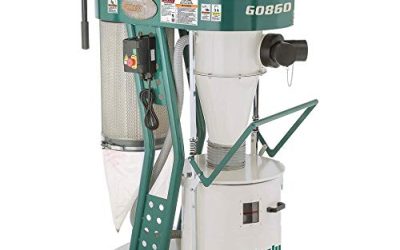
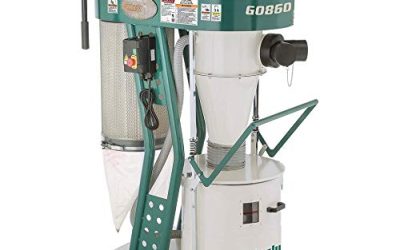
The G0860 earns its place here as the honest comparison, not as a HEPA pick. It is a well-regarded 1.5 HP portable cyclone that separates chips and dust into its drum the same way the Oneida models do, and it has been a default recommendation for small shops for years. The difference sits in the specification that matters most for this guide: its canister filter is rated at 1 micron, which is not HEPA. If your work is mostly planer and jointer chips, that trade may be fine. If sanding dust is your worry, it is the wrong filter.
Watch out for: Do not buy it expecting HEPA performance. The 1-micron canister rating on the listing is the whole story, and fine sanding dust is exactly what passes a filter of this class.
Which One Fits Your Situation
Your Shop Is One Bay of a Garage
Choose the Mini-Gorilla. It rolls to whichever tool is running, connects directly with flex hose, and its 22-gallon bin empties quickly at the end of a session. You get HEPA-GFM filtration without dedicating permanent floor space or installing ductwork, and the whole system parks against a wall when the car comes back in. Just confirm you have the 20-amp receptacle its listing requires.
You Are Ready to Run Short Ducts to Two Machines
Choose the V-System 3000. A table saw and planer on fixed duct runs is the setup this 3 HP machine was built for, and its cyclone keeps the HEPA-GFM cartridge from loading up between weekends. The remote starter makes a corner installation practical, since you never walk over to the machine to switch it on. Budget for the 230-volt circuit as part of the project.
Chips Matter More to You Than the Finest Dust
Choose the G0860, with your eyes open. If your sessions are dominated by jointing and planing, the cyclone stage does the heavy lifting and the 1-micron canister is a reasonable compromise. Add a separate room air cleaner later if you start sanding more. What you should not do is pay for it believing the filtration matches the two Oneida models above, because the listing never claims that it does.
Common Mistakes
Comparing headline CFM figures from different brands as if they were measured the same way.
Assuming any canister filter is HEPA, when the listing rates it at 1 or 2 microns instead.
Buying a 230-volt or 20-amp machine before checking what circuits the shop actually has.
Letting the drum overfill until dust backs up into the filter and suction falls off.
Emptying the drum indoors without a respirator, releasing the finest dust all at once.
Frequently Asked Questions
Is a 1-micron canister filter the same as HEPA?
No. A 1-micron rating describes the particle size the filter is rated around, while HEPA media is defined by very high capture efficiency at 0.3 microns, the hardest size to trap. A good 1-micron canister handles chips and coarse dust well, but more sub-micron sanding dust passes through it and back into the room.
How much airflow does one home-shop machine need?
For a single tool connected by a short hose, a collector delivering roughly 500 to 700 actual CFM at the port covers most table saws, planers and jointers in home shops. The catch is the word actual: ratings taken at an open inlet overstate what a hose and port deliver, which is why listings that state airflow through a defined inlet deserve more trust.
Can a portable cyclone serve two machines at once?
It can be split with a wye and blast gates, but a 1.5 HP portable is sized for one open port at a time. Run two machines together and both get weak capture, especially the one making fine dust. If two tools genuinely run simultaneously in your shop, step up to a 3 HP stationary cyclone instead of splitting a portable.
Does a cyclone mean I can skip the respirator?
No. The cyclone and filter manage dust while the machine runs, but emptying the drum concentrates everything the system collected and releases a puff of fine dust at exactly the moment you are leaning over it. Wear a fitted respirator for every emptying, and let the collector run for a few minutes after the last cut to clear airborne dust before you take the mask off.
J
JD's Woodworks Editorial Team
We compare specs, warranty terms, long-term owner feedback and street pricing before anything earns a spot. Rankings are never paid.
Affiliate disclosure. As an Amazon Associate we earn from qualifying purchases at no extra cost to you. Prices accurate as of the date shown.
Compare the best two stage dust collectors for weekend woodworking projects, with cyclone separation, canister filters, drum sizes and inlet specs compared.
Compare the best cyclone dust collectors for experienced DIY woodworkers, with airflow, canister filtration, remote control and drum capacity compared.
Compare the best wall mounted dust collectors for weekend woodworking projects, with CFM, bag size and filtration from each listing to size one machine right.
Stationary thickness planers that ship with a dust hood, compared for home shops: 15, 20 and 22 inch helical floor models with listing specs and ASINs.
True open-sided thickness planers are rare on Amazon. See the verified open-end pick with a dust connection, its listing specs, safety notes and buying checks.
Floor standing band saws for garage workshops compared on resaw height, throat, motor power and dust ports, with setup and safety checks before buying.
Compare the best cyclone dust collectors for weekend woodworking projects, with airflow, drum size and filter ratings from each listing to pick the right fit.