As an Amazon Associate I earn from qualifying purchases. This post may contain affiliate links at no extra cost to you.
Once a shop has a table saw, a planer and a jointer in regular rotation, the dust collector stops being an accessory and becomes part of the workflow. The real decision with a wall mounted unit is not whether it saves floor space, because it obviously does. It is whether a single 4-inch inlet and roughly 550 to 600 CFM will keep up with the way you actually move between machines, and whether the filter bag it ships with is fine enough for the sanding dust your shop produces.
OUR TOP PICK
BUCKTOOL 1HP 6.5AMP Wall-mount Dust Collector with Remote Control and 2-micron Dust Filter Bag 550CFM Air Flow DC30A-1
This guide is for experienced DIY woodworkers who already run blast gates, know their hose runs, and want a fixed collector that starts fast and filters honestly. The three picks below were chosen from their Amazon listings: a remote-controlled BUCKTOOL, the long-running Shop Fox W1826, and a higher-airflow WEN that can hang on the wall or roll.
Quick Picks
As an Amazon Associate we earn from qualifying purchases.
Product
Best for
Key spec from title
BUCKTOOL DC30A-1 Wall-mount Dust Collector
Starting collection from across the shop
Remote control and 2-micron dust filter bag, 550 CFM
Shop Fox W1826 Wall Dust Collector
A proven single-machine station
2.5 micron filtration, 537 CFM
WEN DC3474 Woodworking Dust Collector
The most airflow of the three, wall or floor
7.4-amp induction motor with 15-gallon bag, 600 CFM
How to Choose
Read the Micron Rating, Not the Marketing
Filtration is where wall mounted collectors differ most, and the number is printed right on the listing. A 5-micron bag catches chips and coarse dust but lets the finest sanding particles back into the room air. A 2-micron or 2.5-micron bag is a genuine step up for a shop where a random orbit sander runs daily, and a 1-micron rating is finer still. None of the bag collectors in this guide is a HEPA machine, so do not let any listing blurb talk you into treating one as such. Match the rating to your dust: heavy planer work is mostly chips, while sanding and MDF work is where finer bags earn their keep.
Treat CFM as a One-Machine Budget
Every collector here is a single-stage unit with one 4-inch inlet, and the listed airflow runs from 537 to 600 CFM. That is a one-machine-at-a-time budget. Experienced users get the most from these units by keeping the hose run short, closing the blast gate on the idle machine, and parking the collector beside the biggest chip producer, usually the planer or jointer. Long flex-hose runs, tight elbows and reducers down to small ports all eat airflow before it reaches the tool. If your habit is two machines running at once, no wall unit in this class will serve both well, whatever the box claims.
Decide How You Will Start It, Every Time
A collector only works when it is switched on, and wall mounting puts the switch up and out of reach. That is why the control method matters more on these units than on a rolling collector you can bump with a hip. A remote control, like the one bundled with the BUCKTOOL below, lets you start collection from the saw without walking over. A paddle switch is the next best thing when the unit hangs beside one dedicated machine. Think about your own routine honestly: if starting the collector means crossing the shop mid-cut setup, you will skip it, and the bag rating becomes irrelevant.
Mount It Like You Mean It, and Empty It Safely
These collectors are heavy before the bag fills, and a full bag adds awkward, shifting weight. Anchor the bracket into wall studs with the supplied locking hardware, never into drywall alone, and check the mount again after the first few emptying cycles. Leave clear space under the bag so it can drop and swing free. When you empty it, switch the unit off, let the dust settle, and wear a dust mask before you open the zipper or unclamp the bag, because the finest fraction is exactly what pours out first. Empty outdoors or into a bag you can seal, not into an open shop bin.
The 3 Best Options
BUCKTOOL 1HP 6.5AMP Wall-mount Dust Collector with Remote Control and 2-micron Dust Filter Bag 550CFM Air Flow DC30A-1
Top Pick
BUCKTOOL 1HP 6.5AMP Wall-mount Dust Collector with Remote Control and 2-micron Dust Filter Bag 550CFM Air Flow DC30A-1
Best for: Experienced users who want remote starting and finer bag filtration at a fixed station.
Experienced users who want remote starting and finer bag filtration at a fixed station.
Watch out for
Confirm the remote and mounting hardware are in the box on delivery, and check the current listing for the exact bag size before ordering replacement bags.
The BUCKTOOL suits the experienced user whose collector hangs in one spot while the work moves around the shop. Its remote control answers the biggest wall-mount annoyance, starting and stopping a unit you cannot reach, and the 2-micron filter bag is finer than the 5-micron bags bundled with many collectors in this class. The listing rates it at 550 CFM from a 1 HP motor, with a 13-gallon bag that swallows a serious amount of planer shavings between emptyings. It also gives you the option to run it on its wheeled setup when a project rearranges the shop.
Shop Fox W1826 Wall Dust Collector, 2.5 Micron Filtration
Runner-Up
Shop Fox W1826 Wall Dust Collector, 2.5 Micron Filtration
Best for: A dedicated station beside a table saw or planer, where short hose runs keep suction strong.
A dedicated station beside a table saw or planer, where short hose runs keep suction strong.
Watch out for
The intake safety cage is known to catch long planer shavings, so check the current listing details and plan on clearing the inlet as part of your routine.
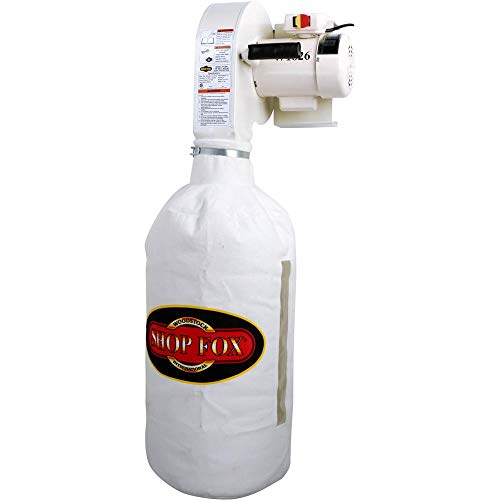
The Shop Fox W1826 has been the default wall collector in small shops for years, and the listing explains why: a simple 1 HP unit, a single 4-inch intake, and a bag with a viewing window and a bottom zipper so emptying is a short job instead of a wrestling match. At 537 CFM it is the lowest airflow here, which experienced buyers should read as a dedicated one-machine collector rather than a whole-shop system. Its 2.5-micron bag sits between coarse chip bags and the finest options, a reasonable middle for mixed sawing and planing work.
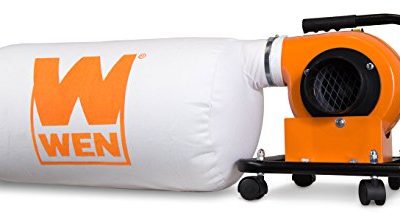
WEN Woodworking Dust Collector, 7.4-Amp Induction Motor with 15-Gallon Bag, Mobile Base, and Optional Wall Mount (DC3474)
WEN Woodworking Dust Collector, 7.4-Amp Induction Motor with 15-Gallon Bag, Mobile Base, and Optional Wall Mount (DC3474)
Best for: Experienced DIYers who want the most airflow in this class and the choice of wall or floor placement.
Experienced DIYers who want the most airflow in this class and the choice of wall or floor placement.
Watch out for
The wall mount is optional rather than the primary design, so read the listing’s mounting instructions carefully and confirm your wall and stud spacing suit the bracket before you buy.
The WEN DC3474 is the flexible pick: the listing sells it as a rolling collector with an optional wall mount, so it can hang above the bench in a tight shop or ride its swivel casters when you would rather bring collection to the machine. Its 600 CFM is the highest airflow in this guide, driven by a 7.4-amp induction motor and a 9-inch impeller, and the 15-gallon bag is the largest here. The trade is filtration: the zippered bag is rated at 5 microns, the coarsest of the three, which matters if fine sanding dust is your main concern.
Which One Fits Your Situation
Your Collector Hangs Once, but You Work Everywhere
Choose the BUCKTOOL DC30A-1. In a shop where the collector stays bolted beside the main bench but you cut, plane and sand at different stations, the remote control is the feature you will use every single session. Its 2-micron bag also handles the fine dust from sanding stations better than a coarse chip bag, and the 13-gallon capacity means the remote convenience is not undermined by constant emptying trips.
One Machine Matters Most in Your Shop
Choose the Shop Fox W1826. If a single table saw or planer produces nearly all your dust and the hose run can stay short, this simple unit’s 537 CFM is honestly matched to the job. The viewing window tells you when to empty it, the bottom zipper makes that quick, and there is no extra hardware to manage. It rewards the user who wants a fixed, predictable station rather than a system to expand.
You Rearrange the Shop With Every Big Project
Choose the WEN DC3474. Some experienced woodworkers rebuild their layout around each commission or furniture piece, and a collector that can hang on the wall this month and roll on casters next month fits that habit. You also get the strongest listed airflow and the biggest bag here. Accept the coarser 5-micron bag as the cost of that flexibility, or plan a separate solution for fine sanding dust.
Fine Dust Is Your Main Complaint
Choose the BUCKTOOL DC30A-1, and be clear-eyed about the limits. Its 2-micron bag is the finest filtration in this guide, so it returns less fine dust to the room than the 5-micron WEN or the 2.5-micron Shop Fox. It is still a filter bag, not a HEPA canister, so heavy sanding sessions still call for a mask and, ideally, separate air cleaning. Buy it for the improvement that is actually on the listing, not for clean-room promises nobody made.
Common Mistakes
Comparing headline CFM figures without counting hose length, elbows and reducers, which cut real airflow fast.
Assuming a wall collector can serve two machines at once through a wye and two open gates.
Treating a 5-micron bag as fine filtration and then wondering why sanding dust still settles everywhere.
Mounting the bracket into drywall anchors instead of studs, then trusting it with a full bag.
Emptying the bag indoors without a mask, releasing the finest dust the bag worked to capture.
Frequently Asked Questions
Can one wall mounted collector handle my whole shop?
Realistically, it handles one machine at a time. Every pick here has a single 4-inch inlet and a listed rating between 537 and 600 CFM, enough for a table saw, planer or jointer with the other blast gates closed. Run short hose runs, keep the collector near your biggest chip producer, and it will feel strong. Ask it to pull from two open ports and suction falls away quickly.
Does a lower micron number always mean cleaner air?
It means the bag is rated to stop smaller particles, so a 2-micron bag holds back more fine dust than a 5-micron bag. It does not make a bag collector a HEPA device, and no pick here claims that. Fit also matters: a fine bag with a poor seal at the clamp leaks dust regardless of rating, so check the seal before judging filtration on the number alone.
Is a remote control worth it on a dust collector?
For a wall mounted unit, often yes. The switch on a hanging collector is rarely within arm’s reach of your machine, and a control you have to walk to is one you will sometimes skip. The BUCKTOOL here bundles a remote for exactly that reason. If your collector hangs beside one dedicated saw, a paddle switch you can hit with a knee works just as well.
How do I know when the bag needs emptying?
Use the window if your collector has one, as the Shop Fox and BUCKTOOL designs do, and learn the signs of a full bag: suction drops, chips linger in the hose, and the bag hangs heavy. Do not wait until dust packs into the filter section, because a clogged bag strangles airflow and pushes fine dust through the fabric. Empty early and the collector keeps its listed performance.
J
JD's Woodworks Editorial Team
We compare specs, warranty terms, long-term owner feedback and street pricing before anything earns a spot. Rankings are never paid.
Affiliate disclosure. As an Amazon Associate we earn from qualifying purchases at no extra cost to you. Prices accurate as of the date shown.
Compare the best two stage dust collectors for weekend woodworking projects, with cyclone separation, canister filters, drum sizes and inlet specs compared.
Compare the best cyclone dust collectors for experienced DIY woodworkers, with airflow, canister filtration, remote control and drum capacity compared.
Compare the best wall mounted dust collectors for weekend woodworking projects, with CFM, bag size and filtration from each listing to size one machine right.
Stationary thickness planers that ship with a dust hood, compared for home shops: 15, 20 and 22 inch helical floor models with listing specs and ASINs.
True open-sided thickness planers are rare on Amazon. See the verified open-end pick with a dust connection, its listing specs, safety notes and buying checks.
Floor standing band saws for garage workshops compared on resaw height, throat, motor power and dust ports, with setup and safety checks before buying.
Compare the best cyclone dust collectors for weekend woodworking projects, with airflow, drum size and filter ratings from each listing to pick the right fit.