3 Best Cyclone Dust Collectors for DIY Shops (November 2026)
Compare the best cyclone dust collectors for experienced DIY woodworkers, with airflow, canister filtration, remote control and drum capacity compared.
Compare the best cyclone dust collectors for experienced DIY woodworkers, with airflow, canister filtration, remote control and drum capacity compared.
As an Amazon Associate I earn from qualifying purchases. This post may contain affiliate links at no extra cost to you.
Experienced woodworkers stop asking how much air a collector moves and start asking how much it still moves at the end of a duct run, behind two elbows and a blast gate. That is where cyclone collectors separate themselves: the spinning airstream drops chips and most dust into the drum before the filter, so the canister loads slowly and the airflow curve stays flatter over weeks of work instead of days. The buying decision becomes about static pressure, filtration stated honestly, and controls that suit a fixed layout.
The three collectors below were selected from their Amazon listings for shops that have outgrown a roll-around bag unit: a 3 HP machine with a remote control for semi-fixed layouts, a portable cyclone with HEPA-grade media for fine-dust control, and a compact 110V cyclone for a second station. Specifications are quoted as the listings state them, including the test conditions where the maker gives them.
Quick Picks
As an Amazon Associate we earn from qualifying purchases.
Product
Best for
Key spec from title
JET JCDC-3 Cyclone Dust Collector
Experienced shops running ducted layouts with gates on 230V power
3 HP, 2-micron filter
Oneida Air Systems Mini-Gorilla Portable Cyclone Dust Collector
Fine-dust control with HEPA-grade media in a dedicated finishing area
A second collection point on 110V power for a saw or miter station
868 CFM at 2.6 in. static pressure
How to Choose
Size the Collector to the Duct Run, Not the Tool List
Every foot of pipe, every elbow and every blast gate spends static pressure, and the collector has to arrive at the tool with airflow to spare. Experienced shops plan the longest run first: the machine farthest from the collector, usually the planer, sets the requirement. Smooth-wall pipe preserves pressure far better than corrugated flex hose, which should appear only in short final connections. If your layout has one long trunk with several gated drops, the 3 HP class with a listed 1,240 CFM is the realistic starting point, not the portable class.
Filtration, Stated the Way the Listing States It
Cyclone describes the separation stage, not the filter. What leaves the shop air is decided by the canister, so read the exact wording. JET titles the JCDC-3 with a 2-micron filter and rates its efficiency at 99 percent of 2-micron particles; Grizzly lists a 1-micron canister on the G0860. Neither is HEPA, and neither should be described that way. The Oneida Mini-Gorilla is the exception in this group: its listing specifies HEPA-grade ePTFE media at an E12 minimum efficiency rating. Compare like with like, and be suspicious of any listing that prints a micron figure without saying what it means.
Remote Control and Filter Cleaning on a Fixed Installation
Once a collector lives behind a partition or in a corner, walking to its switch for every cut gets old within a week. The JCDC-3 listing includes a remote control with batteries, which lets the unit serve a gated layout from whichever machine is open. Filter maintenance matters just as much: a pleated canister loads from the inside, and designs with a manual cleaning paddle or crank restore airflow without removing the filter. Ask how the canister cleans and how the drum releases before you buy, because those two routines decide whether the system stays maintained or slowly clogs.
Collection Capacity Is an Airflow Feature
An undersized drum is not just an inconvenience. As chips mound toward the cyclone outlet, separation efficiency falls and debris carries over into the filter, which loads the canister and drags airflow down across the whole system. Match drum volume to your highest-output machine: a wide planer on a long run justifies the JCDC-3’s 66-gallon drum, while a saw-centred layout does fine on 20 to 22 gallons. Quick-release drum hardware and a fill window are worth real money on a fixed install, because a drum that is annoying to empty gets emptied late.
The 3 Best Options
JET JCDC-3 Cyclone Dust Collector
Top Pick
JET JCDC-3 Cyclone Dust Collector
Best for: Experienced DIY woodworkers building a gated, semi-fixed layout who want remote starting and the largest listed airflow of the three.
Motor: 3 HP, 230V, single-phase
Airflow: 1,240 CFM, as listed
Filter: 2-micron canister filter; maker rates efficiency at 99 percent of 2-micron particles
For an experienced shop moving to fixed ducting, this is the anchor machine: 3 HP on 230V, 1,240 CFM as listed, and a 66-gallon drum that keeps separation efficient through long milling runs. The Amazon listing includes the remote control, swivel casters and both canister and drum collection bags, and it states a 76 dB sound level and a 5-year warranty. The two-stage separation protects the 2-micron canister from the chip stream, so performance at the far end of a gated run stays consistent instead of decaying as a bag would.
Watch out for: It needs a 230V circuit and a permanent parking spot; confirm both, plus the inlet configuration for your trunk line, before ordering.
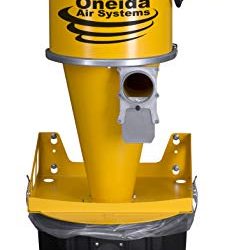
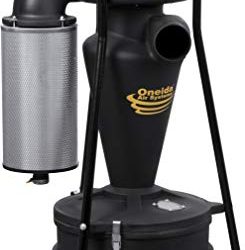
Oneida Air Systems Mini-Gorilla Portable Cyclone Dust Collector
Runner-Up
Oneida Air Systems Mini-Gorilla Portable Cyclone Dust Collector
Best for: Experienced woodworkers who want the finest listed filtration for a sanding and finishing area without giving up portability.
Motor: 1.5 HP industrial fan blower motor, made in the USA
Power: 120V or 220V configuration, as listed
Collection drum: 22 gallons, mobile
Filter: HEPA-grade ePTFE media filter, E12 minimum efficiency rating, as listed
Not every experienced shop needs more airflow; some need cleaner air at the point where sanding and finishing happen. The Mini-Gorilla pairs a two-stage cyclone with a HEPA-grade ePTFE media filter rated by Oneida at E12 minimum efficiency, the finest filtration language on any listing in this group. Its 1.5 HP US-made fan blower motor can be configured for 120V or 220V, and the 22-gallon drum keeps the whole unit mobile. Run it as the dedicated collector for a sanding and finishing zone while a larger unit handles milling.
Watch out for: Verify the exact motor voltage configuration and what the current listing includes, since details vary between configurations.
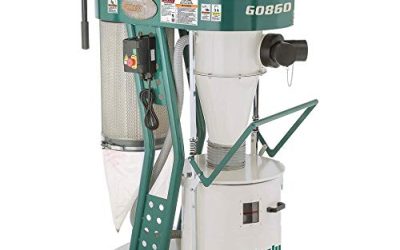
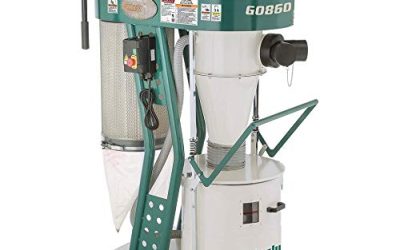
A big central collector is not always the right answer for the far corner of the shop. The G0860 gives an experienced setup a second, independent collection point: 1-1/2 HP on 110V, a listed 868 CFM at 2.6 inches of static pressure, and a 1-micron canister behind the cyclone stage. Dedicate it to a table saw or miter station that sits too far from the main run, and you avoid spending the central system’s pressure on a long branch. At 67 inches tall it parks under most garage ceilings and rolls out of the way when the space has to serve other purposes.
Watch out for: Treat it as a one-machine collector; splitting its inlet between two open ports drops airflow at both tools.
Safety on a fixed installation deserves the same planning as airflow. Bond and ground metal ductwork and follow the collector manual’s grounding directions, because dry chips moving through ducting generate static that needs a controlled path away. Wear a fitted respirator whenever you empty the drum or clean the canister, and do that work where the released dust cannot drift back through the shop. Size the breaker to the motor’s listed draw and give a 230V collector its own circuit, and never use a wood-dust collector for metal grinding debris, liquids or stove ash.
Which One Fits Your Situation
You Are Replacing a Bag Collector With Fixed Ducting and Gates
Choose the JET JCDC-3. Its listed airflow, 66-gallon drum and included remote control are the combination a gated layout actually uses, and the two-stage separation keeps the canister from becoming the maintenance burden your old bag was. Budget for smooth-wall pipe on the trunk and keep flex hose to short final connections so the pressure you paid for reaches the tools.
Your Milling Is Covered, but Sanding Dust Settles on Everything
Choose the Mini-Gorilla for the finishing zone. The HEPA-grade media rating is the specific feature your main collector probably lacks, and a dedicated portable cyclone at the sanding bench captures dust at the source instead of relying on room air exchange after the fact. Its dual-voltage motor also leaves room to reconfigure if the shop’s power layout changes later.
One Machine Sits Too Far From the Main Collector
Choose the Grizzly G0860 as a satellite unit. Extending a branch run to a distant saw spends static pressure the whole system feels, while a compact 110V cyclone at the machine restores full local airflow with no ducting project. The 1-micron canister keeps its exhaust cleaner than a bag unit, and its caster base lets the corner return to other duties between projects.
You Run Long Planer Sessions and Hate Mid-Session Emptying
Choose the JCDC-3 for the drum alone if the power is available. Sixty-six gallons changes the working pattern: chips stay in the drum, separation stays efficient, and the filter sees only the fine fraction it was designed for. Pair that with the remote control and the collector stops interrupting the work, which is the real upgrade experienced users are buying.
Common Mistakes
Comparing CFM figures from different test methods and treating the bigger number as the stronger machine in a real duct run.
Describing any pleated canister as HEPA when the listing states a micron or MERV rating; the words describe different test standards.
Building long runs from corrugated flex hose, which spends static pressure that smooth-wall pipe would have delivered to the tool.
Skipping blast gates on a multi-drop layout, then blaming the collector for weak suction at the machine in use.
Letting the drum fill into the cyclone outlet, which destroys separation efficiency and loads the canister with chips it was never meant to catch.
Frequently Asked Questions
How much airflow does an experienced home shop actually need?
Work backwards from the hungriest machine on the longest run. A planer at the end of a gated trunk needs a collector in the 3 HP class with airflow listed around 1,240 CFM to arrive with useful suction after elbows and gates take their share. Short single-machine runs are a different problem, and a 1-1/2 HP cyclone with an honestly stated static pressure figure handles them well.
Is a 2-micron canister filter good enough, or do you need HEPA-grade media?
It depends on the dust and the exposure. A 2-micron canister rated at 99 percent efficiency for 2-micron particles, as JET lists, controls the visible and most of the respirable fraction from sawing and milling. HEPA-grade media, as Oneida lists for the Mini-Gorilla, targets the finer sanding dust that stays airborne longest. Many experienced shops run both standards in different zones.
Can a cyclone collector keep up with two machines running at once?
Only with discipline. Two open ports split the available airflow, and chip-producing machines like planers resent sharing. A gated layout where only one gate opens at a time is the normal pattern, even on the 3 HP JET. If two machines genuinely run simultaneously, the realistic answers are a second collector, like the G0860 at the far station, or a much larger central system.
What maintenance keeps a cyclone collector performing like new?
Three habits: empty the drum before chips reach the cyclone outlet, clean the canister on the maker’s schedule using its built-in cleaning mechanism, and check duct joints and drum seals for leaks each season. A small suction leak at the drum lid quietly costs more airflow than most tool upgrades return, and it is the fault owners most often misdiagnose as a weak motor.
J
JD's Woodworks Editorial Team
We compare specs, warranty terms, long-term owner feedback and street pricing before anything earns a spot. Rankings are never paid.
Affiliate disclosure. As an Amazon Associate we earn from qualifying purchases at no extra cost to you. Prices accurate as of the date shown.
Compare the best two stage dust collectors for weekend woodworking projects, with cyclone separation, canister filters, drum sizes and inlet specs compared.
Compare the best wall mounted dust collectors for weekend woodworking projects, with CFM, bag size and filtration from each listing to size one machine right.
Stationary thickness planers that ship with a dust hood, compared for home shops: 15, 20 and 22 inch helical floor models with listing specs and ASINs.
True open-sided thickness planers are rare on Amazon. See the verified open-end pick with a dust connection, its listing specs, safety notes and buying checks.
Floor standing band saws for garage workshops compared on resaw height, throat, motor power and dust ports, with setup and safety checks before buying.
Compare the best cyclone dust collectors for weekend woodworking projects, with airflow, drum size and filter ratings from each listing to pick the right fit.