3 Best Two-Stage Dust Collectors for Garages (November 2026)
Compare the best two stage dust collectors for weekend woodworking projects, with cyclone separation, canister filters, drum sizes and inlet specs compared.
Compare the best two stage dust collectors for weekend woodworking projects, with cyclone separation, canister filters, drum sizes and inlet specs compared.
As an Amazon Associate I earn from qualifying purchases. This post may contain affiliate links at no extra cost to you.
The real decision for a weekend woodworker is not raw suction on day one. It is whether the collector still pulls hard at the planer in hour three of a Saturday milling session, after a single-stage bag unit would have choked on its own chips. A two-stage design spins the heavy debris into a drum before the airstream reaches the filter, so the filter loads slowly and suction stays closer to its starting point across a whole project weekend.
That matters most if your shop time comes in short, intense bursts: a table saw, planer and jointer sharing one collector that rolls between machines in a garage or basement. The three picks below were chosen from their Amazon product names and listed specifications, favouring complete portable cyclone units that run one machine at a time without permanent ductwork.
Quick Picks
As an Amazon Associate we earn from qualifying purchases.
Weekend shops on household 110V power that roll the collector from saw to planer
1-1/2 HP portable cyclone
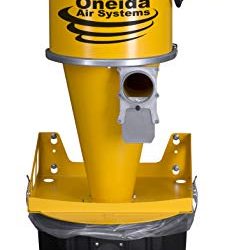
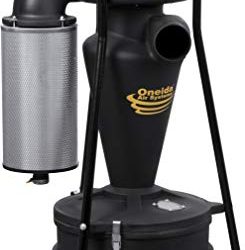
Oneida Air Systems Mini-Gorilla Portable Cyclone Dust Collector
Sanding-heavy weekend projects where fine dust control matters most
HEPA-grade media filter
JET JCDC-3 Cyclone Dust Collector
Bigger weekend builds with long planer and jointer sessions on 230V power
3 HP, 2-micron filter
How to Choose
Why Two-Stage Separation Suits Short Work Sessions
In a single-stage collector, every chip and shaving passes through the impeller and lands in a bag that doubles as part of the filter path, so airflow fades as the bag fills. Two-stage separation reverses that order. The cyclone drops the heavy fraction into a sealed drum first, and only fine dust continues to the canister. For weekend work this changes the rhythm of a project: instead of stopping mid-afternoon to shake out a clogged bag, you empty a drum between sessions and start the next one with suction close to fresh.
Reading Airflow Numbers Without Fooling Yourself
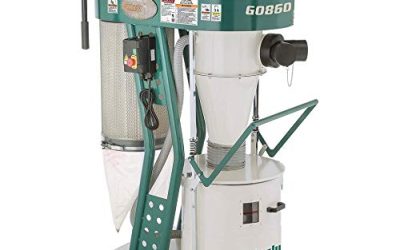
Manufacturers measure airflow under different conditions, so treat CFM as a comparison inside one brand rather than an absolute score. Grizzly lists the G0860 at 868 CFM at 2.6 inches of static pressure, which tells you the test included resistance. A bare free-air number always looks bigger and means less. What actually governs your results is the run between tool and collector: short, smooth hose preserves airflow, while long corrugated flex hose, tight elbows and a reducer at the tool port all spend it. Keep the hose short and the drum sealed, and a 1-1/2 HP two-stage unit serves one machine comfortably.
Drum Capacity and the Emptying Routine
Weekend projects produce chips in bursts. Surfacing a stack of rough boards can fill a small drum before lunch, while a month of joinery might barely cover the bottom. The collectors here use drums around 20 to 22 gallons in the portable class, which suits one-machine work if you empty them before they pack solid. Check how the drum releases: quick-release levers and a drum on its own casters make the job a two-minute task instead of a wrestling match. A viewing window helps, because an overfilled drum pushes debris straight into the filter and quietly cancels the two-stage advantage.
Power, Height and Noise in a Part-Time Shop
Electrical supply decides more purchases than airflow does. The two portable picks run on 110V-class circuits, which suits garages that share power with lights and a saw, while the JET needs a 230V supply. Height is the second filter: these cyclones stand roughly 67 inches tall, so measure ceiling clearance where the unit will park, especially under garage door tracks. Noise matters when the shop shares a wall with the house. JET lists the JCDC-3 at a 76 dB sound level, a useful reference point when comparing listed figures across models.
This is the straightforward weekend answer: a complete 1-1/2 HP cyclone on casters that plugs into ordinary 110V power and rolls to whichever machine is running. The two-stage design keeps planer chips out of the 1-micron canister, so a morning of thicknessing does not end with a blinded filter. Its 6-inch inlet with a two-way 4-inch adapter matches the ports on most home-shop saws, jointers and planers. If your projects are furniture-scale and your shop time is measured in evenings and Saturdays, this is the size class that fits without rewiring anything.
Watch out for: The 20-gallon drum fills quickly during long planer sessions, so check the level before the filter starts swallowing chips.
Oneida Air Systems Mini-Gorilla Portable Cyclone Dust Collector
Runner-Up
Oneida Air Systems Mini-Gorilla Portable Cyclone Dust Collector
Best for: Weekend woodworkers who sand and finish in the same space and want the finest listed filtration of the three.
Motor: 1.5 HP industrial fan blower motor, made in the USA
Power: 120V or 220V configuration, as listed
Collection drum: 22 gallons, mobile
Filter: HEPA-grade ePTFE media filter, E12 minimum efficiency rating, as listed
Sanding produces the dust that hangs in the air longest, and this portable cyclone is built around that problem. Oneida fits it with a HEPA-grade ePTFE media filter, rated by the maker at E12 minimum efficiency, above a 22-gallon mobile drum, with a US-made 1.5 HP fan blower motor that can be configured for 120V or 220V power. For a weekend shop that doubles as a finishing space, that filtration level is the reason to pick it over a standard canister unit: the cyclone handles the chips, and the media handles what your lungs would otherwise meet.
Watch out for: Confirm the voltage configuration on the current listing before ordering, since the motor is offered in more than one setup.
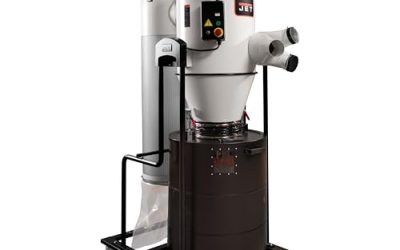
JET JCDC-3 Cyclone Dust Collector
JET JCDC-3 Cyclone Dust Collector
Best for: Weekend shops with 230V power and long milling sessions that would overwhelm a 20-gallon drum.
Motor: 3 HP, 230V, single-phase
Airflow: 1,240 CFM, as listed
Filter: 2-micron canister filter; maker rates efficiency at 99 percent of 2-micron particles
Some weekend shops outgrow the portable class: a wide planer, a jointer with a long bed, or a saw running all day on a cabinet build. The JCDC-3 answers with a 3 HP motor, 1,240 CFM as listed, and a 66-gallon drum that swallows a full day of milling without an emptying break. The Amazon listing includes a remote control, so the unit can live in a corner and start from the machine you are standing at. It is a bigger commitment in power, weight and floor space, but it is the pick that stops being the bottleneck.
Watch out for: At a listed 268 pounds with a 66-gallon drum, plan its parking spot and a 230V circuit before it arrives.
One safety routine applies to all three. Empty drums and clean canister filters outdoors while wearing a fitted respirator, because the fine fraction that settles in the drum is exactly the dust you least want to breathe at close range. Keep the collector and drum bonded to ground where the manual directs, and use anti-static hose on long flex runs, since moving air and dry chips build static charge. Finally, size the circuit to the motor: a 1-1/2 HP unit drawing around 15 amps belongs on a 20-amp breaker of its own, not shared with the saw it serves.
Which One Fits Your Situation
Your Collector Rolls to Each Machine in a One-Car Garage
Choose the Grizzly G0860. Its 110V motor, caster base and two-way 4-inch adapter suit the roll-up, plug-in routine that garage shops actually follow, and the 20-gallon drum matches the chip volume of one-machine work. Park it where the 67-inch height clears your door track, keep one short hose, and the two-stage separation keeps suction steady across a weekend without any permanent installation.
You Sand and Finish in the Same Small Space
Choose the Mini-Gorilla. Weekend furniture work ends in hours of sanding, and the HEPA-grade media filter is the listed difference that matters once airborne dust settles on a wet finish. The 22-gallon drum and portable frame still fit a part-time shop, and the dual-voltage motor gives you an upgrade path if you later add a higher-capacity circuit to the space.
Your Weekends Involve Serious Milling Days
Choose the JET JCDC-3 if you already have 230V power. Surfacing rough lumber for a large build produces chips faster than small drums accept them, and the 66-gallon capacity plus 1,240 CFM rating keeps the planer fed with airflow all day. The included remote control earns its keep here, because the collector can stay parked while you work through a stack at the machine.
You Want One Purchase That Will Not Need Replacing Next Year
Start with the G0860 unless milling volume is already your bottleneck. It covers the saw-planer-jointer trio most weekend projects use, runs on the power you already have, and its running costs are a drum liner and an occasional filter cleaning. Step up to the JCDC-3 only when drum emptying, not suction, is what interrupts your sessions.
Common Mistakes
Buying by free-air CFM alone and ignoring the static pressure figure, hose length and reducers that decide real airflow at the tool.
Letting the drum overfill until chips pack into the canister, which quietly turns a two-stage collector back into a clogged single-stage one.
Running a 15-amp collector and a table saw on the same household circuit, then blaming the motor for nuisance breaker trips.
Choosing a 230V collector before confirming the shop actually has a suitable circuit and a parking spot for its height and weight.
Judging filtration by the word cyclone alone, when the filter rating printed on the listing is what governs the fine dust fraction.
Frequently Asked Questions
Is a two-stage collector worth it for a shop used only on weekends?
Yes, because short sessions concentrate the problem. A Saturday of milling fills bags and loads filters faster than steady daily use, and separation keeps the heavy chips in the drum so the filter stays open. You feel the difference as steady suction at the planer late in the day, not as a bigger number on a specification sheet.
Can one of these collectors serve two machines at once?
Not realistically in this size class. The portable 1-1/2 HP units are designed around one open port at a time, and splitting flow between two machines starves both. Roll the collector to the machine in use, or step up to the 3 HP JET for a fixed layout with gates. One machine at a time is the honest working pattern for weekend shops.
What filter rating should a weekend woodworker look for?
Look for the rating printed on the listing rather than marketing language. A 1-micron canister, as listed for the Grizzly and the JET, captures the fine fraction far better than a basic cloth bag. The Oneida goes further with HEPA-grade media at an E12 minimum efficiency rating. Any of the three is a major step up from a 30-micron stock bag.
How often does the drum on a two-stage collector need emptying?
It depends entirely on the work. Rough milling can fill a 20-gallon drum in a single long session, while joinery and saw work may take weeks to reach the same level. Check the drum before big sessions and empty it at about three-quarters full. Past that point, chips start reaching the filter, suction falls, and the advantage you paid for disappears.
J
JD's Woodworks Editorial Team
We compare specs, warranty terms, long-term owner feedback and street pricing before anything earns a spot. Rankings are never paid.
Affiliate disclosure. As an Amazon Associate we earn from qualifying purchases at no extra cost to you. Prices accurate as of the date shown.
Compare the best cyclone dust collectors for experienced DIY woodworkers, with airflow, canister filtration, remote control and drum capacity compared.
Compare the best wall mounted dust collectors for weekend woodworking projects, with CFM, bag size and filtration from each listing to size one machine right.
Stationary thickness planers that ship with a dust hood, compared for home shops: 15, 20 and 22 inch helical floor models with listing specs and ASINs.
True open-sided thickness planers are rare on Amazon. See the verified open-end pick with a dust connection, its listing specs, safety notes and buying checks.
Floor standing band saws for garage workshops compared on resaw height, throat, motor power and dust ports, with setup and safety checks before buying.
Compare the best cyclone dust collectors for weekend woodworking projects, with airflow, drum size and filter ratings from each listing to pick the right fit.