Key takeaways
- Compare the best closed end drum sanders for small professional workshops, with enclosed frames, fixed widths, steady feed control, and dust handling.
As an Amazon Associate I earn from qualifying purchases. This post may contain affiliate links at no extra cost to you.
A closed end drum sander holds its sanding drum inside an enclosed frame, with the drum supported at both ends. That construction gives the machine a rigid frame and a fixed working width in a single pass, so a board goes through once at the stated width and comes out sanded across its full face. For a small professional workshop, that rigidity matters: it helps hold thickness across a panel, reduces flex under load, and gives the operator a predictable result from the first board of a batch to the last.
The best closed end drum sanders for small professional workshops suit shops that sand panels, doors, and tabletops to a consistent thickness day after day. Because the width is fixed, the choice starts with measuring the widest stock the shop sands regularly. A machine that is too narrow forces awkward workarounds, while a machine that is far wider than needed takes up floor space, needs a larger dust collector, and costs more to run. The enclosed frame also shapes the rest of the buying decision, from dust extraction to abrasive changes, because access to the drum and the conveyor is designed around that frame.
This guide compares three enclosed-frame drum sanders that fit a compact professional shop. Each one lists a fixed single-pass width, a powered conveyor, and a dust port for workshop extraction.
Disclosure: As an Amazon Associate, we earn from qualifying purchases.
At a glance
| Product | Key spec | Best for |
|---|---|---|
| Powermatic DDS-225 | 25-inch width, two drums, 5 HP motor, 230V | Fixed-width production panel sanding |
| JET JWDS-2244 | 22-inch width, 1-3/4 HP motor, 115V | Wide panels on standard shop power |
| JET JWDS-1020 | 10-inch width, 1 HP motor, 115V | Compact benchtop sanding in a tight shop |
How to choose
Fixed width and panel size. A closed end machine sands the stated width in one pass, so measure the widest panels the shop sands in a normal month and choose a drum that covers them. A 22-inch or 25-inch drum handles cabinet doors, drawer fronts, and many tabletops, while a 10-inch benchtop drum suits smaller parts and narrow stock. Buying far more width than the shop uses wastes floor space and extraction capacity, so let real panel sizes set the width.
Frame rigidity and thickness accuracy. The enclosed frame is the point of this design, so look for a heavy frame, a flat conveyor bed, and a drum carriage that stays parallel to the bed under load. A rigid frame holds thickness across a wide panel and reduces the waviness that shows up under a finish. Check how the depth adjustment works, whether it moves in small increments, and whether the setting repeats accurately when the same thickness is dialled in again for the next batch.
Motor power and electrical supply. The Powermatic DDS-225 uses a 5 HP motor on a 230V supply, while the two JET machines run on 115V, with 1-3/4 HP on the JWDS-2244 and 1 HP on the JWDS-1020. Match the motor to the work: wider drums and heavier cuts need more power, and a motor that stalls or slows under load leaves marks on the surface. Confirm the circuit capacity and the wiring route before ordering, especially for the 230V machine, and give the machine a dedicated circuit where the manual calls for one.
Feed speed and load control. A variable-speed conveyor lets the operator slow down for figured grain, dense hardwoods, and wide panels, and speed up for light finish passes on narrow stock. Look for a conveyor that tracks straight and a control that adjusts feed smoothly. Some machines add load-sensing control that slows the feed when the drum motor is working hard, which helps prevent burning and gouging. Light passes and a steady feed are the habits that keep a drum sander producing a clean surface.
Dust handling. Drum sanders produce a large volume of fine dust, and an enclosed frame concentrates that dust inside the hood, so extraction matters even more. Each machine here has a dust port sized for a dust collector, and the collector needs enough airflow to clear the hood and keep dust off the conveyor. Keep the duct run short and straight where possible, and clean the hood and ports regularly.
Top picks
Powermatic DDS-225 Drum Sander

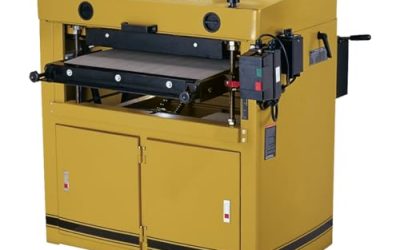
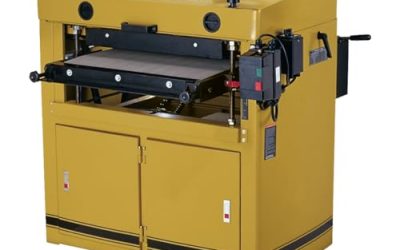
The Powermatic DDS-225 is a 25-inch dual drum sander with a 5 HP motor running on 230V single-phase power. Its enclosed frame holds two drums, so a coarse abrasive on the front drum and a fine abrasive on the rear drum complete rough and finish sanding in one pass. It sands stock up to 25 inches wide and up to 4 inches thick, with a variable-speed conveyor and two 4-inch dust ports. The cast iron table and heavy frame keep vibration low during long sanding sessions.
Best for: A small professional shop that wants a rigid enclosed-frame machine for steady production sanding of panels up to 25 inches wide.
Considerations: It needs a 230V circuit and a capable dust collector, and its weight and footprint call for a permanent position with clear infeed and outfeed space.
JET JWDS-2244 Drum Sander

The JET JWDS-2244 is a 22-inch drum sander with a 1-3/4 HP motor running on 115V power. It sands stock up to 22 inches wide in one pass and up to 4 inches thick, with a variable-speed conveyor and SandSmart load-sensing control that adjusts feed speed to the load on the drum motor. The 4-inch dust port connects to workshop extraction, and the mirrored dust hood is designed to keep dust away from the workpiece. Its enclosed drum housing and steel frame suit a shop that wants wide capacity without a 230V circuit.
Best for: A shop that sands panels up to 22 inches wide and wants a capable enclosed-frame machine that runs on standard 115V shop power.
Considerations: Wide, heavy panels need infeed and outfeed support, and the machine needs a dust collector with enough airflow to keep the hood clear.
JET JWDS-1020 Benchtop Drum Sander
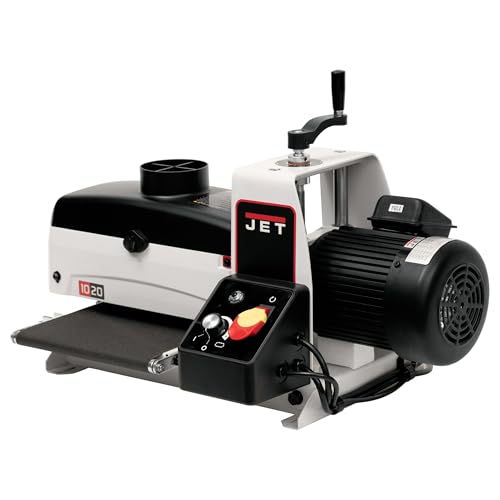
The JET JWDS-1020 is a 10-inch benchtop drum sander with a 1 HP motor running on 115V power. It sands boards up to 10 inches wide in one pass and up to 3 inches thick, with an infinitely variable conveyor speed and a precision-flattened reinforced steel conveyor bed. The die-cast aluminum and steel body keeps the machine rigid for its size, the extruded aluminum drum dissipates heat, and tool-free abrasive take-up fasteners make grit changes quick. At 73 pounds it fits on a workbench and can be moved when the bench is needed for other work.
Best for: A small professional shop with limited floor space that sands narrow parts, small panels, and thin stock on a benchtop machine.
Considerations: Its 10-inch width limits panel size, and wide work needs a larger machine, so it suits parts and narrow panels rather than full tabletops.
Which one fits your shop
Choose the Powermatic DDS-225 when the shop sands panels up to 25 inches wide in steady volume and wants the rigidity and two-drum workflow of an enclosed-frame production machine. Choose the JET JWDS-2244 when 22 inches covers the regular panel work and the shop wants to stay on 115V power with load-sensing feed control. Choose the JET JWDS-1020 when floor space is tight and the work is mostly narrow parts and small panels, since a benchtop machine keeps the capability without taking over the shop. In every case, confirm the electrical supply, the dust collector airflow, and the space for loading and unloading before the machine arrives, since those three items decide whether a closed end sander helps the shop or crowds it.
FAQ
What is a closed end drum sander?
It is a drum sander whose drum sits inside an enclosed frame and is supported at both ends, giving a fixed working width in a single pass. The enclosed frame adds rigidity and helps hold thickness across a panel.
How is a closed end drum sander different from an open end drum sander?
An open end drum sander leaves one end of the drum unsupported, so a wide board can be flipped and passed through twice to sand beyond the drum length. A closed end machine sands its stated width in one pass and does not use that two-pass technique.
What width should a small professional shop choose?
Measure the widest panels sanded in a normal month and choose a drum that covers them in one pass. A 22-inch or 25-inch drum suits most cabinet and furniture panel work, while a 10-inch benchtop drum suits narrow parts.
Do closed end drum sanders need a dust collector?
Yes. They produce a large volume of fine dust, and the enclosed hood is designed for a dust collector rather than a small shop vacuum.
Bottom line
The best closed end drum sanders for small professional workshops give a rigid enclosed frame, a fixed single-pass width, and a powered conveyor that holds thickness across a panel. The Powermatic DDS-225 suits steady production work up to 25 inches wide, the JET JWDS-2244 covers wide panels on standard 115V power, and the JET JWDS-1020 brings drum sanding to a benchtop in a tight shop. Match the width to the widest regular panel, confirm the electrical supply and dust extraction, and leave room for loading and unloading.
Related guides
More from Amazon
Programs that pair well with the guide above. Offers and eligibility are set by Amazon and may change.
A free business account with business pricing and bulk-buying tools for work, shop or home office.
Create a business accountFree shipping on eligible items, Prime Video and more. Eligible new members can start with a free trial.
Start a Prime free trialAudiobooks and podcasts to listen to on the go. Eligible new members can start with a free trial.
Try Audible freeAd-free music streaming. Eligible new subscribers can start with a free trial.
Try Music Unlimited freeAs an Amazon Associate we earn from qualifying purchases.