Key takeaways
- Compare the best dual drum sanders for small professional workshops, with two-drum sanding, strong motors, wide capacity, dust control, and buying guidance.
As an Amazon Associate I earn from qualifying purchases. This post may contain affiliate links at no extra cost to you.
A dual drum sander earns its floor space in a small professional workshop by doing two sanding steps in a single pass. For a shop that sands glued panels, cabinet doors, drawer fronts, and tabletops every day, that single-pass workflow cuts handling time and keeps work moving from the planer to the finishing bench without a long queue at the sanding station.
The best dual drum sanders for small professional workshops balance capacity with footprint. A machine that is too wide wastes floor space and demands a larger dust collector, while a machine that is too narrow forces extra passes and slows down panel work. The right choice depends on the widest panels the shop sands regularly, the thickness range of the stock, the available electrical supply, and how much help is on hand to load and unload heavy panels. A small professional shop also needs a machine that is easy to set up, simple to change abrasives on, and steady enough to hold thickness across a full panel.
This guide compares three dual drum sanders that suit a compact professional shop. Each one uses two drums, a powered conveyor, and a dust port that connects to workshop extraction.
Disclosure: As an Amazon Associate, we earn from qualifying purchases.
At a glance
| Product | Key spec | Best for |
|---|---|---|
| Powermatic DDS-225 | 25-inch width, two drums, 5 HP motor, 230V | Production panel sanding in a dedicated shop |
| Shop Fox W1678 | 26-inch width, two drums, 5 HP motor, 230V | Wide panels and mixed grit sanding in one pass |
| Grizzly Industrial G0449 | 37-inch width, two drums, 10 HP motor | Very wide panels and high-volume sanding |
How to choose
Drum width and panel size. Measure the widest panels the shop sands in a normal month, then choose a drum width that covers most of them in one pass. A 25-inch or 26-inch drum handles cabinet doors, drawer fronts, and many tabletops, while a 37-inch drum suits large conference tabletops and wide glued panels. Wider drums need more floor space, longer infeed and outfeed support, and a second person for heavy panels, so match the width to real work rather than to the largest panel ever made.
Two-drum grit strategy. The main advantage of a dual drum machine is running two grits at once. A coarse grit on the first drum removes milling marks and levels the surface, while a finer grit on the second drum smooths the surface for finishing. Plan the grit pairing around the wood species used most often. Dense hardwoods need light passes and a patient feed rate, while softer woods tolerate a more aggressive first drum. Keep spare abrasive wraps on hand, because a worn first drum forces the second drum to do work it was not set up for.
Motor power and electrical supply. Dual drum sanders in this class need serious power. The Powermatic DDS-225 and the Shop Fox W1678 both use 5 HP motors, and the Grizzly G0449 uses a 10 HP motor. All three need a 230V supply, so check the shop panel, the circuit capacity, and the wiring route before ordering. A machine that trips a breaker or stalls under load wastes more time than it saves, and a dedicated circuit is a normal part of installing a machine of this size.
Feed speed and load control. A variable-speed conveyor lets the operator slow down for figured grain, wide panels, and heavy cuts, and speed up for light finish passes on narrow stock. Look for a conveyor that tracks straight, a depth adjustment that moves in small increments, and a load meter or similar indicator that shows when the drums are working too hard. Taking light passes is the habit that prevents burning, gouging, and premature abrasive wear, and a good feed control makes that habit easy to keep.
Dust handling. Drum sanders produce a large volume of fine dust, and a small shop feels the effect fast. Each machine here has dust ports that connect to a dust collector, and the collector needs enough airflow to keep dust out of the air and off the conveyor. Keep the hose short and straight where possible, and clean the ports and the inside of the hood regularly.
Top picks
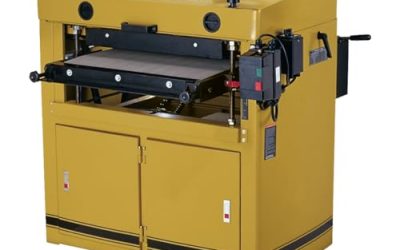
Powermatic DDS-225 Drum Sander

The Powermatic DDS-225 is a 25-inch dual drum sander with a 5 HP motor running on 230V single-phase power. It sands stock up to 25 inches wide in one pass and up to 4 inches thick, with a variable-speed conveyor and two 4-inch dust ports. The two drums accept different grits, so a coarse abrasive on the front drum and a fine abrasive on the rear drum complete rough and finish sanding in one trip through the machine. The cast iron table and heavy frame keep vibration low during long sanding sessions.
Best for: A small professional shop that sands cabinet panels, doors, and tabletops in steady volume and wants a proven dual drum machine with a 25-inch capacity.
Considerations: It needs a 230V circuit and a capable dust collector, and its weight and footprint call for a permanent position with clear infeed and outfeed space.
Shop Fox W1678 Drum Sander
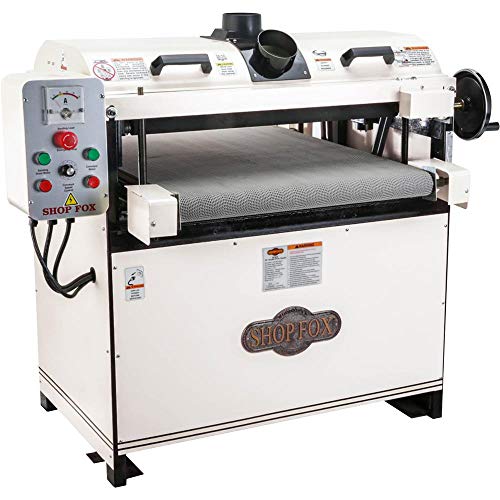
The Shop Fox W1678 is a 26-inch dual drum sander with a 5 HP motor. Its two drums are micro-adjustable, with the rear drum adjustable independently so the two grits can be set for an even cut. The machine handles stock up to 26 inches wide, uses hook-and-loop abrasive attachment for fast grit changes, and includes a conveyor with variable feed speed. A control panel with a load meter helps the operator see when the machine is working hard, and the dust hood connects to workshop extraction.
Best for: A shop that sands wide panels and wants independent rear drum adjustment and fast abrasive changes on a 26-inch dual drum machine.
Considerations: It is a large, heavy machine that needs a 230V supply, a strong dust collector, and enough floor space for long boards and safe loading.
Grizzly Industrial G0449 Drum Sander

The Grizzly Industrial G0449 is a 37-inch dual drum sander with a 10 HP motor and a 1725 RPM drum speed. It sands panels up to 37 inches wide and stock up to 6 inches thick, making it the widest machine in this guide. The dual drum setup allows two grits in one pass, the conveyor feeds stock at a controlled rate, and the heavy frame is built for daily production work. It is a large stationary machine that suits a shop with the floor space and electrical supply to support it.
Best for: A small professional shop that regularly sands very wide panels and needs the largest capacity in this guide, with power to match.
Considerations: It needs a substantial electrical supply and a permanent, level position, and wide, heavy panels need support tables and a second pair of hands.
Which one fits your shop
Choose the Powermatic DDS-225 when the shop sands panels up to 25 inches wide in steady volume and wants a well-established dual drum machine with straightforward controls. Choose the Shop Fox W1678 when a little extra width matters and independent rear drum adjustment and fast abrasive changes are priorities. Choose the Grizzly G0449 only when panels wider than 26 inches are a regular part of the work, because its size, power demand, and weight are justified by wide-panel volume rather than by occasional use. In every case, confirm the electrical supply, the dust collector airflow, and the infeed and outfeed space before the machine arrives, since those three items decide whether a dual drum sander helps the shop or crowds it.
FAQ
What does a dual drum sander do that a single drum sander does not?
A dual drum sander runs two abrasive grits in one pass, so the first drum levels and the second drum smooths. That removes a second trip through the machine and keeps panel thickness consistent across the batch.
How wide a panel can a dual drum sander handle?
The width depends on the drum length. The machines in this guide cover 25, 26, and 37 inches in a single pass, so measure the widest panels the shop sands regularly and choose a drum that covers them.
Do dual drum sanders need a dust collector?
Yes. They produce a large volume of fine dust, and the dust ports are designed for a dust collector rather than a small shop vacuum.
Can a dual drum sander replace a thickness planer?
No. A planer removes material fast and flattens rough lumber, while a drum sander refines the surface and brings panels to a consistent thickness with a finish-ready surface. Most shops use both, with the planer first and the sander second.
Bottom line
The best dual drum sanders for small professional workshops pair two grits in one pass with enough power and width for the panels the shop actually sands. The Powermatic DDS-225 suits steady cabinet and furniture panel work, the Shop Fox W1678 adds width and independent drum adjustment, and the Grizzly G0449 suits shops that regularly sand very wide panels. Match the drum width to the widest regular panel, confirm the 230V supply and dust extraction, and leave room for loading and unloading.
Related guides
More from Amazon
Programs that pair well with the guide above. Offers and eligibility are set by Amazon and may change.
A free business account with business pricing and bulk-buying tools for work, shop or home office.
Create a business accountFree shipping on eligible items, Prime Video and more. Eligible new members can start with a free trial.
Start a Prime free trialAudiobooks and podcasts to listen to on the go. Eligible new members can start with a free trial.
Try Audible freeAd-free music streaming. Eligible new subscribers can start with a free trial.
Try Music Unlimited freeAs an Amazon Associate we earn from qualifying purchases.