Our Top Picks
 SKIL 6 Amp 3"x18" Belt Sander with PressureOne Size12.25 x 6.25 x 5.75 Inches5.51 PoundsCheck on Amazon
What's inside
- Table of Contents
- Quick Answer
- Bosch 1274DVS Variable Speed Belt Sander
- SKIL 7510-01 Sandcat Belt Sander
- WEN 6321 Corded Belt Sander
- BLACK+DECKER DS321 Dragster Belt Sander
- Jellas 7-Amp Belt Sander (BS02-SD)
- How to Choose a Belt Sander for Refinishing Furniture
- Who Should Skip a Belt Sander
- FAQ
- Conclusion
- Product and ASIN Reference
As an Amazon Associate I earn from qualifying purchases. This post may contain affiliate links at no extra cost to you.
Table of Contents
- Quick Answer
- Bosch 1274DVS
- SKIL 7510-01 Sandcat
- WEN 6321
- BLACK+DECKER DS321 Dragster
- Jellas 7-Amp Belt Sander (BS02-SD)
- How to Choose a Belt Sander for Refinishing Furniture
- Who Should Skip a Belt Sander
- FAQ
- Conclusion
- Product and ASIN Reference
Refinishing furniture is mostly finish removal: cracked varnish on a dining table, flaking paint on a dresser, or a worn shellac top that has to come down to bare wood before recoating. A belt sander does that stripping faster than any other handheld tool, but the same aggression can gouge a tabletop or burn through veneer in seconds. Sanders that suit refinishing share a few traits: variable speed or a gentle single speed for control near edges, a flat platen that keeps wide surfaces level, a shape that works close to legs and aprons, and dust collection. The five picks below cover the premium, mid-range, and budget tiers, each suited to a different refinishing job.
As an Amazon Associate, we earn from qualifying purchases.
Quick Answer
For most refinishing work, the Bosch 1274DVS is the best belt sander for refinishing furniture: its variable speed, graphite platen, and flush-sanding body strip tabletops evenly without digging in. The SKIL 7510-01 suits beginners with its pressure warning lights, the WEN 6321 is the budget workhorse, the BLACK+DECKER DS321 reaches edges and corners, and the Jellas 7-amp model adds speed control and bench clamps in the budget tier.
Bosch 1274DVS Variable Speed Belt Sander

The 1274DVS is the control pick, and control is what refinishing rewards. Its variable speed dial runs the belt from 550 to 1,100 surface feet per minute, so a restorer can slow down over thin veneer or soft pine and speed up to level thick varnish on oak. The graphite platen pad is the standout feature: it sits dead flat, runs cool, and supports the belt evenly across a wide top, which prevents the dips and scallops that show up under a fresh coat of finish. The in-line body sands flush to a vertical surface on one side, useful where a tabletop meets an apron. At 7.1 pounds it is light for a 3-by-21 sander, and the removable front handle comes off for close work around legs. It sits in the premium tier, and for anyone refinishing more than the occasional piece, the platen and speed range justify it.
Specs
- Belt size: 3 in. x 21 in.
- Motor: 6.6 amps
- Belt speed: variable, 550 to 1,100 SFPM
- Weight: 7.1 lb
- Platen: graphite pad over cast aluminum
- Dust collection: side-mounted dust bag
- Extras: removable front handle, flush sanding on one side
SKIL 7510-01 Sandcat Belt Sander
The Sandcat is the pick for anyone refinishing a first piece, because it warns you before you make the classic belt sander mistake. Its pressure control indicator lights green when downward pressure is in the right range and red when you are leaning hard enough to gouge or burn through a finish unevenly. That coaching matters on furniture, where most damage comes from pressing instead of letting the tool’s weight work. The compact 3-by-18 body is easier to steer around chair seats, drawer fronts, and small tabletops than a full-size sander, and it sands flush to an edge for work against case sides. The auto-track system keeps the belt centered, and the single-lever belt change is quick when a belt loads up with old finish. Dust goes into a micro-filtration canister whose port also fits standard 1-1/4 inch vacuum hoses. It is a single-speed tool in the mid-range tier, so coarse work takes a little longer, but nothing else on this list teaches the refinishing touch as directly.
Specs
- Belt size: 3 in. x 18 in.
- Motor: 6.0 amps
- Belt speed: 1,050 SFPM, single speed
- Weight: 6.4 lb
- Guidance: pressure control indicator lights, auto-track belt alignment
- Dust collection: micro-filtration canister, fits 1-1/4 in. vacuum hoses
- Cord length: 6 ft
WEN 6321 Corded Belt Sander
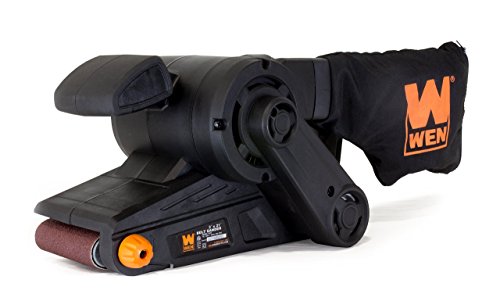
The 6321 is the budget workhorse: a simple, light, single-speed 3-by-21 sander that strips paint and varnish asking little technique beyond keeping it moving. The 7-amp motor turns the belt at 820 feet per minute, a moderate pace that removes finish steadily on dressers, doors, and table leaves without the runaway feel of faster pro sanders. At about six pounds it is the lightest full-size pick here, which helps on vertical surfaces like cabinet sides, where a heavier tool tires the arms and starts to wander. The lock-on switch holds the trigger for long flat runs, and the quick-release lever swaps belts fast when stripped finish clogs the abrasive. There is no speed dial, so veneer work calls for a light touch and a finer belt. For occasional refinishing and painted pieces going back to bare wood, it covers the job in the budget tier, backed by a two-year warranty.
Specs
- Belt size: 3 in. x 21 in.
- Motor: 7 amps
- Belt speed: 820 FPM, single speed
- Weight: 6.2 lb
- Dust collection: detachable dust bag
- Extras: lock-on switch, quick-release belt lever
- Warranty: 2 years
BLACK+DECKER DS321 Dragster Belt Sander

The Dragster exists for the parts of a furniture piece that a standard sander cannot reach. Its low-profile angled nose and retractable hood let the belt run up to the edge of a top and into the inside corners where tabletops meet raised panels or bookcase sides meet shelves. That geometry also helps along door edges and drawer boxes, where finish builds up thickest and a bulky body gets in the way. The 7-amp motor drives the 3-by-21 belt at up to 800 feet per minute, a controlled pace for stripping, and the tool’s 8.2 pounds give it enough planted weight to stay steady on flat work without pressing. As a primary sander for big tabletops it is outclassed by the Bosch above, but as the edge-and-corner specialist in a refinishing kit it has no real rival in its tier.
Specs
- Belt size: 3 in. x 21 in.
- Motor: 7 amps
- Belt speed: up to 800 FPM
- Weight: 8.2 lb
- Design: low-profile angled nose, retractable hood for flush and corner work
- Dust collection: dust bag
- Tier: budget to mid-range
Jellas 7-Amp Belt Sander (BS02-SD)
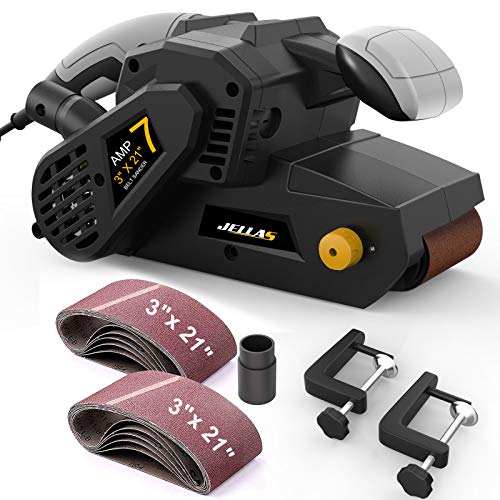
The Jellas is the budget pick for anyone who wants speed control without leaving the budget tier. A six-setting dial adjusts the belt pace, so painted softwood can be stripped gently and thick varnish on hardwood attacked faster, all with the same 7-amp tool. It also converts to bench duty: two included metal clamps fix the inverted sander to a tabletop, turning it into a stationary belt for shaping small parts like replacement drawer pulls and trim blocks that are unsafe to hold under a moving handheld sander. The package is generous for the tier, with ten sanding belts spanning coarse stripping grits through medium smoothing grits, a detachable dust bag, and a two-in-one vacuum adapter. The 10-foot cord gives more working room around a bench than most budget tools allow. Published weight and belt-speed figures conflict between the maker’s own listing materials, so those specs are marked not stated below. For a first refinishing setup on a tight budget, it is the most flexible option here.
Specs
- Belt size: 3 in. x 21 in.
- Motor: 7 amps, 750 watts
- Speed control: 6-setting variable speed dial
- Belt speed: not stated
- Weight: not stated
- Cord length: 10 ft
- Dust collection: detachable dust bag, 2-in-1 vacuum adapter
- Includes: 10 sanding belts, 2 bench clamps, lock-on button
How to Choose a Belt Sander for Refinishing Furniture
Start with speed control. Old finishes vary from soft shellac to hard polyurethane, and veneer sits under many of them, so a variable speed dial is the most useful refinishing feature: slow settings protect thin veneer and softwoods, fast settings level thick finishes on solid tops. Single-speed sanders still work, but they demand a lighter touch and finer belts near edges.
Match the belt size to the furniture. A 3-by-21 belt covers tabletops, dresser tops, and door panels efficiently and tracks straighter on long runs. A compact 3-by-18 body is easier to control on chair seats, drawer fronts, and smaller case pieces, and is less likely to tip over an edge.
Check the platen and the body shape. A flat, well-supported platen keeps wide surfaces level; a worn platen leaves dips that telegraph through new finish. For pieces with raised panels, aprons, or inside corners, a low-profile nose or flush-sanding side saves hand sanding later.
Plan for dust. Stripped paint and varnish dust is the dirtiest output in the shop, and older painted furniture may carry finishes you do not want airborne. A bag is the minimum; a vacuum port that fits your shop vacuum is better. Finally, weigh the tiers honestly: budget sanders strip painted project pieces well, mid-range tools add guidance and comfort, and premium tools add the flat platen and speed range that fine veneered furniture deserves.
Who Should Skip a Belt Sander
Skip the belt sander entirely if the veneer is thin, blistered, or lifting: even a careful pass can cut through to the substrate, and a random orbital sander or a chemical stripper is the safer route. The same applies to antiques with collector value, where preserving the original surface matters more than speed, and to carved, turned, or molded details, which a flat belt cannot follow without flattening them. Small parts and curved components belong on an oscillating spindle sander or sanded by hand. And if the finish is intact and only needs refreshing, a light scuff sand with an orbital sander is all a new coat needs.
FAQ
Can a belt sander damage veneer on furniture?
Yes. Furniture veneer is often very thin, and a belt sander removes material fast enough to cut through it in one careless pass, especially at edges. Use the slowest speed, a finer belt, and keep the sander moving, or choose an orbital sander or chemical stripper for veneered pieces.
What grit belt should I use to strip an old finish?
Start with a coarse belt in the 60 to 80 grit range to remove varnish or paint, then step to 100 or 120 grit to level the surface, and finish with an orbital sander at finer grits before recoating. A thin, worn finish often comes off starting at 100 grit.
Should I strip finish with a belt sander or a chemical stripper?
Use the belt sander on large, flat, solid-wood surfaces where it is fast and controlled, such as tabletops and door panels. Use a chemical stripper on veneer, carvings, turnings, and moldings, where a belt cannot follow the shape and would remove detail along with the finish.
How do I avoid gouges and dips when belt sanding a tabletop?
Keep the sander moving at a steady pace, never let it sit in one spot, and let the tool’s weight supply the pressure instead of pushing down. Work in overlapping passes along the grain, check the surface under raking light between grits, and switch to an orbital sander for the final passes.
Conclusion
Refinishing rewards control more than raw power. The Bosch 1274DVS pairs variable speed with a dead-flat graphite platen and is the safest choice for valuable solid-wood pieces. The SKIL 7510-01 coaches beginners with its pressure lights, the WEN 6321 strips project pieces on a budget, the BLACK+DECKER DS321 handles the edges and corners the others miss, and the Jellas adds a speed dial and bench clamps in the budget tier. Match the sander to the piece.
Product and ASIN Reference
| Product | ASIN |
|---|---|
| Bosch 1274DVS Variable Speed Belt Sander | B0000223HB |
| SKIL 7510-01 Sandcat Belt Sander | B007A9TD3E |
| WEN 6321 Corded Belt Sander | B012VQCCRY |
| BLACK+DECKER DS321 Dragster Belt Sander | B0002ZU73I |
| Jellas 7-Amp Belt Sander (BS02-SD) | B08XYKWGBK |
Related guides
More from Amazon
Programs that pair well with the guide above. Offers and eligibility are set by Amazon and may change.
A free business account with business pricing and bulk-buying tools for work, shop or home office.
Create a business accountFree shipping on eligible items, Prime Video and more. Eligible new members can start with a free trial.
Start a Prime free trialAudiobooks and podcasts to listen to on the go. Eligible new members can start with a free trial.
Try Audible freeAd-free music streaming. Eligible new subscribers can start with a free trial.
Try Music Unlimited freeAs an Amazon Associate we earn from qualifying purchases.