
What's inside
- Quick comparison of leading benchtop UV-Vis instruments
- Best choices by chemistry workflow
- Wavelength range: do not buy more range than your chemistry uses
- Accuracy, resolution, and repeatability
- Cuvette compatibility is a purchasing decision, not an accessory detail
- Decision matrix for real laboratory situations
- Ownership realities: what wears out and what causes bad data
- Typical budget expectations in 2026
As an Amazon Associate I earn from qualifying purchases. This post may contain affiliate links at no extra cost to you.
The best benchtop UV-Vis spectrophotometer for chemistry is usually the Agilent Cary 60 for routine absorbance work, the Shimadzu UV-1900i Plus for higher-resolution quantitative analysis, or a Thermo Scientific GENESYS model when straightforward operation and flexible sample handling matter most.
The right choice depends less on headline wavelength range than on four practical questions: how accurately you need to measure, which cuvettes and sample volumes you use, whether your methods require ultraviolet measurements below 200 nm, and how often the instrument will be cleaned, reconfigured, or used by different operators.
As an Amazon Associate we earn from qualifying purchases at no extra cost to you.

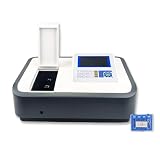
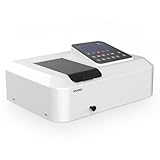

Quick comparison of leading benchtop UV-Vis instruments
| Instrument | Wavelength range | Typical spectral bandwidth | Useful cuvette and accessory considerations | Best fit |
|---|---|---|---|---|
| Agilent Cary 60 UV-Vis | 190–1100 nm | 1.5 nm | Standard 10 mm cuvettes; options for microvolume, fiber-optic, solid, and temperature-controlled measurements | Fast routine chemistry and teaching laboratories |
| Shimadzu UV-1900i Plus | 190–1100 nm | As narrow as 1 nm, depending on configuration | 10 mm rectangular cells are standard; supports multiple-cell and specialized holders | Quantitative methods requiring strong resolution and method control |
| Thermo Scientific GENESYS 150 | 190–1100 nm | Approximately 1.8 nm | 10 mm cuvettes, cell changers, microcells, and specialty holders are available | General laboratory work with a simple workflow |
| Thermo Scientific GENESYS 180 | 190–1100 nm | Approximately 1.8 nm | Broad accessory ecosystem for 10 mm cells, microcells, and temperature-controlled work | Shared laboratories needing more automation and accessories |
| PerkinElmer LAMBDA 365+ | 190–1100 nm | Selectable bandwidths, commonly 0.5–4 nm | Supports standard cells and optional holders for small-volume, solid, and specialized samples | Methods where adjustable resolution is valuable |
Specifications can vary with regional configuration, software package, and accessory selection. Confirm the exact detector, cell holder, validation package, and bandwidth options on the quotation rather than assuming that every configuration includes the features in the table.
Best choices by chemistry workflow
Best for routine absorbance: Agilent Cary 60
The Cary 60 is a strong all-round choice for assays, concentration measurements, kinetics, and teaching laboratories. Its 190–1100 nm range covers ordinary ultraviolet and visible chemistry, while the 1.5 nm bandwidth is suitable for many routine measurements that do not involve narrowly separated spectral peaks.
Its main advantage is flexibility around the sample. Standard 10 mm cuvettes are easy to source, but the instrument can also be configured for small-volume cells, solid samples, and fiber-optic measurements. That matters when a laboratory alternates between clear solutions, reaction vessels, powders, and samples that should not be transferred repeatedly.
Choose the Cary 60 when operators have different experience levels and the priority is reliable daily use without making every measurement a specialist task. It is less compelling if your method depends on resolving fine spectral structure or comparing very closely spaced peaks.
Best for resolution and quantitative method control: Shimadzu UV-1900i Plus
The UV-1900i Plus is the more technically focused choice for laboratories that need tighter control over spectral bandwidth, photometric measurements, and repeatable analytical methods. Its 190–1100 nm range covers the same broad region as the Cary 60, but bandwidth settings as narrow as 1 nm can help distinguish spectral features that a wider-band instrument may smooth together.
This does not automatically make every concentration result more accurate. Accuracy also depends on wavelength accuracy, stray light, cuvette quality, blank preparation, sample stability, and calibration technique. Narrower bandwidth can improve resolution, but it may also reduce light throughput and make noisy or weakly absorbing samples more difficult.
The UV-1900i Plus is a sensible pick for quality-control laboratories, method development, and work where documented parameters must be reproduced precisely. It may be more instrument than necessary for occasional educational measurements.
Best for approachable general-purpose operation: Thermo Scientific GENESYS
The GENESYS 150 and 180 models are designed around accessible workflows and broad sample-handling options. Both cover approximately 190–1100 nm, which is appropriate for many chemistry laboratories measuring dyes, reaction products, metal complexes, environmental samples, and protein or nucleic-acid solutions.
The GENESYS 150 is usually the better value when measurements are performed one cell at a time. The GENESYS 180 becomes more attractive when a shared laboratory needs automated cell handling, temperature control, or a wider range of accessories. Check whether a quoted system includes the cell changer and software functions you need; these are not necessarily included in the base instrument.
Best when adjustable bandwidth matters: PerkinElmer LAMBDA 365+
The LAMBDA 365+ earns consideration when methods vary significantly. Selectable bandwidths, commonly from 0.5 to 4 nm, let the operator favor resolution for narrow features or light throughput for weak samples. That flexibility is useful in research laboratories, but it also creates another method parameter that must be controlled and recorded.
This model is most appropriate when users understand why bandwidth changes the result. For a beginner-focused laboratory with a small number of established methods, a simpler fixed-bandwidth workflow may reduce setup errors.
Wavelength range: do not buy more range than your chemistry uses
Most instruments in this comparison cover 190–1100 nm. That range includes the ultraviolet region commonly used for aromatic compounds and many chromophore-based assays, plus the visible region used for colored complexes and dyes.
Samples requiring measurements below 190 nm need a specialized vacuum-UV or far-UV system, not merely a more expensive standard benchtop unit. At the other end, measurements above 1100 nm require a near-infrared instrument. Confirm the solvent and cuvette material as well: ordinary glass and many plastic cuvettes are unsuitable for deep-UV work, while quartz cuvettes are the normal choice for ultraviolet measurements.
Accuracy, resolution, and repeatability
When comparing instruments, separate these terms:
- Wavelength accuracy: how close the reported wavelength is to the true wavelength.
- Photometric accuracy: how closely measured absorbance matches a reference value.
- Resolution: how well the instrument distinguishes nearby spectral features; bandwidth is a major factor.
- Repeatability: how closely repeated readings agree under unchanged conditions.
A narrow bandwidth is useful only when the sample and method benefit from it. For ordinary Beer-Lambert-law measurements with broad peaks, clean 10 mm quartz cuvettes and consistent pipetting often influence results more than a small difference in nominal bandwidth.
Cuvette compatibility is a purchasing decision, not an accessory detail
Standard 10 mm rectangular cuvettes are the safest starting point because most methods, reference data, and concentration calculations assume a 1 cm optical path. However, the holder must match the cell’s external dimensions and design. A microcuvette that holds 70–100 microliters may require a dedicated holder, and a semi-micro cuvette may not sit correctly in a standard cell compartment.
For ultraviolet work, select UV-grade quartz. For visible-only work, optical glass may reduce operating cost. Disposable plastic cuvettes are convenient, but they can show variation between lots, scratches, solvent incompatibility, and limited UV transmission. Do not compare absorbance values obtained from different cuvette materials without checking their transmission range.
Decision matrix for real laboratory situations
| Laboratory situation | Recommended direction | Why |
|---|---|---|
| Low budget, occasional visible absorbance work | Entry-level visible spectrophotometer or used full-range unit | Paying for UV capability and accessories may not improve the actual workflow |
| Frequent UV-Vis measurements by many operators | Agilent Cary 60 or Thermo GENESYS 150 | Broad compatibility and relatively simple routine operation |
| Research methods with narrow or overlapping peaks | Shimadzu UV-1900i Plus or PerkinElmer LAMBDA 365+ | More control over bandwidth and method parameters |
| Very limited sample volume | Any selected model with a verified microvolume accessory | The accessory and holder determine minimum usable volume more than the base instrument |
| Shared laboratory with temperature-controlled reactions | GENESYS 180, Cary 60, or another configuration with a confirmed temperature accessory | Temperature control and automated handling can improve consistency during kinetics |
Ownership realities: what wears out and what causes bad data
Lamps are a major consumable. Depending on the design, instruments may use xenon flash lamps, deuterium lamps, tungsten-halogen lamps, or combinations of these. A lamp can fail suddenly, but declining intensity, increasing noise, and failed performance checks can also indicate that replacement or service is due.
Cuvettes are more commonly damaged by everyday handling. Scratches, fingerprints on the optical faces, residue from concentrated samples, and droplets left around the bottom can produce absorbance errors. Rinse cells promptly with a compatible solvent, wash them according to the manufacturer’s instructions, and wipe only the non-optical surfaces when possible.
Before an important run, allow the instrument to complete its warm-up or self-check procedure, use the same cuvette orientation for every measurement, prepare a proper blank, and inspect samples for bubbles or particles. A clean blank cannot correct for a dirty sample cuvette or an unstable reaction.
Typical budget expectations in 2026
New full-range benchtop UV-Vis instruments commonly fall into a broad market range of roughly $5,000 to $25,000, depending on automation, software, validation documentation, cell changers, temperature control, and service coverage. Research-oriented configurations can exceed that range. Refurbished instruments may cost less, but budget for lamp replacement, calibration, obsolete software, and a service inspection.
For most chemistry workflows, the best purchase is not the instrument with the longest feature list. Choose the wavelength range your methods require, verify the exact bandwidth and performance specifications, select compatible quartz or glass cells, and price the accessories and service plan as part of the complete system.