
What's inside
- Best benchtop belt sander under 300: quick comparison
- Why the WEN 6502T is the strongest all-around choice
- Head-to-head: large belt machines versus compact models
- Decision matrix: choose by your actual workshop
- What the belt and disc sizes mean in practice
- Tracking, dust collection, and build quality
- Setup and maintenance that prevent common problems
- Final recommendation
- Related Guides
As an Amazon Associate I earn from qualifying purchases. This post may contain affiliate links at no extra cost to you.
The best benchtop belt sander under 300 for most workshop owners is the WEN 6502T, because its 4-by-36-inch belt, 6-inch disc, cast-iron tables, and 1/2-horsepower motor make it more versatile than the compact 1-by-30-inch machines in the same price range.
That recommendation assumes you have room for a roughly 70-pound machine and want to sand boards, bevels, small panels, and end grain. If portability matters more than capacity, a 1-by-30-inch belt-and-disc sander is the better fit. Prices change by seller and promotion, but the models below commonly fall between about $150 and $300 in 2026.
As an Amazon Associate we earn from qualifying purchases at no extra cost to you.
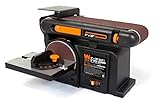
Best benchtop belt sander under 300: quick comparison
| Model | Belt and disc | Motor | Angle range | Approx. weight | Typical market range |
|---|---|---|---|---|---|
| WEN 6502T | 4 x 36 in belt; 6 in disc | 1/2 hp, 4.3 A | Belt 0–90°; tables up to 45° | About 70 lb | $180–$260 |
| BUCKTOOL BD4603 | 4 x 36 in belt; 6 in disc | 3/4 hp, commonly listed around 5 A | Belt position and tables adjustable; verify configuration | About 65–75 lb | $220–$300 |
| WEN 6515T | 1 x 30 in belt; 5 in disc | 2.3 A | Belt 0–90°; tables adjustable | About 17 lb | $100–$160 |
| Shop Fox W1831 | 1 x 30 in belt; 5 in disc | 1/3 hp | Tilting belt and disc table | About 35–40 lb | $180–$260 |
| Rikon 50-151 | 1 x 30 in belt; 5 in disc | 1/3 hp | Adjustable belt and work table | About 35 lb | $220–$300 |
Specifications and included parts can vary between production runs, so check the manufacturer’s current listing before ordering. The table is intended to show the important buying differences rather than imply identical construction across every revision.
Why the WEN 6502T is the strongest all-around choice
The 4-by-36-inch belt is the deciding advantage. It provides substantially more usable sanding area than a 1-by-30-inch belt, stays cooler during longer passes, and accepts a wider variety of woodworking belts. The extra length also makes it easier to smooth an edge without creating a hollow spot.
Its belt assembly can be positioned horizontally or vertically, which changes the machine from an edge sander into a small surface-shaping tool. The 6-inch disc is useful for end grain, small miters, and parts that are easier to control against a disc table. The cast-iron work tables add stability, while the included miter gauge helps with repeatable angle work.
The limitations are just as important. A 1/2-horsepower motor is suitable for normal woodworking but is not a license to force hardwood into the abrasive. The stock dust ports are better than no collection, yet they usually need a properly sized shop-vac hose and careful sealing around the disc guard. Belt tracking may also require adjustment after changing belts or moving the belt arm.
Head-to-head: large belt machines versus compact models
WEN 6502T versus BUCKTOOL BD4603
These are the closest competitors because both use the more useful 4-by-36-inch belt and 6-inch disc format. The BUCKTOOL is attractive when its higher-rated motor and heavier construction are priorities. That additional power can help maintain belt speed while removing material from hardwood, but motor horsepower alone does not guarantee better sanding. Pulley alignment, platen flatness, belt quality, and tracking adjustment matter just as much.
The WEN is usually easier to recommend when price and replacement-belt availability are the main concerns. Choose the BUCKTOOL if you regularly flatten rough edges, work with dense hardwood, or prefer a somewhat more substantial machine and can remain near the top of the budget. Inspect the exact package for the included miter gauge, sanding belts, disc abrasives, and dust-port adapters.
WEN 6515T versus Shop Fox W1831 and Rikon 50-151
The compact 1-by-30-inch machines occupy less bench space and are easier to store. They are well suited to model making, small boxes, trim parts, knife-scale shaping, and occasional light sanding. The WEN 6515T is the value choice and is light enough to move frequently. Its lighter frame, however, makes clamping or bolting it down more important.
The Shop Fox and Rikon versions are more appealing for owners who value a sturdier platform, clearer adjustment hardware, or a better-supported brand ecosystem. Their narrower belts remove less material per pass and can heat small workpieces faster. For furniture edges and frequent panel work, the compact format becomes frustrating rather than economical.
Decision matrix: choose by your actual workshop
| Your situation | Best fit | Reason |
|---|---|---|
| Under about $175 and occasional small parts | WEN 6515T | Lowest entry cost and smallest footprint |
| General woodworking and one main benchtop sander | WEN 6502T | Best balance of belt area, disc size, capacity, and price |
| Frequent hardwood shaping | BUCKTOOL BD4603 | Prioritizes a larger motor and 4-by-36 format |
| Limited bench space or frequent storage | WEN 6515T | Much lighter and easier to relocate |
| More frequent use with a compact footprint | Shop Fox W1831 or Rikon 50-151 | Typically more substantial than the lightest compact machines |
What the belt and disc sizes mean in practice
A 4-by-36-inch belt has 144 square inches of nominal abrasive area, while a 1-by-30-inch belt has only 30 square inches. That does not mean the larger machine removes material 4.8 times faster, because contact pressure, motor speed, abrasive grit, and workpiece shape also control performance. It does mean the larger belt distributes heat and wear over a much bigger surface.
For example, if you sand a 24-inch board edge in six controlled passes, a 4-inch-wide belt can contact most of the edge at once. A 1-inch belt requires more repositioning and is more likely to leave transitions between passes. Conversely, a narrow belt is easier to use on a small curved part where a wide abrasive would obscure your view.
The disc is not a replacement for the belt. A disc is excellent for short end-grain passes and precise small surfaces, but the lower half of a disc generally gives the most useful cutting action. Keep fingers away from the area where the workpiece could be pulled between the disc and table.
Tracking, dust collection, and build quality
Tracking accuracy is more important than a glossy specification sheet. A belt that wanders toward one edge can damage the abrasive, expose the belt seam, and make accurate edge sanding difficult. After installing a belt, run the machine briefly and adjust the tracking knob in small increments. Make sure the belt is centered before applying a workpiece.
Dust collection is a practical dividing line between acceptable and frustrating ownership. Connect the main port to a shop vacuum or dust collector, but do not expect the small port to capture every particle from the open disc. Use a dust mask or respirator appropriate for the material, provide ventilation, and never sand materials that may release hazardous fibers or coatings unless your control system is designed for them.
Look for a rigid base, flat tables, a usable miter slot, positive angle stops, and an accessible belt-release mechanism. A machine that weighs 65 to 70 pounds is harder to move but usually resists vibration better than a 17-pound model. For any machine, bolting it to a bench or using a non-slip base improves control.
Setup and maintenance that prevent common problems
- Square the tables first. Use a small engineer’s square before sanding a reference edge. A table that is only slightly out of square can transfer the error to every workpiece.
- Check the platen. The platen behind the belt should be flat and secure. A loose or worn platen causes inconsistent pressure and uneven edges.
- Use the right grit sequence. Start with 80 or 100 grit for noticeable stock removal, then move to 150 or 180 grit for smoothing. Finer grits are usually more efficient by hand unless the machine is being used for a specific shaping task.
- Keep the belt moving across the work. Holding one spot creates grooves and heat. Use light pressure; a slowing motor is a signal to reduce pressure, not push harder.
- Clean after each session. Vacuum the housing and ports, brush dust from adjustment threads, and inspect the belt for glazing, tears, or a damaged seam.
- Replace worn abrasives early. A glazed belt increases heat and encourages excessive pressure, which can shorten motor and bearing life.
Final recommendation
Choose the WEN 6502T if you want one affordable machine for general woodworking and have room for a heavy benchtop tool. Choose the BUCKTOOL BD4603 when frequent hardwood shaping makes motor capacity and a larger format more important. Select the WEN 6515T, Shop Fox W1831, or Rikon 50-151 when compact storage and small-part control outweigh the productivity of a 4-by-36-inch belt.
The best benchtop belt sander under 300 is therefore not simply the model with the biggest motor. Match the belt size to your work, confirm that the tables and angle adjustments are usable, plan for dust collection, and budget for replacement abrasives. Those factors determine whether the sander remains accurate and pleasant to use after the initial purchase.