
What's inside
As an Amazon Associate I earn from qualifying purchases. This post may contain affiliate links at no extra cost to you.
The best combination belt and disc sander for most home woodworkers is the WEN 6502T 4 x 36-inch belt/6-inch disc model, while the JET JSG-6DC is the stronger choice for frequent shop use because its 6 x 48-inch belt, 9-inch disc, heavier frame, and cast-iron work surfaces handle larger parts more confidently.
A belt-and-disc sander combo saves bench space by combining two abrasive actions: the belt removes material quickly from edges and faces, while the disc gives better control for small end-grain pieces, bevels, and shaped parts. The trade-off is that compact machines usually use smaller motors, stamped-steel tables, and less precise miter gauges.
As an Amazon Associate we earn from qualifying purchases at no extra cost to you.
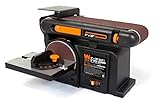
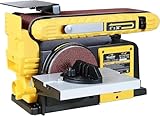
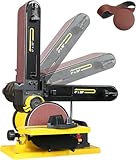
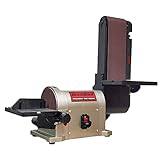
Quick comparison of the seven best options
| Model | Belt / disc | Motor | Approx. weight | Work surfaces and standout feature | Best suited to |
|---|---|---|---|---|---|
| WEN 6502T | 4 x 36 in. / 6 in. | 1/2 hp, 3,450 rpm | 39 lb | Cast-iron belt table; tilting belt assembly | Budget shops and occasional use |
| BUCKTOOL BD4603 | 4 x 36 in. / 6 in. | 1/3 hp, 3,450 rpm | 39–40 lb | Cast-iron tables; quick belt tracking adjustment | Small parts and light furniture work |
| SKIL 3376-01 | 4 x 36 in. / 6 in. | 1/2 hp, 3,450 rpm | About 40 lb | Steel construction; compact tilting belt design | Entry-level hobby use |
| RIKON 50-151 | 6 x 48 in. / 9 in. | 3/4 hp, 1,725 rpm | About 115 lb | Cast-iron tables and base; slower, higher-torque motor | Serious home shops |
| JET JSG-6DC | 6 x 48 in. / 9 in. | 1-1/2 hp, 3,450 rpm | About 200 lb | Cast-iron tables; industrial-style belt tensioning | Frequent and demanding work |
| Grizzly G1183 | 6 x 48 in. / 9 in. | 3/4 hp, 1,725 rpm | About 100 lb | Cast-iron construction; tilting belt and disc tables | Value-oriented production work |
| Shop Fox W1676 | 6 x 48 in. / 9 in. | 3/4 hp, 1,725 rpm | About 100 lb | Cast-iron tables and heavy base; enclosed dust port | Dedicated woodworking shops |
Published specifications can vary slightly by production run and market, so confirm the electrical configuration, table dimensions, and included accessories before ordering. The key comparison is not motor horsepower alone: belt width, motor speed, machine mass, and the rigidity of the tables determine how much usable sanding force reaches the workpiece.
Our picks by situation
- Best budget belt and disc sander combo: WEN 6502T. Its 1/2-hp motor and cast-iron belt table offer a useful step above the lightest stamped-steel machines without requiring a dedicated floor footprint.
- Best compact alternative: BUCKTOOL BD4603. It is a sensible choice when the machine will mainly shape small hardwood parts, knife scales, toys, and trim.
- Best for the smallest workshop: SKIL 3376-01. It is easier to move and store than a 6 x 48 machine, though its lighter frame is more likely to vibrate under pressure.
- Best overall for serious home use: RIKON 50-151. The 6 x 48 belt gives more usable sanding area, and the slower 1,725-rpm motor emphasizes torque and controlled stock removal.
- Best heavy-duty combination disc and belt sander: JET JSG-6DC. It costs and weighs considerably more, but the larger motor and rigid cast-iron structure are appropriate for frequent use.
- Best value in a large format: Grizzly G1183. It provides the useful 6 x 48/9-inch format without moving fully into the price and weight of the JET.
- Best for a permanent shop installation: Shop Fox W1676. Its heavy construction and dust-collection provisions make more sense when the machine will stay bolted to a stand or floor.
4 x 36 versus 6 x 48: which belt size matters?
Choose 4 x 36 inches for portability and light work
A 4-inch-wide belt is adequate for cabinet edges, small boxes, model parts, and general fitting. The shorter belt is also less expensive to replace, and compact machines often weigh roughly 40 pounds rather than 100 pounds or more. That makes a 4 x 36 belt disc sander easier to carry to a temporary work surface.
The limitation is heat and contact area. A narrow belt has less abrasive surface engaged with a wide board, so it can load faster and create a hollow or uneven edge if the operator lingers in one spot. Smaller motors also lose speed when the user presses hard. These machines reward light pressure and frequent belt cleaning.
Choose 6 x 48 inches for flatter, cooler, faster sanding
A 6-inch belt presents 50 percent more belt width than a 4-inch model. Its extra length also provides more abrasive contact area and tends to dissipate heat better. That matters when flattening hardwood edges, refining larger furniture components, or removing saw marks from repeated parts.
The larger format does not automatically mean better accuracy. A poorly aligned 6 x 48 machine can still sand a taper. However, the heavier base, longer platen, and larger work table usually make it easier to hold a long workpiece consistently.
6-inch versus 9-inch discs
A 6-inch disc is adequate for small parts, but the usable sanding zone is limited near the center hub and table. It works well for rounding corners and sanding short end-grain pieces. A 9-inch disc offers roughly 2.25 times the face area of a 6-inch disc, though the effective gain is less because the center portion is not normally used for sanding.
The 9-inch format is more stable with wider stock and gives the operator a larger reference surface. It also usually appears on heavier machines with more rigid tables. If your projects include chair parts, cabinet components, or repeated hardwood pieces, the larger disc is easier to live with.
What separates a good machine from a frustrating one?
Motor torque and speed
Horsepower is only part of the story. A 3/4-hp motor turning at 1,725 rpm can feel more controlled under load than a smaller, faster motor, particularly when sanding dense hardwood. The JET’s 1-1/2-hp motor provides the greatest reserve, but its value appears mainly in continuous work; occasional users may not recover the extra cost.
Regardless of rating, avoid forcing the stock. If the belt audibly slows, the abrasive is too fine, clogged, or being pushed too aggressively. A sharp 80-grit belt with moderate pressure removes material more efficiently than a worn 60-grit belt pressed into the table.
Miter gauge quality
The included miter gauge is often the weakest precision component. Look for a broad head, a bar with minimal side-to-side play, and positive detents at common angles. A gauge that rattles in the slot can turn a nominal 90-degree end into a visible error.
Before relying on it, place a machinist’s square against the gauge and the disc table, then check the gauge at 90 degrees and 45 degrees. If the bar is loose, thin adhesive-backed shim material on the appropriate side can reduce play. Do not use the gauge as a substitute for a sled when repeatedly sanding very small parts.
Table tilt accuracy
Tilting tables are useful for bevels, but the scale stamped into the machine is a reference rather than proof of accuracy. Cast-iron tables generally resist flexing better than thin stamped steel. Check the table with a digital angle gauge or a reliable square after locking it in place; tightening the knob can shift the setting by a degree or more on inexpensive machines.
For repeatable bevels, make a test cut on scrap, measure the result, and record the machine’s actual scale position. This compensates for scale inaccuracies without requiring expensive modifications.
Cast iron versus stamped steel
Cast iron adds mass, damps vibration, and stays flatter when the operator applies pressure near an edge. It is not immune to damage: a dropped tool can chip a cast surface, and rust can develop in an unheated shop. Stamped steel is lighter and cheaper, but it can flex or transmit more vibration, especially on a small base.
A stamped-steel machine can still produce good work when bolted to a rigid bench. A heavy cast-iron machine can perform poorly if it sits loose on a wobbly stand. Mounting quality is part of the machine’s accuracy.
Ownership costs and maintenance
Consider consumables before buying. A 4 x 36 belt and 6-inch disc are generally less expensive and easier to find than 6 x 48 belts and 9-inch discs. For a simple estimate, suppose a small machine uses one $8 belt and two $4 discs each year. At 30 uses, abrasives cost about 53 cents per use. A larger machine might use a $15 belt and two $7 discs over the same period, or roughly 97 cents per use. The larger machine can still be cheaper in practice if it saves several minutes on every project.
- Vacuum dust from the motor vents, table slots, and belt enclosure regularly.
- Use a crepe-style abrasive cleaning stick to remove pitch and resin from belts.
- Check belt tracking with the machine unplugged before making adjustments.
- Inspect the platen, idler bearings, and drive belt when vibration increases.
- Wax steel tables lightly, but keep wax away from abrasive surfaces.
- Replace a glazed abrasive instead of compensating with excessive pressure.
The components that usually wear first are the abrasive, drive belt, tracking mechanism, and idler bearings. The most common operator mistake is sanding against the disc’s upward-moving side without a properly supported table; use the downward-moving portion of the disc where the work is pressed toward the table.
Bottom line
For occasional projects and limited space, buy a 4 x 36 belt/6-inch disc machine such as the WEN 6502T. For larger work, frequent hardwood sanding, and better control, move to a 6 x 48 belt/9-inch disc model such as the RIKON 50-151 or Grizzly G1183. Choose the JET JSG-6DC when uptime, torque, and heavy cast-iron construction matter more than portability or price.