
Our Top Picks
 DEWALT 20V MAX XR Cordless Bandfile Power ToolLarge11.69 x 6.65 x 5.55 inches3.66 poundsCheck on Amazon


What's inside
As an Amazon Associate I earn from qualifying purchases. This post may contain affiliate links at no extra cost to you.
Every cordless belt sander review I read before buying my first one skipped the part that actually mattered: runtime under real sanding pressure. Not the manufacturer’s number, not a spec sheet, but what happens when you lean on a glued-up panel and the pad starts fighting back. That’s where these tools either earn a spot on the bench or become an expensive nuisance you reach for twice a year.
I run a two-car garage shop by myself. No dust collection worth bragging about, one 15-amp circuit doing too much work, and an extension cord that has been run over by a car. That last detail is why I looked at battery belt sanders in the first place. What I found is a category with a narrow but real use case, and a lot of buyers who would be happier spending less on a corded model. Let me walk through where the line falls.
As an Amazon Associate we earn from qualifying purchases at no extra cost to you.


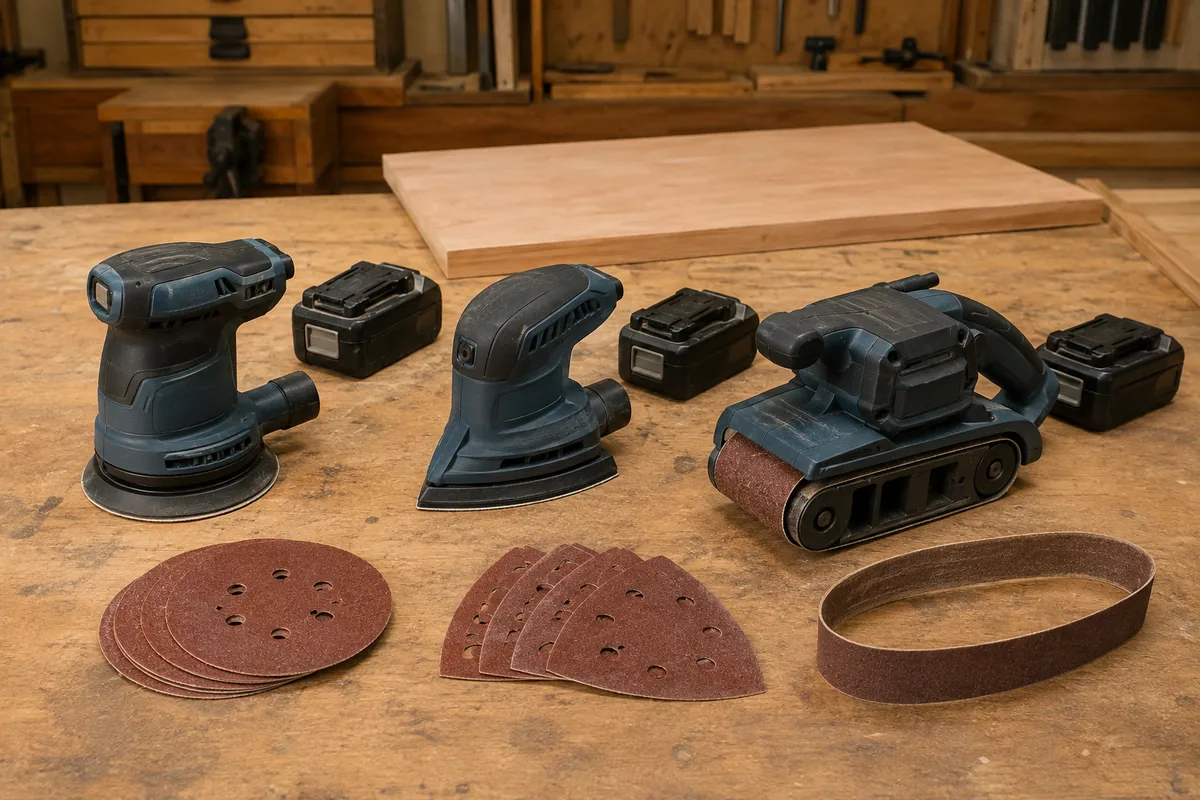
Cordless belt sander review: the three formats worth knowing
“Belt sander” covers three very different machines, and mixing them up is the most common buying mistake I see. A 3×21 benchtop-style sander is a stock removal machine. A file sander (sometimes called a bandfile or power file) runs a narrow 1/2″ to 1-1/8″ belt for detail and metal work. And then there’s the in-between: compact 3×18 or 2-1/2×14 battery units aimed at trim carpenters more than furniture makers.
Here’s how I’d frame the trade-offs before you spend anything:
| Format | Best use in a small shop | Where it disappoints | Battery draw | ||
|---|---|---|---|---|---|
| 3× | 21 cordless belt sander | Flattening glue-ups, aggressive stock removal, deck boards | Runtime on long sessions, weight during vertical work | Very high, plan on two large packs | |
| Compact 3× | 18 / 2-1/2× | 14 | Cabinet edges, jobsite trim, quick knockdown of mill marks | Not enough mass to flatten a wide panel evenly | High but manageable |
| File / bandfile sander | Inside curves, weld cleanup, chair joinery, tight rabbets | Useless for broad surfaces, easy to gouge | Moderate, real all-day tool | ||
| Corded 3× | 21 (the honest baseline) | Anything stationary in the shop | The cord, obviously | None |
If you look at that table and realize your work is mostly panels and tabletops sanded at a fixed bench, the honest answer is that a corded sander plus a decent cord reel serves you better for less money. I own both, and the corded one has more hours on it.
Where a battery belt sander actually earns its keep
Three situations converted me. First, working on something too big to move: a workbench top already assembled in place, a set of stair treads, exterior railing. Dragging a cord across a finished floor or up a ladder is how you knock things over. Second, quick tasks where setup time dominates the actual sanding. If the job takes 90 seconds, a battery tool wins by not requiring you to unspool anything. Third, outdoor work with no convenient outlet, which for me is fence and gate repair.
What surprised me was the deck-board use case. Battery belt sanders are genuinely good at knocking down cupped, weathered boards because you can walk the length of a deck without a cord snagging on every joist hanger. That is a chore, not woodworking, but it’s the kind of chore that justified the purchase.
What still frustrates me: heat. Both the tool and the battery get warm during sustained removal, and thermal management shows up as slowing rather than a hard shutdown. You feel it more than you see it. On a long session I rotate packs partly for charge and partly to let the warm one cool off.
Cordless belt sander, 18V/20V platform
Buy this only if you already own three or more high-capacity packs on the same platform. The tool body is the cheap part of the equation. Filter for brushless motors and variable speed, then check that the model takes the larger high-output batteries rather than only compact packs. If you’d be starting a new battery ecosystem from scratch just for this tool, the math does not work.
Batteries: the part that decides whether you like the tool
A belt sander is closer to a circular saw than a random orbit sander in terms of current draw. Continuous load, no coasting, and the load increases as you press harder. That means compact 2.0Ah packs are near useless here. You want the largest high-output packs your platform offers, and you want at least two so one is always charging.
Practical expectations from my own shop, and I’m deliberately giving ranges rather than pretending I ran a stopwatch on specific models: with a large pack you get a solid stretch of aggressive work, enough for a small tabletop or a handful of boards, then you swap. It is not an all-day tool at full pressure. Anyone telling you otherwise is sanding gently.
Two habits stretch runtime more than any spec:
Let the belt cut. Pushing harder does not remove more material, it just loads the belt with dust and pulls amps. Light pressure, keep it moving, let the grit work.
Change belts sooner than feels reasonable. A worn belt is a runtime tax. Cheap belts in bulk cost less than the battery capacity you burn trying to make an old one cut.
- ✔ No cord to snag on clamps, benches, or stair rails
- ✔ Genuinely useful for in-place work on assembled furniture
- ✔ Fast setup for short tasks
- ✔ Brushless models hold speed decently under moderate load
- ✘ Runtime falls apart under heavy stock removal
- ✘ Heavier at the tool than a comparable corded sander because of the pack
- ✘ Higher cost per capability if you don’t own batteries already
- ✘ Dust collection is usually a small bag, not a shop vac port on every model
Dust, which is the part nobody advertises
Belt sanders make more dust faster than almost anything else in a small shop, and cordless models frequently ship with a small cloth bag that fills in minutes. Before you buy, look at whether the port accepts a standard hose adapter. If your shop vac can hook up, do that instead of the bag every single time. In a garage with the door closed, belt sanding without collection puts fine dust in the air for hours after you stop.
My mistake, since I promised honesty: I sanded a white oak panel with just the bag on, in winter, door shut. Cleaned the shop three times over the following week and still found dust on the bandsaw. Wear a real respirator, not a paper mask, and run the vac.
Cordless file / bandfile sander
If you build furniture with curves, this is the cordless belt tool I’d buy first. Narrow belts sneak into inside curves, chair joints, and tight rabbets where nothing else reaches. Battery draw is much lower than a 3×21, so a mid-size pack lasts a real work session. Look for adjustable arm position and a tool-free belt change. It will not flatten a panel, so it complements a corded sander rather than replacing one.
What I’d tell a friend setting up a garage shop
If you have a limited budget and no belt sander at all, buy a corded 3×21 and a good random orbit sander. That pairing handles the overwhelming majority of furniture work, and you’ll spend the savings on clamps you actually need. Well-known cordless lines like DeWalt XR, Milwaukee FUEL, and Makita LXT all make competent battery sanding tools, but the value lives in the batteries you already own.
If you already have four or five large packs and you regularly work on assembled pieces, jobsites, or outdoors, add a cordless model as a second sander. Not a replacement. That framing keeps expectations honest and keeps you from being annoyed at a tool that is doing exactly what its design allows.
And if your work is curves, joinery cleanup, or metal, skip the full-size cordless belt sander entirely and get a file sander. It’s the tool I reach for most often out of that whole category, and it costs less.
FAQ
Is a cordless belt sander powerful enough for hardwood? Yes for edges, mill marks, and moderate flattening on species like maple, oak, and walnut. Brushless motors hold speed reasonably under light to moderate pressure. What suffers is runtime, not raw capability. Heavy stock removal across a wide hardwood panel is where you’ll be swapping batteries often enough to wish you had a cord.
What belt size should I buy for a small shop? For general furniture work, 3×21 is the standard and belts are easy to find at any US home center. Compact 3×18 or 2-1/2×14 models are lighter and better for cabinet edges and trim, but they lack the mass to flatten a wide surface evenly. Get 3×21 if you own one belt sander, and add a narrow file sander later for detail work.
Can I use a cordless belt sander for finish sanding? I wouldn’t. A belt sander is a stock removal tool and it leaves straight scratch patterns that show under finish. Use it to flatten and level, then move to a random orbit sander for 120 through 180 grit, and hand sand with the grain before you apply anything. Trying to finish-sand with a belt is how you end up with a dished panel and visible tracks.
Pick the format that matches the work you actually do, buy the biggest batteries your platform sells, and keep a fresh belt on the tool. That’s most of the decision right there.
Check prices on Amazon →