
What's inside
- Best benchtop belt sanders of 2026
- 1. WEN 6502T: best overall for woodworking
- 2. RIKON 50-151: best 1 x 30 for knives and small parts
- 3. WEN 6515: best budget compact belt sander
- 4. BUCKTOOL BD4603: larger format on a moderate budget
- 1 x 30 versus 4 x 36: which size should you buy?
- How to reduce tracking problems and vibration
- Ownership costs and maintenance
- Final verdict
- Related Guides
As an Amazon Associate I earn from qualifying purchases. This post may contain affiliate links at no extra cost to you.
The best benchtop belt sander for most woodworkers is the WEN 6502T 4 x 36-inch belt-and-6-inch disc machine, while the RIKON 50-151 is the better choice for knife sharpening, small parts, and limited bench space.
Those two machines serve different jobs. A 1 x 30-inch belt sander is compact, relatively easy to control, and well suited to sharpening blades or shaping small handles. A 4 x 36-inch belt sander removes stock faster and gives you a longer sanding surface, but it needs more room and places greater demands on tracking, dust collection, and vibration control.
As an Amazon Associate we earn from qualifying purchases at no extra cost to you.
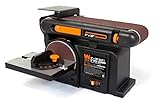
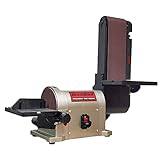
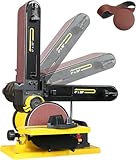

Best benchtop belt sanders of 2026
| Rank | Model | Belt and disc | Motor | Best for | Typical market range |
|---|---|---|---|---|---|
| 1 | WEN 6502T | 4 x 36 in belt, 6 in disc | 4.3 A | General woodworking and heavy stock removal | $140–$190 |
| 2 | RIKON 50-151 | 1 x 30 in belt, 5 in disc | 0.3 hp | Knife sharpening and small workpieces | $180–$240 |
| 3 | WEN 6515 | 1 x 30 in belt, 5 in disc | 2.3 A | Budget hobby use and detail shaping | $90–$130 |
| 4 | BUCKTOOL BD4603 | 4 x 36 in belt, 6 in disc | 4.3 A | Affordable larger-format sanding | $150–$220 |
Motor ratings and included accessories can vary by production run and seller, so treat the figures as buying benchmarks rather than a substitute for the current manual. The important differences are belt format, table support, tracking adjustment, and how securely the machine can be bolted to a bench.
1. WEN 6502T: best overall for woodworking
The WEN 6502T is the strongest all-purpose choice because its 4 x 36-inch belt provides substantially more working area than the 1 x 30-inch format. The longer belt spreads wear over a larger surface and gives you more room to flatten board edges, refine joinery, shape hardwood parts, and remove machining marks.
Its 6-inch sanding disc is useful for end grain, convex curves, and smaller pieces that are awkward on the belt. The belt table tilts for angled work, and the disc table provides a second reference surface. That belt-and-disc combination makes this belt sander machine more versatile than a dedicated narrow belt unit.
The compromises are size and vibration. A 4 x 36 machine occupies roughly 22 x 20 inches of bench area before allowing room for a workpiece. It should be bolted down, particularly when using coarse belts for aggressive stock removal. The supplied dust ports help, but a shop vacuum and a simple hood or adapter often capture more dust than the factory arrangement alone.
Choose it if:
- You routinely flatten edges or remove material from hardwood.
- You want both a belt and disc in one machine.
- You have a permanent bench location and can anchor the sander.
2. RIKON 50-151: best 1 x 30 for knives and small parts
The RIKON 50-151 is the more controlled option for knife sharpening, carving tools, pen blanks, small handles, and model-sized components. Its 1 x 30-inch belt is narrow enough to expose a manageable sharpening zone, while the 5-inch disc handles light edge and end-grain work.
A narrow belt does not automatically make sharpening safe or precise; technique matters more than the brand. Use a fine abrasive, light pressure, and frequent cooling in water when the steel requires it. A belt sander can remove metal surprisingly quickly, so a beginner should practice on inexpensive blanks before sharpening a valuable blade.
The RIKON’s main advantage over many inexpensive 1 x 30 belt sanders is a more useful small-shop layout and a sturdier feel. The disadvantage is capacity: the narrow belt can dig into a broad wooden surface, and it is inefficient for flattening large edges or removing a lot of material.
Choose it if:
- Knife sharpening is a primary use rather than an occasional task.
- Your bench is small or the sander must be stored between uses.
- You work on small wooden parts and value control over speed.
3. WEN 6515: best budget compact belt sander
The WEN 6515 offers the basic 1 x 30-inch belt and 5-inch disc combination at a lower entry price. It is a sensible first electric belt sander for light shaping, deburring, craft work, and occasional sharpening, especially when the machine will not run for long sessions.
Its value depends on realistic expectations. Light benchtop machines often transmit more vibration and require more frequent tracking adjustments than heavier equipment. They also have less thermal reserve, so pressing hard or sanding continuously can overheat the motor and shorten belt life.
For a first belt sander, reserve it for controlled passes rather than trying to replace a bandsaw, jointer, or large stationary sander. Clamp or bolt it to a rigid board, and clamp that board to the bench if permanent mounting is not practical. This inexpensive modification can improve stability more than upgrading a small motor.
4. BUCKTOOL BD4603: larger format on a moderate budget
The BUCKTOOL BD4603 belongs in the 4 x 36-inch class and combines the long belt with a 6-inch disc. It is appealing when you want larger-format capability but do not want to move immediately into a heavier industrial belt sander.
Its suitability depends on careful setup. Inspect the belt tracking before applying pressure, tighten the base to a rigid surface, and check that the tables are square to the abrasive. A machine in this class can remove material quickly, but an unstable base or poorly aligned table will produce tapered edges and frustrating results.
Compared with a compact 1 x 30 unit, the BD4603 is the better choice for furniture components, wide boards, and repeated edge work. Compared with a heavier professional machine, expect more vibration and less tolerance for continuous production use.
1 x 30 versus 4 x 36: which size should you buy?
| Decision factor | 1 x 30-inch belt | 4 x 36-inch belt |
|---|---|---|
| Abrasive contact area | Small, precise working zone | Longer surface for flattening and blending |
| Typical footprint | About 12 x 18 inches | About 20 x 22 inches |
| Best abrasive grits | 80–400 for detail and sharpening | 40–220 for stock removal and finishing |
| Typical task | Knife edges, handles, small parts | Board edges, furniture parts, hardwood shaping |
| Storage | Often portable enough for a shelf | Usually deserves a dedicated bench position |
Choose a 1 x 30 if your workpieces are small, sharpening is frequent, and available space is limited. Choose a 4 x 36 if you regularly need to remove visible amounts of wood. So-called 2-inch belt sanders sit between these categories, but they are less common in affordable benchtop belt-and-disc combinations; do not buy one merely because the belt is wider unless replacement belts are easy to source.
How to reduce tracking problems and vibration
- Mount the base. Use bolts, washers, and a rigid bench or a heavy plywood mounting plate. A loose machine makes every belt look poorly tracked.
- Center the belt by hand. Unplug the machine, rotate the belt several turns, and adjust the tracking knob in small increments.
- Run it unloaded. Switch on the sander briefly and observe whether the belt walks, the housing shakes, or the machine creeps across the bench.
- Square the tables. Check with a small machinist’s square. Even a two-degree error can become obvious along a long board edge.
- Use the correct pressure. Let fresh abrasive cut. Excess pressure flexes the belt, increases heat, and can pull the workpiece into an edge.
Tracking stability matters more on a 4 x 36 than on a 1 x 30 because a small alignment error is magnified across the longer belt. Vibration matters most when sharpening or sanding thin parts: it can create a wavy edge and encourages the operator to push harder.
Ownership costs and maintenance
A useful budgeting example is a machine used twice each month for three years: 24 uses per year multiplied by three equals 72 sessions. A $120 compact sander therefore costs about $1.67 per session before abrasives; a $200 machine costs about $2.78 per session. The larger machine may still be cheaper in practice if it saves time and uses longer-lasting 4 x 36 belts for your workload.
Belts are the first consumable to wear. Replace a glazed belt rather than compensating with pressure. Inspect the platen, platen graphite, drive wheel, and tracking mechanism periodically. Clean dust from cooling openings and the motor housing with vacuum suction or low-pressure air, and empty the dust collector before airflow becomes restricted.
Common mistakes include using a wood belt on steel, sharpening at high pressure until the edge turns blue, running without eye protection, and relying on a small dust port for fine dust control. Wear eye protection, keep loose clothing away from the belt, and disconnect power before changing abrasives.
Final verdict
Buy the WEN 6502T for the best balance of belt capacity, disc versatility, and general woodworking value. Choose the RIKON 50-151 when knife sharpening and small parts are the priority. Choose the WEN 6515 for inexpensive occasional use, and the BUCKTOOL BD4603 when you want a larger 4 x 36 format at a moderate price. The right choice is less about maximum motor power than matching belt size to the material you actually remove.