
What's inside
- 7 Best Oscillating Belt and Spindle Sanders of 2026
- Quick comparison of the seven leading choices
- The seven best oscillating belt and spindle sanders
- Match the sander to your space and workpiece
- How to choose the correct spindle diameter
- Setup and ownership details that affect results
- Final recommendation
- Related Guides
As an Amazon Associate I earn from qualifying purchases. This post may contain affiliate links at no extra cost to you.
7 Best Oscillating Belt and Spindle Sanders of 2026
The best oscillating belt and spindle sander for most home workshops is the Triton TSPS450, while the Jet JBOS-5 is the stronger choice for frequent professional use and the Grizzly G0529 offers the most substantial belt-and-spindle platform for a larger shop.
An oscillating belt and spindle sander combines a vertical sanding belt with interchangeable sanding spindles. The belt handles long, convex curves and inside edges; the spindles are better for tighter radii, cutouts, and smaller curved workpieces. The important buying differences are not simply motor power: belt length, included spindle diameters, oscillation stroke, and the amount of bench space each machine occupies determine whether a unit fits your work.
As an Amazon Associate we earn from qualifying purchases at no extra cost to you.
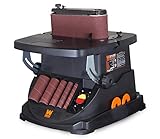
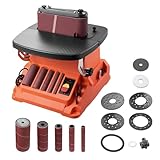


Quick comparison of the seven leading choices
| Model | Motor | Belt size | Included spindle diameters | Oscillation | Approx. footprint | Best suited to |
|---|---|---|---|---|---|---|
| Triton TSPS450 | 3.5 A | 4 x 24 in | 1/2, 3/4, 1, 1-1/2, 2 in | 5/8 in | 17 x 18 in | Home shops and mixed projects |
| Jet JBOS-5 | 1/2 hp | 3 x 24 in | 1/4, 1/2, 5/8, 1, 1-1/2, 2 in | 5/8 in | 17 x 19 in | Frequent, accurate production work |
| Grizzly G0529 | 1 hp | 6 x 48 in | 1/2, 3/4, 1, 1-1/2, 2 in | 1-1/2 in | 24 x 24 in | Large workpieces and heavy use |
| Shop Fox W1831 | 1/2 hp | 4 x 24 in | 1/2, 3/4, 1, 1-1/2, 2 in | 5/8 in | 17 x 19 in | Value-focused users |
| Rikon 50-300 | 1/2 hp | 4 x 24 in | 1/2, 3/4, 1, 1-1/2, 2 in | 5/8 in | 18 x 18 in | Furniture and cabinet parts |
| WEN HA24200 | 3.5 A | 4 x 24 in | 1/2, 3/4, 1, 1-1/2, 2 in | 5/8 in | 18 x 18 in | Occasional DIY use |
| Grizzly G1071 | 1/2 hp | 3 x 24 in | 1/2, 3/4, 1, 1-1/2, 2 in | 5/8 in | 20 x 18 in | Compact professional-style setups |
Dimensions are approximate machine footprints; allow additional clearance for dust collection, workpiece support, and belt access. Product packages and specifications can change, so confirm the current manual before ordering replacement accessories.
The seven best oscillating belt and spindle sanders
1. Triton TSPS450: best all-around choice
The Triton TSPS450 is the easiest recommendation for a general woodworking shop. Its 4 x 24-inch belt gives more usable sanding length than the narrower belt on many compact competitors, while five spindle sizes cover common template-routing and scroll-saw shapes. The 5/8-inch oscillation stroke helps distribute wear across the abrasive rather than grinding one narrow strip into the work.
Its footprint is manageable for a benchtop machine, but it is not genuinely portable once connected to dust collection. Choose it when you want one oscillating spindle sander and belt setup for occasional furniture, signs, brackets, and cabinet components.
2. Jet JBOS-5: best for repeated precision work
The Jet JBOS-5 is the premium benchtop oscillating spindle and belt sander in this group. Its 1/2-horsepower motor, cast-iron work surface, six spindle diameters, and positive table adjustments suit repeated work where predictable support matters more than the lowest purchase price.
The 3 x 24-inch belt is narrower than the Triton’s, but that can make it easier to control on smaller edges. The 1/4-inch spindle is particularly useful for compact inside curves that larger machines cannot reach cleanly. It is a strong match for a cabinetmaker or serious hobbyist who uses an oscillating belt spindle sander every week.
3. Grizzly G0529: best for large work and heavy use
The Grizzly G0529 is a floor-standing-style choice for users who need more capacity than a small benchtop oscillating spindle sander can provide. Its 6 x 48-inch belt gives substantially more contact area and a longer abrasive surface, and the 1-horsepower motor is better suited to sustained material removal.
The trade-off is clear: its roughly 24 x 24-inch footprint needs a dedicated location, and it is considerably less convenient to store. Select it for large hardwood components, frequent production, and broad curves—not for a small apartment workshop.
4. Shop Fox W1831: best value-oriented option
The Shop Fox W1831 follows the practical 4 x 24-inch belt and five-spindle format. It offers the core capability buyers usually want from an oscillating spindle sander and belt combination without moving into the larger floor-machine category.
It makes sense when your work involves occasional curved furniture parts, plywood templates, and small batches rather than daily production. Leave room around the 17 x 19-inch body: a compact footprint can become awkward if the machine is pushed against a wall and there is no space to guide a wide workpiece.
5. Rikon 50-300: best for furniture and cabinet components
The Rikon 50-300 provides a sturdy benchtop format with a 4 x 24-inch belt and five useful spindle diameters. Its approximately 18 x 18-inch footprint is relatively easy to accommodate, while the 1/2-horsepower motor gives it more reserve than the lightest DIY machines.
Consider it when smooth, repeatable edge preparation matters and the machine will remain assembled on a dedicated bench. It is a better fit for regular furniture work than for someone who needs to lift the sander onto a shelf after every project.
6. WEN HA24200: best for occasional DIY sanding
The WEN HA24200 is a sensible entry-level oscillating belt and spindle sander for users who need the basic functions at a lower general market price. It uses the familiar 4 x 24-inch belt, five spindle diameters, and a 5/8-inch oscillation stroke.
This model is most appropriate for softer woods, plywood, craft projects, and intermittent use. With a 3.5-amp motor, it is less attractive for forcing large hardwood pieces through long sanding sessions. Let the abrasive do the work and use short passes instead of applying heavy pressure.
7. Grizzly G1071: best compact shop-machine alternative
The Grizzly G1071 occupies a useful middle ground between lightweight DIY machines and larger dedicated sanders. Its 3 x 24-inch belt and five spindle sizes cover most curved-edge work, while the approximately 20 x 18-inch footprint remains feasible in a crowded shop.
Choose it when you want a more shop-oriented build and do not need the larger belt or 1-horsepower capacity of the G0529. The narrower belt rewards careful positioning, especially on wide workpieces where it is easy to sand an uneven track.
Match the sander to your space and workpiece
| Your situation | Most suitable choice | Why |
|---|---|---|
| Under 20 inches of bench depth | Triton TSPS450 or WEN HA24200 | Compact benchtop format with a useful 4 x 24-inch belt |
| Frequent hardwood and furniture work | Jet JBOS-5 or Rikon 50-300 | More substantial support and better repeatability |
| Large convex curves or wide panels | Grizzly G0529 | 6 x 48-inch belt and higher motor capacity |
| Occasional projects on a tight budget | WEN HA24200 or Shop Fox W1831 | Core belt-and-spindle capability without a large floor machine |
| Tight inside radii | Jet JBOS-5 | Includes a 1/4-inch spindle |
How to choose the correct spindle diameter
Match the spindle to the inside radius of the curve, not merely to the width of the workpiece. A smaller spindle reaches tighter concave curves; a larger spindle removes material faster and leaves a gentler radius. As a practical example, a 1/2-inch-diameter spindle has a 1/4-inch radius. If your cutout has an inside radius close to 1/4 inch, that spindle can follow it, whereas a 1-inch spindle cannot.
Keep at least two abrasive grits available. Start with 80 or 100 grit only when substantial material must be removed, then switch to 150 or 180 grit for a cleaner edge. Heavy pressure increases heat, loads the abrasive, and can make the curve less consistent.
Setup and ownership details that affect results
- Secure the machine. Bolt or clamp a benchtop unit before sanding. A machine that shifts changes the angle of the edge and creates chatter.
- Install the correct table insert and spacer. The insert should closely support the spindle without rubbing. Missing or incorrectly fitted spacers can allow abrasive contact with the metal table.
- Connect dust extraction. Fine sanding dust quickly clogs sleeves and belts. A shop vacuum may work for light use; a stronger collector is preferable for the larger Grizzly.
- Use light, moving pressure. Feed the workpiece steadily and keep it moving across the abrasive. Holding one spot in place can burn wood and wear a narrow groove in the sleeve.
- Clean before changing abrasives. Unplug the machine, brush dust from the table and belt path, and inspect the belt tracking. Replace belts when edges are torn, seams are lifting, or sanding becomes noticeably slower.
The consumables that usually wear first are sanding sleeves, belts, table inserts, and sometimes drive belts. Buying a machine with common 4 x 24-inch belts or widely available spindle sleeves can reduce downtime. Do not continue using a split sleeve: it can catch an edge and damage both the workpiece and the machine.
Final recommendation
For the broadest combination of capacity, accessory coverage, and reasonable shop size, choose the Triton TSPS450. Pick the Jet JBOS-5 if accuracy, build quality, and a small 1/4-inch spindle justify a higher general market price. Choose the Grizzly G0529 only when you have the floor space and genuinely need its larger belt and heavier-duty capacity. For occasional DIY work, the WEN HA24200 provides the essential oscillating spindle and belt functions without committing a large part of the workshop to one machine.