Key takeaways
- Cyclone dust collectors for cabinet makers compared, with verified separators and collectors for planer, saw and sander stations in cabinet production.
As an Amazon Associate I earn from qualifying purchases. This post may contain affiliate links at no extra cost to you.
As an Amazon Associate, we earn from qualifying purchases made through links on this page.
Cabinet production makes dust at industrial rhythm in a small-shop footprint: sheet goods on the saw all morning, solid stock through the planer, then hours of sanding before finishing. That mix is exactly what cyclone separation is for. The cyclone takes the chip volume and the bulk of the dust into a drum, the filter handles only fines, and — critically for production — airflow at the machines stays consistent from the first panel to the last.
This guide covers the verified cyclone path for cabinet shops: a full-size separator that converts or anchors a collector system, the vacuum-scale separator for the sanding bench, and a canister collector with cone separation that pairs naturally with the full-size cyclone. The emphasis is on system design for the three dust producers every cabinet shop runs.
What to Look For
- Size the blower to the biggest machine. The planer sets the airflow requirement. The collector behind the cyclone should be a 1-1/2 HP class or larger machine with 6-inch plumbing for the main run.
- Drum capacity for sheet-goods days. MDF and particleboard produce fine, heavy dust in volume. A drum that fills by lunch is a workflow problem; size the drum to a full day of your typical cutting.
- Protect the sander circuit separately. Sanding dust is the finest in the shop and the most damaging to filters. A vacuum-scale cyclone at the sanding bench keeps that stream out of the main system entirely.
- Filter as the final stage. With a cyclone ahead of it, a canister filter’s job shrinks to fine capture, and its cleaning interval stretches accordingly. That pairing — cyclone plus canister — is the production standard for small cabinet shops.
- Layout around the drum. The cyclone and drum need a service position: clearance to lift the lid, swap drums, and stage a spare. Design the corner before the equipment arrives.
- Blast gates and branch discipline. In a multi-machine cabinet shop, one open branch at a time keeps capture strong. Gates at each machine are part of the cyclone system, not accessories.
The Picks
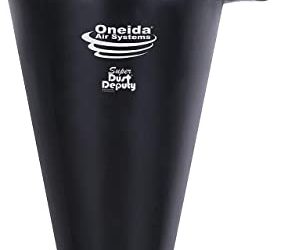
Oneida Air Systems Super Dust Deputy XL DIY Cyclone Separator
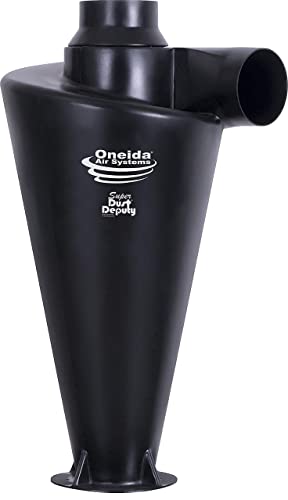
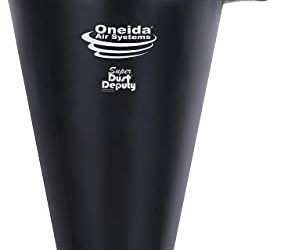
The Super Dust Deputy XL is the component that turns a single-stage collector into a two-stage system. Mounted on a drum between the tools and the collector, its cyclone spins the airstream so chips and the bulk of the dust fall into the drum; only the fine remainder reaches the collector’s filter. The 6-inch ports match the inlets on common 1-1/2 to 3 HP collectors, and the payoff is practical: filters stay cleaner far longer, airflow stays consistent, and emptying a drum is faster than wrestling a collector bag.
The Super Dust Deputy XL is the centerpiece conversion for a cabinet shop’s main collector: 6-inch ports for the primary run, drum collection for sheet-goods volume, and filter intervals that stop dictating the production schedule.
Key features and specifications (manufacturer):
- Type: cyclone separator only — pairs with an existing collector or vacuum blower
- Ports: 6-inch inlet and outlet for dust collector systems
- Separation: cyclonic action drops chips and most dust into your drum before the filter
- Construction: anti-static resin
- You supply: collection drum and the blower or collector it attaches to
Best for: Cabinet makers running a central collector for saw and planer stations.
Limitations to know: It is a separator, not a collector — it needs a blower or dust collector and a suitable drum to work, and it adds height and a hose bend to the layout that must be planned.
JET DC-1100VX-CK Vortex Cone Dust Collector (708659K)

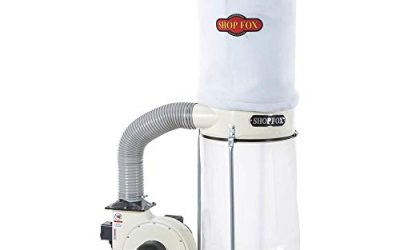
The DC-1100VX-CK pairs a 1,100 CFM single-stage blower with two upgrades that matter in daily use. The Vortex Cone sits in the collection chamber and helps spin chips down into the bag instead of up into the filter, which keeps airflow steadier between cleanings. The 2-micron canister filter offers far more filter area than a bag and can be cleaned with the built-in handle without removing it. Dual 4-inch inlets on a mobile base make it a strong one-collector answer for a small shop’s main machines.
The DC-1100VX-CK works as the collector behind the cyclone or as a standalone cone-assisted unit for a second zone, with a 2-micron canister suited to the fine fraction a cyclone passes.
Key features and specifications (manufacturer):
- Motor: 1-1/2 HP, 115/230V
- Airflow: 1,100 CFM
- Filtration: 2-micron canister filter with cleaning handle
- Vortex Cone design helps keep chips out of the filter area
- Inlet: 6-inch main inlet with dual 4-inch ports
- Collection bag capacity: 5.3 cubic feet
Best for: Cabinet shops building the cyclone-plus-canister pairing or adding a second collection zone.
Limitations to know: It is still a single-stage design, so abrasive chips pass through the impeller, and the canister needs periodic deep cleaning beyond the paddle handle when fine dust loading builds up.
Oneida Air Systems Dust Deputy 2.5 DIY Cyclone Separator

The Dust Deputy 2.5 applies the same two-stage idea at vacuum scale. Connected between a tool and a shop vacuum, the cyclone drops chips and dust into a bucket so the vacuum’s filter and bag see only a fraction of the load. For renovation-style work and cabinet shops alike, it is the standard way to keep a vacuum pulling strongly through a long sanding or routing session, and to make emptying a simple bucket swap instead of a filter cleaning.
The Dust Deputy 2.5 isolates the sanding bench: on a vacuum, it captures the finest stream in the shop at the source and keeps vacuum filters alive through finishing schedules.
Key features and specifications (manufacturer):
- Type: cyclone separator only — pairs with a shop vacuum or small extractor
- Ports: 2.5-inch connections for vacuum hoses
- Separation: cyclonic pre-separation protects vacuum filters and bags
- Construction: anti-static resin
- You supply: a bucket or drum and the vacuum
Best for: Cabinet shops with a dedicated sanding bench running vacuum-connected sanders and routers.
Limitations to know: Vacuum-scale airflow suits handheld tools and small benchtop machines; it cannot replace a true dust collector on a planer, jointer, or table saw, which need far higher CFM.
Quick Comparison
| Product | ASIN | Airflow | Motor | Format |
|---|---|---|---|---|
| Oneida Air Systems Super Dust Deputy XL DIY Cyclone Separator | B011DI6FE2 | Uses your collector | None (separator) | Drum-mounted cyclone |
| JET DC-1100VX-CK Vortex Cone Dust Collector | B004T86NAK | 1,100 CFM | 1-1/2 HP | Rolling |
| Oneida Air Systems Dust Deputy 2.5 DIY Cyclone Separator | B09W68X4HJ | Uses your vacuum | None (separator) | Bucket-mounted cyclone |
Frequently Asked Questions
Why do cabinet shops favor cyclones over single-stage collectors?
Production consistency. Sheet goods and planing fill filters fast on a single-stage machine, and suction decays through the day. A cyclone keeps the filter nearly clean, so capture at the saw and planer is the same at closing as at opening.
What drum size suits a cabinet shop cyclone?
Match it to a day of your heaviest cutting. Many small cabinet shops land on a drum in the mid-size range with a spare on hand, swapping drums instead of emptying during production.
Should the wide sander have its own collection?
Wide sanders produce heavy fine dust. On a shared system, give the sander its own gated branch and consider the vacuum-scale or a dedicated path for bench sanding tools, which produce the finest dust of all.
How does a cyclone change filter maintenance?
Dramatically. With bulk separation upstream, the canister or filter sees only fines, so cleaning intervals stretch from daily to occasional, and filter life extends with them.
Conclusion
Cabinet shops should think in systems: the Super Dust Deputy XL on the main run, the JET canister collector as its partner or a second zone, and the Dust Deputy 2.5 quarantining the sanding bench’s fine dust.
Related guides
More from Amazon
Programs that pair well with the guide above. Offers and eligibility are set by Amazon and may change.
A free business account with business pricing and bulk-buying tools for work, shop or home office.
Create a business accountFree shipping on eligible items, Prime Video and more. Eligible new members can start with a free trial.
Start a Prime free trialAudiobooks and podcasts to listen to on the go. Eligible new members can start with a free trial.
Try Audible freeAd-free music streaming. Eligible new subscribers can start with a free trial.
Try Music Unlimited freeAs an Amazon Associate we earn from qualifying purchases.