Our Top Picks

As an Amazon Associate I earn from qualifying purchases. This post may contain affiliate links at no extra cost to you.
As an Amazon Associate, we earn from qualifying purchases made through links on this page.
A dust extractor is not a small dust collector, and the distinction matters most exactly where HEPA enters the conversation. Extractors are high-pressure, lower-volume machines built for handheld and benchtop tools — sanders, routers, track saws, miter saws — and the certified HEPA models capture 99.97 percent of particles at 0.3 microns at the filter, with full-unit HEPA configurations designed so that fine dust stays in the machine instead of returning to the room.
The three extractors below are the verified certified-HEPA class for woodworking shops. They differ in capacity, airflow, and how they clean their filters — the three specs that decide which one fits a shop’s sanding and cutting rhythm. All offer tool-triggered auto-start, the feature that makes extraction actually happen on every cut.
What to Look For
- Certified HEPA, not HEPA-style. Look for a HEPA filter and a unit designed and rated as a HEPA system by the manufacturer. Marketing terms like ‘HEPA-type’ describe lesser filters and are not the same purchase.
- Filter cleaning system. Automatic filter cleaning — timed pulses that clear the filter during work — holds suction through long sanding sessions. Manual systems cost less attention only if you actually stop to clean them.
- Capacity versus your tools. Sanders fill extractors slowly; track saws and routers faster. Tank sizes here run about 7 to 9 gallons, which suits tool extraction duty; none of these replaces a collector for a planer.
- Airflow and suction control. Extractor airflow runs 130 to 150 CFM in this class. Variable suction matters for sanders: too much suction pins the pad and leaves swirl marks, so a dial is a finish-quality feature.
- Hose system. Antistatic hoses protect electronics and reduce dust cling. Check the hose diameter and the adapter ecosystem for your tool brands before choosing a platform.
- Auto-start outlet rating. Confirm the extractor’s tool outlet handles the amperage of your largest connected tool, typically a miter saw or large router.
The Picks
Festool CT 26 E HEPA Dust Extractor (583492)

The CT 26 E is the mid-size extractor in Festool’s CLEANTEC line and the reference design for tool-triggered extraction in a wood shop. Plug a sander, track saw, or router into its outlet and the extractor starts and stops with the tool; variable suction lets you dial back for small sanders so the pad stays planted. The 26-liter container, antistatic hose, and flat HEPA filter are sized for sanding-heavy work — the exact duty where fine dust control matters most — and Systainer cases dock on top so the extractor doubles as a tool cart.
The CT 26 E is the sanding specialist: variable suction for pad control, an antistatic hose, and a Systainer dock that turns the extractor into the sanding station’s base of operations.
Key features and specifications (manufacturer):
- Filtration: HEPA filter, certified full-unit HEPA configuration
- Capacity: 6.9 gallons (26 liters)
- Airflow: 137 CFM maximum
- Features: tool-triggered auto-start outlet, antistatic hose, variable suction control
- Storage: hose garage and Systainer dock on top
- Mobility: large wheels and locking casters
Best for: Woodworking shops whose HEPA need centers on sanding and track saw work.
Limitations to know: It is an extractor, not a dust collector: its high-pressure, low-volume airflow cannot serve a planer or table saw, and Festool hoses and bags are proprietary consumables to budget for.
Bosch VAC090AH 9-Gallon Dust Extractor with Auto Filter Clean and HEPA Filter
The VAC090AH posts the strongest airflow figure in this group — 150 CFM with 97 inches of static lift — and cleans its HEPA filter automatically every 15 seconds. Bosch includes a fleece filter bag, a power tool adapter nozzle, and a bend nozzle in the box, and the extractor rides on a wheeled metal frame that tolerates being moved around a shop daily. The power-tool activation outlet handles the auto-start role, so sanders and saws trigger extraction without a separate switch.
The VAC090AH posts the highest airflow in the group at 150 CFM and the fastest automatic cleaning cycle, suiting shops that run extractors hard across mixed tools all day.
Key features and specifications (manufacturer):
- Filtration: HEPA filter capturing 99.97 percent of particles at 0.3 microns (manufacturer specification)
- Capacity: 9 gallons
- Airflow: 150 CFM maximum, 97 inches of static water lift
- Filter cleaning: automatic cleaning every 15 seconds
- Features: power tool activation outlet, wheeled metal frame, fleece filter bag included
- Compliance: manufacturer rates the unit for OSHA silica dust requirements when configured as directed
Best for: Shops wanting maximum extractor airflow with automatic filter cleaning.
Limitations to know: The 9-gallon tank and extractor format share the category limit — this is fine-dust equipment for handheld and benchtop tools, not a planer or jointer solution — and HEPA replacement filters are a recurring cost to plan around.
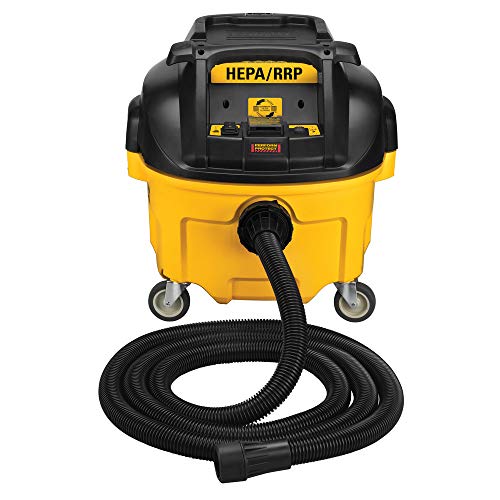
DEWALT DWV010 HEPA Dust Extractor with Automatic Filter Cleaning
The DWV010 builds its case on automatic filter cleaning: every 30 seconds the unit pulses its dual HEPA filters clean, which holds suction steady through long sanding and routing sessions without stopping to service a filter. The 8-gallon tank, 130 CFM airflow, tool-activated outlet, and a variable speed dial cover the standard extractor checklist, and DEWALT rates the unit for RRP lead-renovation work, which is why it also shows up on renovation sites. In a wood shop it pairs naturally with sanders, routers, and track saws.
The DWV010 pairs automatic filter cleaning with an 8-gallon tank and a variable speed dial, and its manufacturer RRP rating makes it the double-duty choice for shops that also do renovation work.
Key features and specifications (manufacturer):
- Filtration: HEPA filters, rated for lead paint renovation (RRP) work by the manufacturer
- Capacity: 8 gallons
- Airflow: 130 CFM
- Filter cleaning: automatic pulse cleaning every 30 seconds
- Features: tool-activated outlet, variable speed dial, 15-amp motor
- Hose: crush-resistant, with swiveling connections
Best for: Woodworkers who split time between shop projects and on-site renovation work.
Limitations to know: Tank capacity is mid-pack, so heavy chip-producing tools will fill it quickly — keep it on fine-dust duty, and note the automatic cleaning pulse is audible during quiet work.
Quick Comparison
| Product | ASIN | Capacity | Airflow | Filtration |
|---|---|---|---|---|
| Festool CT 26 E HEPA Dust Extractor | B003XWAZ9S | 6.9 gal | 137 CFM | HEPA |
| Bosch VAC090AH 9-Gallon Dust Extractor with Auto Filter Clean and HEPA Filter | B076CSZXY3 | 9 gal | 150 CFM | HEPA, auto-clean |
| DEWALT DWV010 HEPA Dust Extractor with Automatic Filter Cleaning | B00OA02TZ0 | 8 gal | 130 CFM | HEPA, auto-clean |
Frequently Asked Questions
What does certified HEPA mean on a dust extractor?
The unit’s filtration is rated to capture 99.97 percent of particles at 0.3 microns, and the machine is designed as a sealed HEPA system. That is the configuration referenced by workplace rules for tasks like lead renovation and silica dust control when the manufacturer rates the unit for them.
Can a HEPA extractor replace my dust collector?
No. Extractors move modest air volume at high pressure — right for tool ports on sanders and saws, wrong for the 4-inch ports of planers, jointers, and table saws, which need a collector’s high-volume airflow. Most shops run both.
Why does automatic filter cleaning matter for woodworking?
Sanding loads filters with exactly the fine dust that chokes suction. Automatic pulsing keeps airflow near its rating through a session, so capture at the sander does not fade as the filter loads.
Which tools in a wood shop belong on an extractor?
Random orbit and belt sanders, routers and router tables with small ports, track saws, miter saws, biscuit joiners, and Domino-style joinery tools — anything with a small port designed for vacuum extraction.
Conclusion
Choose by duty: the Festool for a sanding-centered shop, the Bosch for maximum airflow and cleaning frequency, and the DEWALT for a shop that also answers renovation calls. Any of the three gives a wood shop genuine HEPA capture where it matters most — at the tools that make the finest dust.
Related guides
More from Amazon
Programs that pair well with the guide above. Offers and eligibility are set by Amazon and may change.
A free business account with business pricing and bulk-buying tools for work, shop or home office.
Create a business accountFree shipping on eligible items, Prime Video and more. Eligible new members can start with a free trial.
Start a Prime free trialAudiobooks and podcasts to listen to on the go. Eligible new members can start with a free trial.
Try Audible freeAd-free music streaming. Eligible new subscribers can start with a free trial.
Try Music Unlimited freeAs an Amazon Associate we earn from qualifying purchases.