Key takeaways
- Find the best floor standing drum sanders for cabinet makers, with wide drums, stable stands, and steady feed control for doors, panels, and tabletops.
As an Amazon Associate I earn from qualifying purchases. This post may contain affiliate links at no extra cost to you.
Choosing the best floor standing drum sanders for cabinet makers starts with the work itself. Cabinet parts are wide, flat, and repeated. Doors, drawer fronts, side panels, and shelves all need the same thickness, the same flat surface, and the same clean edge to edge finish. A floor standing drum sander gives you a stable station for that work, with a stand that holds the machine steady, a conveyor that feeds panels at a controlled rate, and a drum wide enough to sand a cabinet door in one or two passes.


Cabinet makers also work in batches. A single kitchen can mean dozens of doors and drawer fronts in the same species and thickness. A benchtop machine can handle a few parts, but it slows down when the batch grows. A floor standing machine stays in one place, stays level, and stays ready, so you can move from one panel to the next without resetting the bench or clearing space. The best floor standing drum sanders for cabinet makers are built for that rhythm, with solid stands, reliable feed control, and dust ports that connect to a shop dust system.
Disclosure: As an Amazon Associate, we earn from qualifying purchases.
At a glance
| Product | Key spec | Best for |
|---|---|---|
| JET JWDS-1632 Drum Sander | 16-inch drum, 1-1/2 HP motor, 115V | Small cabinet shops and door parts |
| SuperMax 19-38 Drum Sander | 19-inch drum, 1-3/4 HP motor, 115V | Wide doors and panels up to 38 inches |
| Powermatic PM2244 Drum Sander | 22-inch drum, 1-3/4 HP motor, 115V | Large panels and full cabinet batches |
How to choose
Sanding width for doors and panels. Cabinet doors are often 18 to 24 inches wide, and side panels can be wider still. A 16-inch drum suits narrow doors and drawer fronts, while a 19-inch or 22-inch drum suits full-size doors and panels with fewer passes. Check the two-pass capacity as well, because an open-end machine can sand a panel twice as wide as its drum by flipping the panel between passes.
Stand stability and floor space. A floor standing sander needs a stand that does not rock, flex, or shift during a pass. Look for a steel stand with levelers, a wide footprint, and room for infeed and outfeed support. A closed stand adds stability and storage, while an open stand is lighter and easier to move. Measure the full footprint, including the space you need to walk around the machine and feed long panels.
Motor power and feed control. Cabinet work means long runs in hardwoods such as maple, oak, and cherry. A 1-1/2 HP or 1-3/4 HP motor suits that work when passes stay light, and a feed control that slows under load helps prevent burning on dense stock. Look for SandSmart, Intellisand, or Feed Logic style controls that adjust the conveyor when the drum load rises, and for a variable feed range that lets you slow down for figured grain.
Thickness accuracy and repeatability. Cabinet parts must match in thickness, or doors will sit unevenly and drawers will bind. Check how the height adjustment works, whether the table stays parallel to the drum, and whether the setting holds through a full batch. A digital readout or a clear scale helps when you return to the same thickness for a second batch of parts.
Dust handling for a cabinet shop. A floor standing drum sander creates a steady stream of fine dust, and a cabinet shop needs that dust out of the air and off the panels. A 4-inch dust port connects to most shop dust systems, and a hood that covers the drum well will keep dust from settling on finished parts. Check the airflow your dust system can supply, and keep the hose short and straight where possible.
Top picks
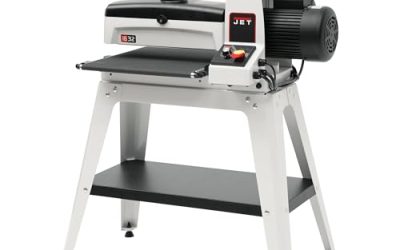
JET JWDS-1632 Drum Sander
Key specs: 16-inch drum with 32-inch two-pass capacity; 1-1/2 HP motor; 115V single-phase power; SandSmart auto-feed control; infinitely variable feed up to 10 FPM; extruded aluminum drum; 4-inch dust port; steel stand included; 80-grit abrasive pre-installed.
Best for: Small cabinet shops and makers who sand doors and drawer fronts up to 16 inches wide in one pass, with a compact floor footprint.
Considerations: The 16-inch width means wide panels need two passes, so plan the flip carefully to avoid a visible line in the middle of a panel. The 1-1/2 HP motor suits light passes in hardwood, and heavier cuts can slow the feed or load the drum. Add infeed and outfeed tables if you sand long panels often, and check that your dust system can keep up with a full day of cabinet parts.
SuperMax 19-38 Drum Sander
Key specs: 19-inch drum with 38-inch two-pass capacity; 1-3/4 HP motor; 115V single-phase power; Intellisand feed control; drum speed 1740 RPM; maximum thickness 4 inches; minimum thickness 1/32 inch; 4-inch dust port; open stand included.
Best for: Cabinet makers who sand wide doors and panels, and who want a 19-inch drum that covers most cabinet parts in one pass.
Considerations: The open stand is lighter than a closed stand, so level the machine carefully and check that it stays steady on your shop floor. The 1-3/4 HP motor needs a 15 amp circuit and a strong dust system, and the 19-inch drum needs room for infeed and outfeed support on wide panels. Keep the conveyor bed clean and flat, because a cabinet panel will show any unevenness in the table as a variation in thickness.
Powermatic PM2244 Drum Sander
Key specs: 22-inch drum with 44-inch two-pass capacity; 1-3/4 HP motor; 115V single-phase power; Feed Logic feed control; LED control panel; closed stand with integrated casters; extension tables included; 4-inch dust port; maximum thickness 4 inches.
Best for: Larger cabinet shops and makers who sand full-size doors, side panels, and tabletops in batches, with a stable closed stand.
Considerations: This is a large, heavy machine that needs a permanent floor station, a clear infeed and outfeed path, and a dust system that can serve a 22-inch drum through a full batch. The closed stand adds stability, but it also adds weight and footprint, so measure doorways and turning space before delivery. The LED panel and Feed Logic control are useful, but they work best when you learn the settings on test boards before sanding finished cabinet parts.
Which one fits your shop
If your cabinet doors are usually 16 inches wide or less, the JET JWDS-1632 gives you a compact floor standing station with SandSmart feed control and a manageable footprint. If your doors run wider and you want to sand most panels in one pass, the SuperMax 19-38 gives you a 19-inch drum and Intellisand control in a similar 115V package. If you build full-size cabinets in batches and need the widest drum and the most stable stand, the Powermatic PM2244 gives you a 22-inch drum, a closed stand, and extension tables for long panels.
FAQ
What width do I need for cabinet doors?
Most cabinet doors are 18 to 24 inches wide, so a 19-inch or 22-inch drum covers many doors in one pass. A 16-inch drum can still sand a wider door in two passes by flipping the panel, but that adds handling and a risk of a visible line. Measure your most common door width and choose a drum that covers it, or a two-pass capacity that covers it comfortably.
How do I keep cabinet parts at the same thickness?
Sand parts in batches at one height setting, and check thickness with calipers at several points on each part. Take light passes, keep the feed steady, and do not change the height setting between parts in the same batch. Clean the conveyor and check parallelism often, because dust or a shifted table can change thickness across a panel.
What grit sequence works well for cabinet parts?
Start with a coarse grit to remove planer marks and bring parts close to final thickness, then move to a medium grit for general smoothing, and finish with a fine grit for the final surface. Change grits when the abrasive stops cutting cleanly, and sand all parts in a batch through the same grit sequence so the finish matches across doors and drawer fronts.
Bottom line
The best floor standing drum sanders for cabinet makers match width, stability, and feed control to the doors and panels you build every week. The JET JWDS-1632 suits smaller shops and narrower doors, the SuperMax 19-38 suits wide doors and panels up to 38 inches in two passes, and the Powermatic PM2244 suits large batches and full-size cabinet parts. Measure your usual door width, check your circuit and dust system, and choose the floor standing machine that fits your shop layout and your cabinet work. A stable, well-fed drum sander will bring cabinet parts to an even thickness with less hand sanding and a cleaner finish.
Related guides
More from Amazon
Programs that pair well with the guide above. Offers and eligibility are set by Amazon and may change.
A free business account with business pricing and bulk-buying tools for work, shop or home office.
Create a business accountFree shipping on eligible items, Prime Video and more. Eligible new members can start with a free trial.
Start a Prime free trialAudiobooks and podcasts to listen to on the go. Eligible new members can start with a free trial.
Try Audible freeAd-free music streaming. Eligible new subscribers can start with a free trial.
Try Music Unlimited freeAs an Amazon Associate we earn from qualifying purchases.