Key takeaways
- Compare the best benchtop drill presses for trade training workshops, with durable cast iron builds, repeatable depth stops and class-friendly speed ranges.
What's inside
As an Amazon Associate I earn from qualifying purchases. This post may contain affiliate links at no extra cost to you.
A drill press in a trade training workshop lives a harder life than one in a home garage. A different student switches it on every hour, and it has to produce the same hole depth on Friday afternoon that it produced on Monday morning. The SKIL DP9505-00 leads this list because its 6.2-amp induction motor, bump-off safety switch and three-year warranty suit shared equipment, while the WEN 4210T follows closely with a cast iron build and laser guide that help new learners line up work quickly.
This guide is for trade school instructors equipping a row of identical stations, training centre managers replacing worn machines, and workshop leads teaching evening classes. Every pick was chosen from its Amazon listing title and stated specifications, emphasising durability, repeatable depth control, chuck capacity and speed changes a class can manage without an instructor at every bench.
Quick Picks
As an Amazon Associate we earn from qualifying purchases.
| Product | Best for | Key spec |
|---|---|---|
| SKIL DP9505-00 10-Inch 5-Speed Drill Press — ASIN: B0BFQYZPQK — https://www.amazon.com/dp/B0BFQYZPQK | Busy shared training stations | 6.2-amp induction motor, 610 to 2,800 RPM |
| WEN 4210T 10-Inch Cast Iron Drill Press with Laser — ASIN: B07MSJST4R — https://www.amazon.com/dp/B07MSJST4R | Demonstrations and guided practice | Cast iron build with crosshair laser guide |
| WEN 4208T 8-Inch 5-Speed Benchtop Drill Press — ASIN: B08ZVT5JKC — https://www.amazon.com/dp/B08ZVT5JKC | Introductory classes and tight benches | Compact 8-inch swing, 2.3-amp motor |
How to Choose
Durability for shared, daily use
Training machines are handled by beginners who overtighten chucks and forget to switch off. Cast iron tables and bases resist that treatment better than thin stamped parts, and an induction motor has no brushes for a maintenance schedule to track. A warranty term stated in the listing is worth weighing, since longer coverage signals the maker expects the machine to survive institutional use.
Repeatability of depth and position
A class exercise only works if twenty students can produce twenty matching holes. An adjustable depth stop lets an instructor set one drilling depth for the whole group, and a laser guide or work light reduces the alignment errors that waste material and lesson time.
Chuck capacity and swing
Most training work in wood and light metal uses bits up to 1/2 inch, so a 1/2-inch keyed chuck covers standard coursework. Swing — twice the distance from spindle centre to column — decides how wide a board can be drilled at its centre. A 10-inch swing handles typical project boards; an 8-inch swing suits smaller exercises.
Speed changes a class can handle
Belt-driven speed changes teach students how spindle speed relates to bit diameter and material, itself a lesson objective. Five speeds spanning roughly 600 to 3,100 RPM cover small twist bits in metal through to larger bits in timber. The trade-off is time: every belt move is a pause, so group exercises by speed where the timetable allows.
The 3 Best Options
SKIL DP9505-00 10-Inch 5-Speed Benchtop Drill Press — OUR TOP PICK
The SKIL DP9505-00 pairs the strongest motor in this group with the safety details a training environment needs. Its 6.2-amp induction motor drives five belt-selected speeds from 610 to 2,800 RPM, and the listing highlights a bump-off switch that stops the machine with a quick strike, a crosshair laser and an LED work light. The cast iron table tilts 45 degrees each way for angled coursework, and the stated three-year warranty is the longest coverage here.
Specs
- Motor: 6.2-amp induction
- Speeds: 5, from 610 to 2,800 RPM
- Swing: 10 inches
- Chuck: 1/2-inch keyed
- Spindle travel: 2 inches
- Table: cast iron, tilts 45 degrees left and right
- Guides: laser alignment system and LED work light
- Switch: bump-off safety switch
- Warranty: three-year, per the listing
Best for: High-turnover training stations where one machine serves several classes a day and safety controls matter as much as drilling power.
Watch out for: The 610 RPM floor is not slow enough for very large diameter cutters in metal, and the 1/2-inch chuck caps the bit sizes an advanced class can use.
WEN 4210T 10-Inch Cast Iron Drill Press with Laser
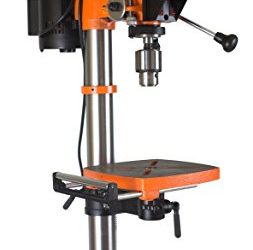
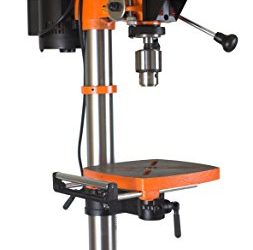
The WEN 4210T is built around a cast iron frame that shrugs off the knocks of a teaching workshop, and its crosshair laser gives students a visible target while they learn to position work under the bit. The specification label lists a 3.2-amp motor and a speed range of 600 to 3,100 RPM, the widest span here, helping one machine cover both slow metal exercises and faster wood boring across a syllabus.
Specs
- Motor: 3.2-amp
- Speeds: 600 to 3,100 RPM, belt selected
- Swing: 10 inches
- Construction: cast iron base, table and head housing
- Guide: built-in laser
- Display: digital RPM readout shown in listing images
Best for: Instructor-led demonstrations and mixed wood-and-metal coursework where the speed setting itself is part of the lesson.
Watch out for: The 3.2-amp motor gives up torque to the SKIL under heavy feed pressure, so large bits in dense hardwood need a gentler hand.
WEN 4208T 8-Inch 5-Speed Benchtop Drill Press
The WEN 4208T is the compact option for training rooms where bench space is shared with other tools. Its listing describes a 2.3-amp, 8-inch, five-speed cast iron benchtop press that fits on a standard workbench and can be moved between classrooms by one person. For introductory modules — layout, centre punching, pilot holes and small project work — the smaller swing rarely limits the exercise, and the simple belt layout keeps the first lesson focused on technique rather than machine setup.
Specs
- Motor: 2.3-amp
- Speeds: 5, belt selected
- Swing: 8 inches
- Construction: cast iron benchtop design
- Format: compact benchtop, movable between benches
Best for: Beginner modules, mobile training setups and satellite benches where a full 10-inch press will not fit.
Watch out for: The 8-inch swing restricts centre drilling on wider boards, and the smaller motor is aimed at light coursework rather than production drilling.
Which One Fits Your Situation
- Equipping a full row of student stations: Choose the SKIL DP9505-00. The bump-off switch, strong induction motor and longer warranty suit machines that many hands use every day.
- Teaching mixed wood and metal units from one bench: Choose the WEN 4210T. Its 600 to 3,100 RPM span and laser guide support demonstrations across both materials.
- Running an introductory course in a multipurpose room: Choose the WEN 4208T. It stores and moves easily, and its capacity matches beginner exercises.
- Setting one depth for an entire class exercise: The SKIL’s combination of depth stop, laser and work light makes group consistency easiest to supervise.
Common Mistakes
- Buying the smallest press for a whole programme, then finding the swing too narrow for second-year project boards.
- Ignoring the lowest available speed, which decides whether larger bits can run safely in metal and dense hardwood.
- Skipping a depth stop check, so student work varies in depth and assessment becomes inconsistent.
- Placing a benchtop press on a wobbly stand; vibration in training rooms usually traces back to the bench, not the machine.
- Forgetting chuck key storage, which leads to keys left in chucks — a basic safety point every training workshop should design out.
Frequently Asked Questions
How many speeds does a training workshop drill press need?
Five speeds covering roughly 600 to 3,100 RPM handle the standard training range, from small bits in metal to mid-size bits in timber. More important than the count is that students can change speeds quickly and an instructor can verify the setting at a glance.
Is a laser guide worth it for teaching?
A laser crosshair shortens the alignment stage of every exercise and reduces wasted material, which matters when a class repeats the same setup many times. It supports, but does not replace, teaching proper layout and centre punching.
What chuck size suits coursework?
A 1/2-inch keyed chuck covers the twist bits, brad points and small hole saws used in most trade training modules. Programmes that add large Forstner bits or metal hole cutters should confirm the chuck and spindle travel before ordering.
Can one benchtop press serve both wood and metal classes?
Yes, provided the speed range reaches low enough for metal and the table stays rigid under feed pressure. The picks above all span speeds suitable for both, with the SKIL and WEN 4210T giving the most headroom for shared timetables.
A training workshop press earns its place by surviving beginners while still drilling true. Match swing and chuck to the coursework, favour cast iron construction and a clear depth stop, and these machines will carry a class schedule without constant supervision.
Related guides
More from Amazon
Programs that pair well with the guide above. Offers and eligibility are set by Amazon and may change.
A free business account with business pricing and bulk-buying tools for work, shop or home office.
Create a business accountFree shipping on eligible items, Prime Video and more. Eligible new members can start with a free trial.
Start a Prime free trialAudiobooks and podcasts to listen to on the go. Eligible new members can start with a free trial.
Try Audible freeAd-free music streaming. Eligible new subscribers can start with a free trial.
Try Music Unlimited freeAs an Amazon Associate we earn from qualifying purchases.