Key takeaways
- Find the best quiet shop air compressors for woodworking shops, with low decibel figures, oil-free pumps and tanks sized for nailers and sanders.
What's inside
As an Amazon Associate I earn from qualifying purchases. This post may contain affiliate links at no extra cost to you.
Key takeaways
- A quiet shop compressor pairs a low decibel figure with enough airflow at 90 PSI for the tools, and the quietest units here run at 56 to 60 dBA while still covering nailers and light sanding.
Noise is the hidden drawback of a shop compressor. A loud pump that cycles all day wears down everyone in the shop, and in a small or shared space it can make fine work hard to concentrate on. Quiet compressors use slower, oil-free pumps and better sound control to cut the noise figure, and the best of them still deliver enough airflow for real woodworking tools.
The five compressors below run from 56 dBA to 70 dBA, and they range from a 1-gallon portable unit to a 20-gallon stationary tank. They differ in airflow and tank size as well as noise, so the right pick balances quiet operation against the tools that need air. Check the noise figure on the listing and match the airflow at 90 PSI to the hungriest tool.
Quick Picks
As an Amazon Associate, we earn from qualifying purchases.
| Product | Best for | Key spec |
|---|---|---|
| California Air Tools 8010 | Quiet work with a useful tank | 60 dBA, 8-gallon tank |
| California Air Tools 1P1060S | The quietest unit here | 56 dBA, 1-gallon tank |
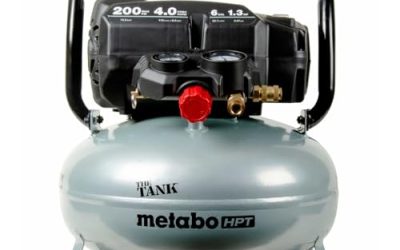
| Metabo HPT EC28M | Quiet portability for trim work | 59 dB, 1-gallon tank, 25.2 lb |
| California Air Tools 10020C | Quiet airflow for a mid-size shop | 70 dBA, 5.30 CFM at 90 PSI |
| California Air Tools 20020 | Quiet airflow for a large shop | 70 dB, 5.30 CFM at 90 PSI |
How to Choose
The decibel figure and what it means
The noise figure on the listing, measured in dB or dBA, is the way to compare quiet compressors. A 60 dBA unit is noticeably quieter than a 70 dBA unit, and a 56 dBA unit is quieter still. Small differences in the figure mean large differences in how loud the pump sounds in the shop, so treat a 10 dBA gap as a real change, not a rounding error. Check whether the figure is measured at a stated distance, since the same pump reads differently at different distances.
Airflow at 90 PSI for woodworking tools
A quiet compressor is only useful if it can feed the tools. Nailers sip air, while a random orbital sander can need several CFM at 90 PSI on a continuous basis. Compare every compressor on its airflow at 90 PSI and match it to the tool that runs longest. The quietest 1-gallon units suit nailers and blow-off work, while the 10-gallon and 20-gallon units here deliver 5.30 CFM at 90 PSI and cover a sander as well.
Tank size and motor cycles
A larger tank means fewer motor cycles, and fewer motor cycles mean less noise through the day. A 20-gallon tank gives a sander long stretches of work between recovery cycles, while a 1-gallon tank needs the motor to cycle often under the same tool. For a shop where the compressor sits in one spot, a larger tank is almost always worth the floor space. For trim work and jobsites, a small tank and light weight matter more than capacity.
Oil-free pumps and low noise
Most quiet compressors use oil-free pumps, which run clean and need no oil changes. The slower pump speed that keeps noise down also limits airflow, which is why the quietest units here have the lowest CFM figures. Check the pump life figure on the listing as well: a pump with a 3,000-hour or longer stated life is built for regular shop use, while a shorter figure suits lighter, intermittent work.
The 5 Best Options
1. California Air Tools 8010

OUR TOP PICK
The 8010 runs at 60 dBA, which makes it one of the quietest compressors in this guide, and it pairs that with an 8-gallon steel tank on wheels. Its oil-free pump runs at 1.0 HP with a 2.0 HP peak, delivers 3.10 CFM at 40 PSI and 2.20 CFM at 90 PSI, and holds a 120 PSI maximum pressure. At 48 lb and 26 x 14 x 23 in, it moves easily between benches.
It is the best balance in this guide between quiet operation and useful capacity: quiet enough for indoor trim work and finished spaces, with a tank large enough to run a nailer for long stretches without constant motor cycles. The airflow is lower than the 10-gallon and 20-gallon units below, so it is not the pick for a sander that runs all day.
- Specs:
- Tank: 8 gallons, steel
- Motor: 1.0 HP running, 2.0 HP peak, 110V, 8.5A
- Airflow: 3.10 CFM at 40 PSI, 2.20 CFM at 90 PSI
- Maximum pressure: 120 PSI
- Noise: 60 dBA
- Pump: oil-free
- Weight: 48 lb
- Dimensions: 26 x 14 x 23 in
- Wheels: yes
- Best for: quiet work with a useful tank
- Watch out for: a stale cached listing once showed no featured listings and strong recent demand at the same time, so confirm availability on the live listing
2. California Air Tools 1P1060S

The 1P1060S is the quietest compressor in this guide at 56 dBA. Its 1-gallon steel tank and 0.6 HP oil-free pump deliver 1.20 CFM at 90 PSI in a lightweight portable unit built for small jobs. It is made for intermittent use: a brad nailer, a stapler, tire inflation and blow-off work where the tank refills between short bursts.
It suits a shop that needs a near-silent compressor for light tasks, or a second compressor that stays beside a bench for trim work while a larger unit handles the heavy tools. The small tank and low airflow mean it cannot feed a sander or a spray gun.
- Specs:
- Tank: 1 gallon, steel
- Motor: 0.6 HP
- Airflow: 1.20 CFM at 90 PSI
- Noise: 56 dBA
- Pump: oil-free
- Portability: lightweight and portable
- Best for: the quietest unit here
- Watch out for: the small tank and low airflow suit intermittent nailer work only, not continuous-draw tools
3. Metabo HPT EC28M

The EC28M runs at 59 dB in a 1-gallon oil-free unit that weighs 25.2 lb and measures 14 x 14 x 13.5 in. Its 0.5 HP motor draws 2.8A on 120V, delivers 1.3 CFM at 40 PSI and 0.8 CFM at 90 PSI, and holds a 125 PSI maximum pressure. A universal quick coupler speeds tool changes, and a steel roll cage and rubber handle protect the unit in transit.
It is built for trim work and jobsites where portability matters more than stored air. The quiet operation suits indoor work in finished spaces, and the roll cage makes it easy to carry between rooms. Like the 1P1060S, it suits intermittent nailing rather than continuous airflow work.
- Specs:
- Tank: 1 gallon
- Motor: 0.5 HP, 120V, 2.8A
- Airflow: 1.3 CFM at 40 PSI, 0.8 CFM at 90 PSI
- Maximum pressure: 125 PSI
- Noise: 59 dB
- Pump: oil-free
- Weight: 25.2 lb
- Dimensions: 14 x 14 x 13.5 in
- Coupler: universal quick coupler
- Best for: quiet portability for trim work
- Watch out for: the 1-gallon tank limits stored air, so sustained high-demand tools will outrun it
4. California Air Tools 10020C

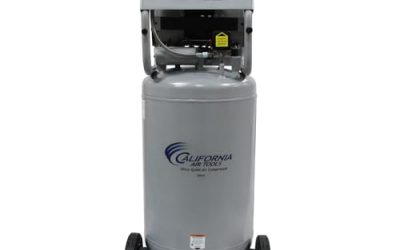
The 10020C runs at 70 dBA, which is louder than the small units above but still quiet for a compressor that delivers 5.30 CFM at 90 PSI. Its 10-gallon steel tank and 2.0 HP oil-free dual-piston pump deliver 6.40 CFM at 40 PSI and 5.30 CFM at 90 PSI, with a 125 PSI maximum pressure, on 110V at 14A. It weighs 82.5 lb.
It suits a mid-size shop that wants real airflow without the noise of an oil-lubricated stationary unit. The 5.30 CFM at 90 PSI covers a sander and a nailer together, and the 10-gallon tank keeps motor cycles reasonable under that load.
- Specs:
- Tank: 10 gallons, steel
- Motor: 2.0 HP, 110V, 14A
- Airflow: 6.40 CFM at 40 PSI, 5.30 CFM at 90 PSI
- Maximum pressure: 125 PSI
- Noise: 70 dBA
- Pump: oil-free, dual-piston
- Weight: 82.5 lb
- Best for: quiet airflow for a mid-size shop
- Watch out for: a third-party seller fulfilled a recent listing check, so confirm the seller on the live listing
5. California Air Tools 20020

The 20020 is the largest compressor in this guide, and it runs at 70 dB while delivering the same 5.30 CFM at 90 PSI as the 10020C. Its 20-gallon steel tank and 2 HP oil-free dual-piston pump deliver 6.40 CFM at 40 PSI, hold a 125 PSI maximum pressure, and run on 110V. Wheels make the 114 lb unit movable around the shop.
The large tank means long stretches between motor cycles, so the shop hears the pump less often through the day even though the noise figure matches the 10-gallon unit. It suits a large shop that wants strong airflow and fewer motor cycles.
- Specs:
- Tank: 20 gallons, steel
- Motor: 2 HP, 110V
- Airflow: 6.40 CFM at 40 PSI, 5.30 CFM at 90 PSI
- Maximum pressure: 125 PSI
- Noise: 70 dB
- Pump: oil-free, dual-piston
- Weight: 114 lb
- Wheels: yes
- Best for: quiet airflow for a large shop
- Watch out for: 114 lb is heavy to lift, so use the wheels and plan a floor spot for it
Which One Fits Your Situation
A small shop where quiet matters most
Pick the California Air Tools 8010. At 60 dBA with an 8-gallon tank on wheels, it is quiet enough for indoor work and large enough to run a nailer for long stretches without constant motor cycles.
Trim work in finished spaces
Pick the Metabo HPT EC28M or the California Air Tools 1P1060S. The EC28M runs at 59 dB and weighs 25.2 lb with a roll cage, while the 1P1060S runs at 56 dBA in a 1-gallon unit. Both suit intermittent nailing and light work where portability matters.
A mid-size shop with sanders and nailers
Pick the California Air Tools 10020C. Its 5.30 CFM at 90 PSI covers a sander and a nailer together, and its 70 dBA noise figure is quiet for a compressor with that much airflow.
A large shop that wants fewer motor cycles
Pick the California Air Tools 20020. Its 20-gallon tank gives the longest stretches between motor cycles in this guide, so the pump runs less often through the day.
Common Mistakes
- Picking the quietest compressor without checking its airflow, then finding it cannot feed a sander.
- Comparing noise figures measured at different distances as if they were the same, which makes a loud pump look quiet.
- Running a 1-gallon compressor on a continuous-draw tool, which drains the tank and forces the motor to cycle constantly.
- Placing the compressor next to a bench where fine work happens instead of placing it where the noise bothers the shop least.
- Ignoring the pump life figure and buying a light-duty quiet pump for daily shop use.
Frequently Asked Questions
How quiet is a quiet shop compressor?
The quietest units in this guide run at 56 to 60 dBA, which is quiet enough for normal conversation nearby while the pump runs. A 70 dBA unit is noticeably louder but still quiet for a compressor that delivers more than 5 CFM at 90 PSI. Compare the noise figure on the listing and check whether it states a measurement distance.
Can a quiet compressor run a sander?
It depends on airflow, not noise. The 10-gallon and 20-gallon units in this guide deliver 5.30 CFM at 90 PSI, which covers a random orbital sander. The 1-gallon units deliver 0.8 to 1.2 CFM at 90 PSI, which suits nailers and blow-off work only. Match the airflow at 90 PSI to the tool, not the decibel figure.
Why are quiet compressors usually oil-free?
Quiet compressors use slower, oil-free pumps with better sound control, and oil-free pumps also keep the air clean for finishes. The trade is airflow and pump life: an oil-free pump usually delivers less airflow and has a shorter stated service life than an oil-lubricated pump of the same size.
Does a bigger tank make a compressor quieter?
Not directly. A bigger tank means the motor cycles less often, so the shop hears the pump less often through the day, but the noise figure while the pump runs stays the same. Tank size cuts how often the noise happens, while the pump design cuts how loud it is.
Final Thoughts
For a woodworking shop that values quiet operation, the California Air Tools 8010 is the best balance of low noise and useful capacity, the 1P1060S is the quietest unit here, and the 10020C and 20020 bring real airflow at 70 dBA. Pick the unit whose airflow at 90 PSI covers the tools that run together, confirm the seller and availability on the live listing, and place the compressor where its noise bothers the shop least.
Related guides
- 5 Best Triple-Output Bench Power Supplies for Engineering Workbenches (November 2026)
- 5 Best Programmable DC Bench Power Supplies for Engineering Workbenches (November 2026)
- 5 Best Pancake Air Compressors for Woodworking Shops (November 2026)
- 5 Best Oil-Lubricated Shop Air Compressors for Woodworking Shops (November 2026)
More from Amazon
Programs that pair well with the guide above. Offers and eligibility are set by Amazon and may change.
A free business account with business pricing and bulk-buying tools for work, shop or home office.
Create a business accountFree shipping on eligible items, Prime Video and more. Eligible new members can start with a free trial.
Start a Prime free trialAudiobooks and podcasts to listen to on the go. Eligible new members can start with a free trial.
Try Audible freeAd-free music streaming. Eligible new subscribers can start with a free trial.
Try Music Unlimited freeAs an Amazon Associate we earn from qualifying purchases.