Key takeaways
- Find the best linear bench power supplies for engineering workbenches, with clean low-ripple output, fine resolution and steady voltage for sensitive work.
What's inside
As an Amazon Associate I earn from qualifying purchases. This post may contain affiliate links at no extra cost to you.
Key takeaways
- A linear bench supply trades efficiency for a clean, low-ripple output, and the best ones pair that clean output with fine display resolution and steady voltage under load.
A linear power supply regulates its output with a pass element rather than switching, which gives it a cleaner output with less ripple and less electrical noise than a switching supply. That clean output matters for sensitive analog circuits, audio work and precision measurement, where ripple on the supply rail can show up in the result. The trade is size, weight and heat: linear supplies are heavier and less efficient than switching supplies of the same power.
The five supplies below are all linear designs, and they range from a single-output 30V unit to a triple-output unit with two variable channels and a fixed channel. They differ in output count, resolution and ripple, so the right pick depends on whether the bench needs one clean channel or several, and how fine the display needs to be. Check the ripple figure and the regulation type on the listing before choosing.
Quick Picks
As an Amazon Associate, we earn from qualifying purchases.
| Product | Best for | Key spec |
|---|---|---|
| Siglent SPD3303X-E | Three linear outputs in one unit | 2 x 0 to 32V plus a fixed 5V channel, 220W |
| Siglent SPD3303X | Three outputs with fine resolution | 1 mV and 1 mA resolution, 220W |
| Korad KA3005P | A single linear output with remote control | 0 to 30V, 0 to 5A, 150W |
| Korad KD3005D | A single linear output without remote control | 0 to 30V, 0 to 5A, 150W |
| Dr.meter PS305DM | A single linear output with CV and CC modes | 0 to 30V, 0 to 5A, 150W |
How to Choose
Ripple and output cleanliness
Ripple is the small AC variation left on a DC output, and it is the main reason to choose a linear supply. The ripple figure on the listing, measured in mVrms or mVpp, is the way to compare: a unit with ripple of 1 mVrms or less gives a cleaner rail than one with ripple of 2 mVrms. For sensitive analog work, pick the lowest ripple figure the bench can afford, and check whether the figure is stated for constant voltage and constant current modes separately.
Single or multiple outputs
A single-output supply feeds one load at a time, which suits most benches. A triple-output supply feeds two variable channels and a fixed channel at once, which suits circuits that need two rails plus a logic supply, or a bench that powers two loads without a second unit. The Siglent units in this guide carry three outputs with independent, series and parallel modes, so two channels can combine into one higher-voltage or higher-current output when needed.
Display resolution and control
A display that reads to 1 mV and 1 mA lets the bench set voltage and current far more precisely than one that reads to 10 mV and 1 mA. Coarse and fine controls help too, because they let the user move in large steps and then dial in the last few millivolts. Check the resolution on the listing and match it to the work: precision analog circuits need fine resolution, while general bench work is fine with a coarser display.
Programmable or manual
Some linear supplies carry USB and RS232 interfaces for computer control, while others are manual-only. The Korad KA3005P is programmable through USB and RS232, while the Korad KD3005D is not, even though the two share the same output range and display. Decide before ordering whether the bench needs remote control: a programmable unit suits automated tests, while a manual unit suits practical work where the knobs are the interface.
The 5 Best Options
1. Siglent SPD3303X-E
OUR TOP PICK
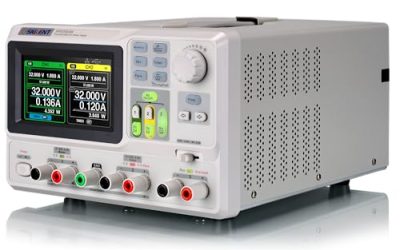
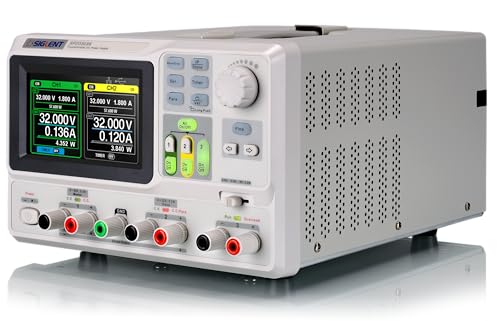
The SPD3303X-E is a triple-output linear supply that carries two variable channels of 0 to 32V at up to 3.2A each, plus a third channel selectable at 2.5, 3.3 or 5V up to 3.2A, for 220W total. Its 4.3-inch TFT-LCD display reads to 10 mV and 10 mA, and the ripple is 1 mVrms or less in constant voltage mode and 3 mArms or less in constant current mode. Independent, series and parallel modes let the channels work alone or combine, and USB and LAN interfaces carry remote control.
It earns the top spot because it covers the most bench work in one unit: two variable rails plus a logic rail, clean linear output, and remote control. At 225 x 143 x 278 mm and about 8.0 kg it is a substantial bench unit, but it replaces two or three separate supplies.
- Specs:
- Outputs: CH1 and CH2 at 0 to 32V and 0 to 3.2A each; CH3 selectable at 2.5, 3.3 or 5V and 0 to 3.2A
- Total power: 220W
- Display: 4.3-inch TFT-LCD, 10 mV and 10 mA resolution
- Design: linear
- Ripple: 1 mVrms or less in constant voltage mode, 3 mArms or less in constant current mode
- Modes: independent, series, parallel
- Interfaces: USB, LAN
- Dimensions: 225 x 143 x 278 mm
- Weight: about 8.0 kg
- Best for: three linear outputs in one unit
- Watch out for: the 10 mV resolution is coarser than the SPD3303X below, so pick that unit when finer setting matters
2. Siglent SPD3303X
The SPD3303X matches the SPD3303X-E on outputs and power: two variable channels of 0 to 32V at up to 3.2A each, a third channel selectable at 2.5, 3.3 or 5V up to 3.2A, and 220W total. The difference is resolution: this unit reads to 1 mV and 1 mA, which is ten times finer than the E model. The ripple is the same at 1 mVrms or less in constant voltage mode and 3 mArms or less in constant current mode, and the dimensions match at 225 x 143 x 278 mm.
It suits a bench where the voltage needs setting to the millivolt, such as precision analog circuits and sensor work. The finer display makes it the better pick when the bench sets and checks small voltages often, while the E model suits benches where 10 mV steps are fine.
- Specs:
- Outputs: CH1 and CH2 at 0 to 32V and 0 to 3.2A each; CH3 selectable at 2.5, 3.3 or 5V and 0 to 3.2A
- Total power: 220W
- Display: 1 mV and 1 mA resolution
- Design: linear
- Ripple: 1 mVrms or less in constant voltage mode, 3 mArms or less in constant current mode
- Modes: independent, series, parallel
- Interfaces: USB, LAN
- Dimensions: 225 x 143 x 278 mm
- Best for: three outputs with fine resolution
- Watch out for: pick it only when the bench needs millivolt setting
3. Korad KA3005P

The KA3005P is a single-output linear programmable supply that outputs 0 to 30V at up to 5A, for 150W total. Its four-digit LED display reads to 10 mV and 1 mA, and the ripple is 2 mVrms or less. USB and RS232 interfaces carry remote control with software included, and the unit weighs 9.52 lb at 100 x 156 x 260 mm.
It suits a bench that wants one clean linear channel with computer control. The 5A current ceiling covers most low-voltage electronics work, and the USB and RS232 interfaces suit automated tests that set and log the output from a bench computer.
- Specs:
- Output: 0 to 30V, 0 to 5A, 150W
- Display: four-digit LED, 10 mV and 1 mA
- Design: linear
- Ripple: 2 mVrms or less
- Interfaces: USB, RS232, programmable
- Weight: 9.52 lb, 4.32 kg
- Dimensions: 100 x 156 x 260 mm
- Best for: a single linear output with remote control
- Watch out for: the 2 mVrms ripple is higher than the Siglent units here, so pick a Siglent when the cleanest output matters
4. Korad KD3005D

The KD3005D shares the KA3005P output and display: a single output of 0 to 30V at up to 5A, for 150W total, with a four-digit LED display reading to 10 mV and 1 mA and ripple of 2 mVrms or less. The difference is control: this unit is non-programmable on the listing table, with no USB or RS232 interface, and it carries a 110V and 220V switchable input. It weighs 9.52 lb at 100 x 156 x 260 mm, the same as the KA3005P.
It suits a bench that wants a straightforward manual linear supply and never needs computer control. The knobs and display are the whole interface, which keeps the unit simple and the bench focused on practical work.
- Specs:
- Output: 0 to 30V, 0 to 5A, 150W
- Display: four-digit LED, 10 mV and 1 mA
- Design: linear
- Ripple: 2 mVrms or less
- Control: manual, non-programmable on the listing table
- Input: 110V and 220V switchable
- Weight: 9.52 lb
- Dimensions: 100 x 156 x 260 mm
- Best for: a single linear output without remote control
- Watch out for: it has no USB or RS232 interface, so it cannot be controlled from a computer; confirm the D variant before ordering
5. Dr.meter PS305DM

The PS305DM is a single-output linear supply that outputs 0 to 30V at up to 5A, for 150W total. Its three-digit LED display reads to 0.1V and 0.01A with automatic amp and milliamp conversion, and the listing states a linear DC voltage regulator design with constant voltage and constant current modes. The ripple is under 1.0 mVrms and under 3 mArms, the input switches between 110V and 220V, and the unit weighs 12.1 lb at 285 x 128 x 145 mm.
It suits a bench that wants a clean linear output at a simple manual interface. The ripple under 1.0 mVrms is the lowest single-output figure in this guide beside the Siglent units, and the constant voltage and constant current modes cover both voltage-driven and current-driven loads.
- Specs:
- Output: 0 to 30V, 0 to 5A, 150W
- Display: three-digit LED, 0.1V and 0.01A, with amp and milliamp auto-conversion
- Design: linear DC voltage regulator design stated on the listing
- Ripple: under 1.0 mVrms, under 3 mArms
- Modes: constant voltage, constant current
- Input: 110V and 220V switchable
- Weight: 12.1 lb
- Dimensions: 285 x 128 x 145 mm
- Best for: a single linear output with CV and CC modes
- Watch out for: the three-digit display reads more coarsely than the four-digit Korad units, so pick a Korad when finer setting matters
Which One Fits Your Situation
A bench that needs several clean rails at once
Pick the Siglent SPD3303X-E. Its two variable channels plus a fixed logic channel cover circuits that need two rails and a logic supply, with independent, series and parallel modes to combine channels when needed.
A bench that needs millivolt setting
Pick the Siglent SPD3303X. Its 1 mV and 1 mA resolution is the finest in this guide, and it matches the E model on outputs, power and ripple.
A bench that wants one clean channel with computer control
Pick the Korad KA3005P. Its USB and RS232 interfaces carry remote control, and its 5A current ceiling covers most low-voltage electronics work.
A bench that wants one clean channel with manual control only
Pick the Korad KD3005D or the Dr.meter PS305DM. The Korad has a finer four-digit display, while the Dr.meter has lower ripple under 1.0 mVrms. Pick the Korad for display resolution and the Dr.meter for the cleanest single-output rail.
Common Mistakes
- Buying a switching supply when the work needs a linear output, then finding ripple on the supply rail in the measurement.
- Comparing linear supplies on wattage alone and ignoring the ripple figure, which is the main reason to choose linear.
- Ordering the wrong Korad variant and finding the unit has no USB or RS232 interface, or paying for an interface the bench never uses.
- Ignoring the display resolution and buying a three-digit unit for work that needs millivolt setting.
- Forgetting that a linear supply is heavier and runs warmer than a switching supply of the same power, and placing it where airflow is poor.
Frequently Asked Questions
What is a linear bench power supply?
A linear supply regulates its output with a pass element rather than switching, which gives it a cleaner output with less ripple and less electrical noise than a switching supply. The trade is size, weight and heat: linear supplies are heavier and less efficient than switching supplies of the same power.
Why does ripple matter?
Ripple is the small AC variation left on a DC output, and it can show up in sensitive measurements, audio circuits and precision analog work. A supply with ripple of 1 mVrms or less gives a cleaner rail than one with ripple of 2 mVrms. For work where the supply rail feeds a sensitive circuit, pick the lowest ripple figure the bench can afford.
Is a triple-output linear supply better than a single-output one?
It depends on the work. A triple-output supply feeds two variable rails and a logic rail at once, which suits circuits that need several voltages. A single-output supply feeds one load, which suits most benches and keeps the outlay lower. Pick the output count that matches the circuits, not the largest count available.
Do linear supplies need special care?
They need airflow around the unit, since the pass element turns excess power into heat. Place the supply where air can move around it, keep the vents clear, and check the input voltage switch before the first use on a unit that switches between 110V and 220V.
Final Thoughts
For an engineering workbench, the Siglent SPD3303X-E leads this guide on output count and clean linear power, the SPD3303X leads on fine resolution, and the Korad KA3005P leads on a single programmable linear channel. Match the output count, ripple and resolution to the work, confirm the variant on the live listing, and the bench will have a clean rail for every sensitive circuit.
Related guides
- 5 Best Triple-Output Bench Power Supplies for Engineering Workbenches (November 2026)
- 5 Best Quiet Shop Air Compressors for Woodworking Shops (November 2026)
- 5 Best Programmable DC Bench Power Supplies for Engineering Workbenches (November 2026)
- 5 Best Pancake Air Compressors for Woodworking Shops (November 2026)
More from Amazon
Programs that pair well with the guide above. Offers and eligibility are set by Amazon and may change.
A free business account with business pricing and bulk-buying tools for work, shop or home office.
Create a business accountFree shipping on eligible items, Prime Video and more. Eligible new members can start with a free trial.
Start a Prime free trialAudiobooks and podcasts to listen to on the go. Eligible new members can start with a free trial.
Try Audible freeAd-free music streaming. Eligible new subscribers can start with a free trial.
Try Music Unlimited freeAs an Amazon Associate we earn from qualifying purchases.