Key takeaways
- Find the best high-voltage bench power supplies for engineering workbenches, with 60V to 120V output, fine display resolution and strong protection.
What's inside
As an Amazon Associate I earn from qualifying purchases. This post may contain affiliate links at no extra cost to you.
Key takeaways
- For work above 60V, pick a supply whose voltage ceiling, current headroom and total wattage all clear the load at the same time, with a clear display and solid protection.
Most bench supplies top out at 30V, which covers a lot of electronics work but stops short of higher-voltage loads such as LED strings, motors, charger circuits and higher-voltage prototypes. A high-voltage bench supply reaches 60V, 80V or 120V, and that extra headroom changes what a workbench can do. The catch is that voltage alone is not enough: the supply also needs enough current at that voltage, and enough total power to deliver both at once.
The five supplies below all reach at least 60V. They differ in voltage ceiling, current, display resolution and protection, so the right pick depends on whether the bench needs high voltage, high current, or a balance of the two. Treat every voltage above about 50V DC as hazardous and follow electrical safety practice on the bench.
Quick Picks
As an Amazon Associate, we earn from qualifying purchases.
| Product | Best for | Key spec |
|---|---|---|
| Jesverty SPS-12003V | 120V work in a compact unit | 0 to 120V, 0 to 3A, 360W |
| NICE-POWER 60V 20A | High current at 60V | 0 to 60V, 0 to 20A, 1200W |
| Tekpower TP12001X | 120V at low current with a large display | 0 to 120V at 1A, 120W |
| NICE-POWER SPS-C1203 | 120V work with a USB charging port | 0 to 120V, 0 to 3A, 360W |
| OWON SPE8105 | 80V work with a clear LCD | 0 to 80V, 0 to 10A, 500W |
How to Choose
Voltage ceiling and headroom
Begin with the highest voltage the bench will ever need, then add headroom. A supply that tops out at exactly the load voltage leaves no margin for testing at the edge of the load range or for voltage drop in the leads. A 120V supply covers work up to 120V with room to spare, while a 60V supply is the right ceiling for work that never passes 60V. Do not buy a 120V unit for work that never leaves 30V; the extra ceiling adds nothing and the resolution at low voltage may be coarser.
Current and total power
Current and power matter as much as voltage. A supply listed at 120V and 3A delivers 360W only when the load takes both at once, and a load that needs 5A at 60V needs a different supply than one that needs 1A at 120V. Check the wattage figure on the listing and compare it with the load: voltage times current at the working point must stay under the stated wattage. The NICE-POWER 60V 20A unit in this guide delivers 1200W, which is why it suits high-current loads that a 120V 1A unit cannot feed.
Display resolution and control
A four-digit display that reads to 0.01V and 0.001A lets the bench set voltage and current with far more precision than a three-digit display. Coarse and fine encoder knobs help too, because they let the user move in large steps and then dial in the last few millivolts. An output switch that turns the terminals on and off without touching the knobs is worth having: it keeps the set values while the load is connected and disconnected.
Protection and cooling
High-voltage work needs protection that acts before a mistake becomes damage. Look for short-circuit, over-voltage, over-current and over-temperature protection on the listing, and check how the fan behaves: a fan that speeds up with temperature is quieter at light loads and still cools the unit at full load. A supply with a stated protection set and a temperature-controlled fan is a safer bench companion than one with neither.
The 5 Best Options
1. Jesverty SPS-12003V

OUR TOP PICK
The SPS-12003V reaches 0 to 120V at up to 3A, for 360W total, in a unit that weighs only 2.5 lb and measures 7.09 x 3.35 x 6.1 in. Its four-digit LED display shows voltage, current and power at once, with 0.01V, 0.001A and 0.1W resolution, and the encoder knob gives coarse and fine adjustment. A 20W USB and Type-C quick-charge port sits on the front, and an output switch turns the terminals on and off without losing the set values.
That combination makes it the most versatile high-voltage pick in this guide: it covers LED strings, motors and charger work up to 120V, it fits a crowded bench, and the display is precise enough for careful work. Treat 120V DC with respect and keep the bench clear of loose leads when the output is live.
- Specs:
- Output: 0 to 120V, 0 to 3A, 360W
- Display: four-digit LED showing voltage, current and power
- Resolution: 0.01V, 0.001A, 0.1W
- USB: 20W USB and Type-C quick-charge
- Control: encoder with coarse and fine adjustment, output switch
- Dimensions: 7.09 x 3.35 x 6.1 in
- Weight: 2.5 lb
- Best for: 120V work in a compact unit
- Watch out for: 3A is the current ceiling, so loads that need more current at high voltage need a different supply
2. NICE-POWER 60V 20A

This NICE-POWER unit trades voltage ceiling for current: it reaches 0 to 60V at up to 20A, for 1200W total, which is the highest power figure in this guide by a wide margin. The four-digit LED display, encoder knob and output switch match the Jesverty on control, and the fan speeds up above 50 degrees C. Short-circuit, over-voltage, over-current and over-temperature protection are all stated on the listing.
It suits benches that run high-current loads at 60V and below, such as motor drivers, battery work and high-power LED arrays. The listing also carries other variants, including 30V 20A, 30V 30A, 60V 10A, 15V 30A and 15V 60A, so confirm the 60V 20A variant is the one in the cart before ordering.
- Specs:
- Output: 0 to 60V, 0 to 20A, 1200W
- Display: four-digit LED
- Control: encoder knob, output switch
- Cooling: fan that speeds up above 50 degrees C
- Protection: short-circuit, over-voltage, over-current, over-temperature
- Package dimensions: 15 x 9.49 x 5.2 in
- Weight: 6.6 lb
- Best for: high current at 60V
- Watch out for: the 60V ceiling means it cannot feed loads above 60V; confirm the variant before ordering
3. Tekpower TP12001X

The TP12001X is a 120V switching supply built for steady, low-current work: it adjusts from 0 to 120V at up to 1A, for 120W total, with constant current setting and a large LCD display with back light that shows voltage and current clearly. The input is 110V, the unit measures 15.7 x 10.1 x 7.8 in, weighs 13.25 lb and carries a one-year warranty.
It is the heaviest unit in this guide and the slowest to move, but its size buys a clear display and a stable output for work that needs 120V at modest current. It suits a fixed bench position where the supply stays put and the load changes around it.
- Specs:
- Output: 0 to 120V at 1A, 120W
- Display: large LCD with back light
- Input: 110V
- Dimensions: 15.7 x 10.1 x 7.8 in
- Weight: 13.25 lb
- Warranty: 1 year
- Best for: 120V at low current with a large display
- Watch out for: 1A is the current ceiling, so it cannot feed loads that need more current at 120V
4. NICE-POWER SPS-C1203

The SPS-C1203 matches the Jesverty on output: 0 to 120V at up to 3A, for 360W total, with a four-digit LED display at 0.01V and 0.001A resolution, an output switch and a 5V 2A USB port for charging devices at the bench. It measures 8.4 x 3.3 x 5.5 in and weighs 2.6 lb, so it is nearly as compact as the top pick.
The key difference is the input: this unit takes 110V input only, with no 220V input available, which suits a US bench but rules out use on a 220V circuit. For a US engineering workbench that needs 120V at up to 3A, it is a close second to the Jesverty.
- Specs:
- Output: 0 to 120V, 0 to 3A, 360W
- Display: four-digit LED, 0.01V and 0.001A resolution
- USB: 5V 2A port
- Control: output switch
- Input: 110V only
- Dimensions: 8.4 x 3.3 x 5.5 in
- Weight: 2.6 lb
- Best for: 120V work with a USB charging port
- Watch out for: 110V input only, so it cannot run on a 220V circuit; confirm the ASIN on the live listing before ordering
5. OWON SPE8105

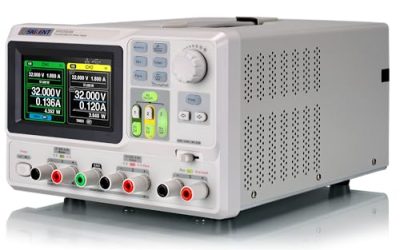
The SPE8105 sits between the 60V and 120V units in this guide: it reaches 0 to 80V at up to 10A, for 500W total, which covers work that passes 60V but never needs the full 120V. It is a single-channel programmable DC supply with a 2.8-inch IPS LCD screen, and the unit measures 82 x 226 x 142 mm at about 1.5 kg.
That 80V ceiling with 10A of current makes it a strong middle ground for benches that work on higher-voltage prototypes, capacitor circuits and motor drives. The programmable control and clear LCD suit benches where the supply setting changes often through the day.
- Specs:
- Output: 0 to 80V, 0 to 10A, 500W
- Display: 2.8-inch IPS LCD
- Channels: single channel, programmable
- Dimensions: 82 x 226 x 142 mm
- Weight: about 1.5 kg
- Best for: 80V work with a clear LCD
- Watch out for: the 80V ceiling cannot feed loads that need 120V; confirm the ASIN on the live listing before ordering
Which One Fits Your Situation
A bench that works above 60V most days
Pick the Jesverty SPS-12003V. Its 120V ceiling, 3A current and compact size cover most above-60V work, and the four-digit display with coarse and fine control keeps settings precise.
A bench that needs high current at 60V
Pick the NICE-POWER 60V 20A. Its 1200W total and 20A ceiling feed loads that no 120V 3A unit can, and the protection set and temperature-controlled fan suit long sessions at high current.
A bench that needs 120V at low current
Pick the Tekpower TP12001X. Its 1A ceiling is enough for low-current 120V loads, and the large backlit LCD makes the voltage easy to read from across the bench. Keep it in a fixed spot, since it is the heaviest unit here.
A compact bench with limited space
Pick the Jesverty SPS-12003V or the NICE-POWER SPS-C1203. Both weigh under 3 lb and fit in a small footprint, and both reach 120V at 3A. The Jesverty adds a 20W USB and Type-C port, while the NICE-POWER adds a 5V 2A USB port and takes 110V input only.
Common Mistakes
- Buying on voltage ceiling alone and ignoring current, so the supply cannot feed the load at the voltage it needs.
- Ignoring total wattage, so a load that needs high voltage and high current at the same time passes the wattage limit.
- Treating 120V DC as safe because it comes from a bench supply, when voltages above about 50V DC can be hazardous.
- Ordering the wrong variant on a listing that carries several voltage and current options, then finding the unit in the cart tops out at 30V.
- Skipping the input voltage check and ordering a 110V-only unit for a bench wired for 220V.
Frequently Asked Questions
What counts as high voltage for a bench supply?
In this guide, high voltage means a ceiling of 60V or more. Most general bench supplies top out at 30V, so a 60V, 80V or 120V unit opens up LED strings, motors, charger circuits and higher-voltage prototypes that a 30V supply cannot feed. The right ceiling is the highest voltage the bench will ever need, plus headroom.
Is 120V DC dangerous?
Yes. Voltages above about 50V DC can be hazardous, so treat a 120V bench supply with the same care as mains work: keep leads tidy, use the output switch to cut the terminals before connecting or disconnecting a load, and never touch the terminals while the output is live. Follow electrical safety practice on the bench.
Do I need 120V, or is 60V enough?
It depends on the loads. If nothing on the bench ever passes 60V, a 60V supply with high current is the better buy, because current and wattage matter more than an unused voltage ceiling. If any load needs more than 60V, even occasionally, a 120V supply is the only option in this guide that covers it.
What does the USB port do on these supplies?
The USB port charges phones, tablets and other devices at the bench, and on some units it also carries quick-charge output. It is separate from the main DC output terminals: the USB port cannot power the load, and the main output cannot charge a phone. Check whether the listing states a plain 5V port or a quick-charge port, since the two differ.
Final Thoughts
For an engineering workbench that goes above 60V, the Jesverty SPS-12003V is the most versatile pick in this guide, with the NICE-POWER 60V 20A leading on current and the Tekpower TP12001X leading on a clear display at 120V. Match the voltage ceiling, current and wattage to the load at the same time, confirm the variant and the input voltage on the live listing, and treat every voltage above 50V DC with respect.
Related guides
- 5 Best Triple-Output Bench Power Supplies for Engineering Workbenches (November 2026)
- 5 Best Quiet Shop Air Compressors for Woodworking Shops (November 2026)
- 5 Best Programmable DC Bench Power Supplies for Engineering Workbenches (November 2026)
- 5 Best Pancake Air Compressors for Woodworking Shops (November 2026)
More from Amazon
Programs that pair well with the guide above. Offers and eligibility are set by Amazon and may change.
A free business account with business pricing and bulk-buying tools for work, shop or home office.
Create a business accountFree shipping on eligible items, Prime Video and more. Eligible new members can start with a free trial.
Start a Prime free trialAudiobooks and podcasts to listen to on the go. Eligible new members can start with a free trial.
Try Audible freeAd-free music streaming. Eligible new subscribers can start with a free trial.
Try Music Unlimited freeAs an Amazon Associate we earn from qualifying purchases.