Key takeaways
- Compare the best gas powered welder options — engine-driven welder generators from Hobart, Lincoln Electric and Tomahawk — by weld output, duty cycle, auxiliary power and weight.
What's inside
As an Amazon Associate I earn from qualifying purchases. This post may contain affiliate links at no extra cost to you.
A gas powered welder in this guide means one specific kind of machine: an engine-driven welder generator. A gasoline engine inside the frame drives both a welding power source and an auxiliary generator, so the machine welds where there is no mains supply at all and, at the same time, runs grinders, lights and chargers from its own receptacles. That is a different purchase from a portable gasoline generator bought to power a separate plug-in welder, and it is also different from a mains-powered stick, MIG or TIG machine that happens to use shielding gas. Those other products are useful, but they are not covered here, because mixing them into one list makes the comparison meaningless: weight, fuel use, starting, transport and servicing are all decided by the engine, not by a power cord.

This shortlist keeps to three engine-driven machines that cover the realistic spread of field work. At the compact end is an inverter-based unit that one or two people can load and move around a site. In the middle is a dedicated DC stick machine built for farm, ranch and maintenance welding all day. At the top is a larger multi-process engine drive aimed at crews who weld heavier material, run wire processes with additional equipment, and need strong auxiliary power for a full set of tools. Read the welding output first, the duty cycle second, and the auxiliary watts third, in that order, and the right size usually becomes obvious.
Disclosure: As an Amazon Associate, we earn from qualifying purchases made through links in this article, at no additional cost to you.
Quick comparison
| Model | Welding output | Auxiliary power | Engine and starting | Weight and best fit |
|---|---|---|---|---|
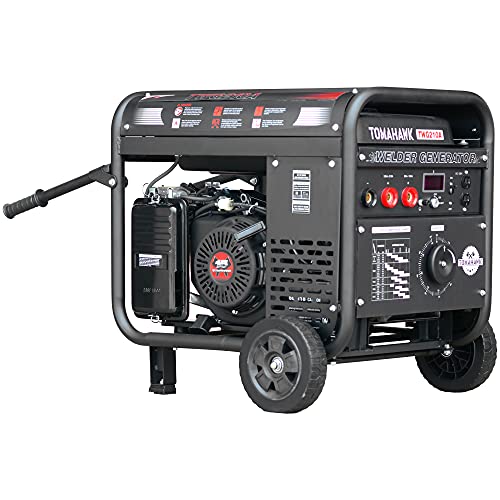
| Tomahawk TWG210A | Up to 210 A DC, stick and TIG | 2,000 W | 15 hp gasoline engine | About 202 lb; compact field repairs and included kit |
| Hobart Champion Elite 225 | 25 to 225 A DC stick | 9,500 W continuous, 10,000 W peak | Two-cylinder gasoline engine, electric start | About 373 lb; farm, ranch and maintenance stick work |
| Lincoln Electric Ranger 330MPX | Up to 330 A, multi-process capable | About 10,000 W rated class | Gasoline engine, electric start | Truck or trailer mounted; heavy fabrication and crew work |
Figures in this table are the headline ratings from manufacturer and listing information for each model. Engine supplier, receptacle layout and exact weight can vary by model year and configuration, so confirm the specification sheet for the exact unit you order before you commit to a mount, a trailer or a lifting plan.
1. Tomahawk TWG210A — the compact engine-driven option
View the Tomahawk TWG210A on Amazon
The Tomahawk TWG210A is the smallest machine in this guide, and that is its main argument. It produces up to 210 amps of DC welding output for stick and TIG work, with a 60% duty cycle at its rated output, and it provides 2,000 watts of generator power for tools and lights. A 15 hp gasoline engine drives the unit, and the inverter design is intended to give a steadier arc than older, simpler engine drives of a similar size. Listing information puts the machine at about 202 pounds, with dimensions around 29 by 29 by 22 inches, so it is still a substantial lift, but it is in a different transport class from the two larger machines below: it can ride in a truck bed or a small trailer without dominating the load, and it can be repositioned around a yard or a building site far more easily.
The kit aspect matters for buyers starting from nothing. The TWG210A package is sold with welding accessories, including a TIG torch, a stick holder, leads, a grounding clamp and gloves in the kit configuration described by the manufacturer. Always check the exact listing contents before ordering, because kit contents can change, and because leads, helmets and consumables are the items most often assumed rather than confirmed. If the kit is complete as described, a buyer can move from delivery to practice welds without a second order for the basics, which is rarely true of the larger professional engine drives, where leads and accessories are commonly sold separately.
Choose this machine for mobile repair work, gates, fencing, equipment brackets and general fabrication in places without a reliable supply, where 210 amps covers the electrodes you actually run and where the modest auxiliary output is enough for an angle grinder, a work light and a battery charger used sensibly. Do not choose it expecting to run a whole workshop from its receptacles while welding at full output. Two thousand watts is tool support, not site power, and the honest way to use this class of machine is to weld, grind, cut and light the immediate job, not to feed several heavy tools at once. For a small crew, a farm workshop or a mobile repair service that values portability over maximum output, that trade is often the right one.
2. Hobart Champion Elite 225 — dedicated stick welding with serious auxiliary power
View the Hobart Champion Elite 225 on Amazon
The Hobart Champion Elite 225 is a simpler idea executed at a larger scale: a DC stick welder and a strong generator in one heavy frame, with no attempt to be a compact machine. Its welding range runs from 25 to 225 amps DC for stick electrodes, and manufacturer information rates it at a 100% duty cycle at 225 amps, which means the rated output is intended for continuous welding rather than short bursts followed by cooling pauses. Alongside the welding output, it delivers 9,500 watts continuous and 10,000 watts peak of auxiliary AC power, with 120 volt and 240 volt receptacles, so it can run larger tools, a separate small welder through its 240 volt outlet where the manufacturer allows it, and a meaningful set of site loads when it is not welding.
Current versions are listed with a two-cylinder gasoline engine of around 23 horsepower and electric start, and a fuel tank in the region of 11 gallons. Older specification sheets name a different engine supplier for the same model family, which is a normal mid-life production change and a good reason to read the data plate and the manual for the exact unit delivered rather than relying on a photograph or an older review. At about 373 pounds, this is not a machine to lift by hand. Plan on a truck bed, a trailer mount or a wheeled setup in a workshop yard, with proper securing for transport and enough ventilation in use. Electric start, a large tank and continuous rated output all point the same way: this machine is built to be started in the morning and worked through a list of repairs without nursing it.
This is the natural pick for farm and ranch maintenance, structural repairs, trailer and implement work, and contractors whose field welding is overwhelmingly stick welding on mild steel. Stick process simplicity is a strength outdoors, because stick tolerates wind, imperfect surfaces and less-than-perfect preparation better than wire processes that depend on shielding gas. The limits are equally clear. If you need MIG or TIG as your main process rather than an occasional extra, a stick-only engine drive will frustrate you, and you should look at the multi-process class below instead. If your work is mostly thin sheet, the bottom of the 25 amp range still needs care and practice. But for the large middle ground of outdoor stick work, the Champion Elite 225 offers the most straightforward combination in this guide: full rated duty cycle, strong auxiliary power, and controls that do not require a menu to understand.
3. Lincoln Electric Ranger 330MPX — the heavy, multi-process crew machine
View the Lincoln Electric Ranger 330MPX on Amazon
The Lincoln Electric Ranger 330MPX, model K3459-1, sits at the professional end of gasoline engine drives. Its welding output extends to 330 amps, well beyond the other two machines here, and it is designed as a multi-process power source, covering stick and TIG in constant-current work and wire processes in constant-voltage work when paired with the appropriate feeder and accessories. Auxiliary power is in the 10,000 watt rated class, with peak output above that, so a crew can weld and still run the tools that support a fabrication or repair job. Manufacturer material for this class also emphasises a compact footprint for its output, digital controls and features intended to reduce noise and improve arc performance compared with older engine drives.
That capability comes with size, weight and cost of ownership that need to be planned rather than discovered. A machine in this class belongs on a service truck or a dedicated trailer, with lifting equipment for installation, secure mounting, and a maintenance routine that includes engine servicing, filters and periodic checks of leads, receptacles and output terminals. Fuel consumption at high output is a real operating consideration on long jobs, as is noise for anyone working near the machine all day. None of that is a criticism; it is simply the nature of a 330 amp engine drive. Buyers who weld thick sections, run larger electrodes, gouge, or work with a wire feeder in the field will use what this machine offers. Buyers who mostly repair a gate twice a month will not, and will be carrying weight and complexity they never benefit from.
Before ordering a Ranger 330MPX, confirm the exact configuration, including engine, included accessories and whether leads, a feeder or a remote control are part of the listing or separate purchases. On professional engine drives, the headline machine is often only the centre of a working system, and the total setup is what decides whether you can weld on the first day. Also confirm delivery arrangements, because freight handling for a machine of this size is different from a parcel delivery, and you need a safe way to unload and position it on arrival.
How to choose the right size
Start with the thickest material and the largest electrode or wire you will genuinely run, not the largest you can imagine. Welding output in amps should cover that work with headroom, and the duty cycle at that output tells you whether the machine can sustain it. A high maximum amperage with a low duty cycle can suit short repairs, while a lower maximum with a continuous rating can be the better tool for long seams and repeated joints. For most farm, maintenance and general fabrication work in mild steel, the 210 to 225 amp machines in this guide cover a wide range, including electrodes up to 5/32 inch on the models whose specifications list them. The 330 amp class earns its place on thicker sections, heavier electrodes and multi-process crew work.
Next, count auxiliary power honestly. List the tools you expect to run from the machine at the same time as, or between, welds: grinder, chop saw, lights, charger, compressor or a separate small welder. Compare their combined running load with the continuous auxiliary rating, not the peak figure, and remember that motor starting loads are higher than running loads. The Tomahawk supports the immediate job. The Hobart and the Lincoln support a working site. If your plan depends on running several large tools continuously, size for that plan rather than hoping the machine will cope.
Then decide how the machine will live. Weight and starting method decide daily usability more than brochure output does. A recoil-start compact unit that you can move is better than a heavier machine that stays in the yard because moving it is a project. An electric-start machine on a trailer, fuelled and ready, is better still for regular field work. Think about fuel storage, ventilation, exhaust direction, hearing protection and where hot work can be done safely away from fuel, timber and dry vegetation, which matters on a woodworking and rural property as much as on a construction site.
Finally, consider process. Stick-only machines are rugged, simple and well suited to outdoor repair. Multi-process engine drives cost and weigh more, but they let one power source cover stick, TIG and wire work with the right accessories. If you already own a shop MIG or TIG machine, check whether the engine drive’s auxiliary output and receptacles are the better route for occasional field wire work, rather than buying multi-process capability twice.
Safety and ownership basics
An engine-driven welder combines three hazards in one frame: a gasoline engine, high welding current and auxiliary mains-voltage output. Run it outdoors or with exhaust directed safely away from enclosed spaces, because engine exhaust is dangerous in a workshop, barn or garage. Keep fuel handling away from welding and grinding sparks, allow the engine to cool before refuelling, and follow the manual for oil, air filter and spark plug service. Inspect leads and connectors before use, keep the work clamp connection clean and close to the joint, and treat damaged insulation as a stop-work fault, not a cosmetic issue.
Use normal welding protection without exception: a suitable helmet, gloves, eye protection for grinding and chipping, protective clothing and hearing protection around a running engine drive. Keep a suitable fire extinguisher within reach, clear the area of flammable material before striking an arc, and watch the work area after you finish, because hot metal and slag can start a fire after the machine is off. If you are new to engine drives, spend time on scrap material at low output first, learn how the machine behaves at idle and under load, and read the electrode chart on the machine or in the manual before moving to work that matters.
Verdict
For most buyers searching for the best gas powered welder for field repairs, the Hobart Champion Elite 225 is the balanced choice: continuous rated stick output, strong auxiliary power and electric start in a machine designed to work all day from a truck or trailer. Choose the Tomahawk TWG210A if portability and an included kit matter more than auxiliary watts, and your work fits within 210 amps and light tool support. Choose the Lincoln Electric Ranger 330MPX if you need 330 amp output and multi-process capability for crew work and you are prepared to mount, maintain and feed a professional engine drive properly. Match the machine to the work you do every week, confirm the exact listing contents and specifications before ordering, and any of these three will weld a long way from the nearest outlet.
Related guides
More from Amazon
Programs that pair well with the guide above. Offers and eligibility are set by Amazon and may change.
A free business account with business pricing and bulk-buying tools for work, shop or home office.
Create a business accountFree shipping on eligible items, Prime Video and more. Eligible new members can start with a free trial.
Start a Prime free trialAudiobooks and podcasts to listen to on the go. Eligible new members can start with a free trial.
Try Audible freeAd-free music streaming. Eligible new subscribers can start with a free trial.
Try Music Unlimited freeAs an Amazon Associate we earn from qualifying purchases.