The best portable CNC machines for small shops and shared spaces, compared by footprint, weight, work area, and setup. Compact benchtop picks for wood, acrylic, and soft metal.
As an Amazon Associate I earn from qualifying purchases. This post may contain affiliate links at no extra cost to you.
A portable CNC machine is a benchtop machine you can actually move. It fits on a workbench, a sturdy desk, or a folding table, and one person can carry it to a different room, out to the garage, or into storage when the job is done. That is a different thing from a handheld CNC router, which you guide by hand across a workpiece, and it is a different thing from a full-size CNC that needs a dedicated stand, a dust-collection run, and a permanent corner of the shop.
Portability in a CNC comes down to four things: footprint, weight, setup time, and how much of the machine comes apart. A machine under thirty pounds that assembles in under an hour is portable in a practical sense; one that needs two people to lift it is not. The picks below all clear the practical bar. Each one is a compact benchtop CNC router or mill that runs on standard household power, cuts wood, acrylic, MDF, and soft plastics, and can be packed away or carried by one person.
The Short Answer
If you want the smallest machine that still cuts real parts, get the Genmitsu 3018-PROVer V2. If you want the most cutting area in a machine that still fits on a bench, get the FoxAlien Masuter Pro. If you want a stiffer machine with lead-screw drive and room to grow, get the Genmitsu 4040-PRO. If you want a compact middle step between the small and mid-size machines, get the Genmitsu 3020-PRO MAX V2. If you want an enclosed machine you can run indoors without a cloud of chips, get the Makera Carvera Air with the 4th axis.
The 3018-PROVer V2 is the smallest machine in this roundup and the easiest one to move. Its frame measures roughly 400 by 330 millimeters, and the whole machine weighs about nine kilograms, so it lifts off a bench with one hand on each side and rides in a car trunk without a second person. The working area is 300 by 180 millimeters with 45 millimeters of Z travel, which covers signs, plaques, small boxes, inlays, and circuit boards. The effective engraving area is a little smaller than the full travel, so measure your largest planned workpiece against the 260 by 155 millimeter engraving area before you buy.
The machine arrives with the gantry frame and the one-piece aluminum spoilboard pre-assembled, which keeps first setup short. Limit switches, an emergency stop button, and a Z-probe come in the box, and the GRBL offline controller lets you run jobs without keeping a laptop tethered to the machine. The spindle is a 775 motor that runs up to 10,000 RPM on 24-volt power, which is enough for wood, acrylic, MDF, plastic, and PVC, plus light engraving on soft metal.
This is the pick for a first CNC, for a shared workspace, or for anyone who needs to set up on a kitchen table and put the machine away when dinner is ready. Its limits are honest ones: the work area is small, the spindle is modest, and deep cuts in hardwood take light passes. For learning, for gifts, for small parts, and for proving out designs before committing to a bigger machine, it is the most portable CNC you can buy.
The Masuter Pro is the largest cutting area in this roundup that still counts as portable. Its working area is 400 by 400 millimeters, which is enough for cutting boards, cabinet door panels, sign blanks, and guitar bodies in a single setup, and the all-metal frame with a linear-rail Z axis keeps the gantry steady across that span. The machine weighs just under twenty-nine pounds, so one person can carry it, though it is a two-handed lift and you will want a clear bench waiting for it.
The controller box is compact and dust-resistant, with home and emergency-stop buttons on the front, and the machine runs GRBL firmware that works with common design and sender software. Two spindle clamps are included, in 52-millimeter and 65-millimeter sizes, so the machine accepts a range of compact spindles and trim routers if you decide to upgrade later. The perforated wasteboard gives you plenty of hold-down points, which matters on a portable machine, because a workpiece that shifts mid-cut ruins the part.
Choose the Masuter Pro when the 3018 class feels too small but a full-size machine is out of the question. It is the pick for a small garage shop, for cutting sheet goods down to size, and for anyone who wants one machine that can handle both small detailed work and larger panels. The trade-off is size: it needs a real bench, not a desk, and it is the heaviest machine in this roundup, so moving it every day gets old. If you move it once a week or less, it is still firmly portable.
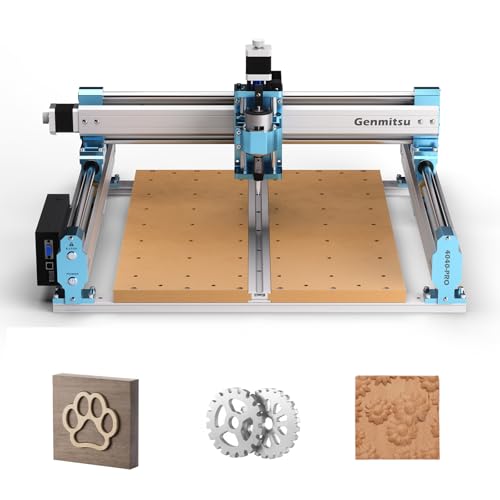
The 4040-PRO is the stiffest open-frame machine in this roundup. It uses lead-screw drive on its axes instead of belts, which gives it more consistent positioning under load and less drift over long jobs, and its working area is 400 by 400 millimeters with 78 millimeters of Z travel. That extra Z height matters for thicker stock, for taller jigs, and for the optional fourth-axis rotary attachment, which the machine supports. The frame is pre-assembled, the structure is rigid, and the GRBL control works with the same software most hobby CNC users already run.
This machine suits a buyer who has already outgrown a 3018 and wants a portable machine that can do real production work in small batches. It cuts wood, acrylic, MDF, nylon, and soft metal, and the lead-screw drive holds up better than belts when you push feed rates on harder material. It is still a benchtop machine that one person can move, but it is a substantial piece of equipment, so plan a semi-permanent bench spot for it and move it only when you need to, not every session.
The 3020-PRO MAX V2 sits between the small 3018 machines and the mid-size 4040 machines, and that middle spot is exactly why it belongs in a portable roundup. Its working area is 11.8 by 8.1 inches with 3.1 inches of Z travel, which is a useful step up from a 3018 for larger plaques, boxes, and panels, while the machine itself stays compact enough to carry and store on a shelf. It is an upgraded three-axis engraver with a new frame structure, an offline controller, and six limit switches, which gives it more consistent homing and safer travel limits than the entry-level machines.
The 3020-PRO MAX V2 is the pick for a buyer who has a specific size problem: the 3018 is too small for the work, but the 4040 is more machine than the space allows. It is also a good second machine for a shop that already has a large CNC and wants a small one for quick jobs or for a classroom. The offline controller means you can run it from a memory card without a dedicated computer, which is a real advantage on a portable machine that moves between rooms.
The Carvera Air is the only enclosed machine in this roundup, and the enclosure is what makes it portable in a different way. Because the cutting area is sealed inside a metal chassis, chips stay inside the machine instead of spreading across the room, which means you can run it on a desk in a shared space, in an apartment, or in a classroom without building a dust enclosure first. The machine is a compact desktop mini mill with a quick tool changer, closed-loop stepper control, automatic probing, and Makera CAM software, and this version includes the fourth-axis rotary attachment for milling cylindrical work.
The spindle runs from zero to 13,000 RPM under closed-loop control, and tool changes take about ten seconds with the quick-change mechanism. Automatic probing sets tool height for you, which removes one of the most common setup errors on a small CNC. The machine handles metal, wood, plastics, and circuit boards, and the enclosed design makes it the best pick here for milling metal indoors, where chip control matters most. The fourth axis adds the ability to carve round stock and mill parts that need rotation.
Start with the largest workpiece you plan to cut, then add room for clamps. A machine whose work area barely fits the part leaves no space to hold it down, and hold-downs are the difference between a clean cut and a ruined blank. If your work is signs and plaques under twelve inches wide, a 3018-class machine is enough. If you cut panels, doors, or sheet goods, you need a 400-millimeter class machine. Measure the bench too: a 4040-class machine needs a bench at least 600 millimeters deep once you allow for the controller, the cables, and the dust hose.
Weight decides whether you will actually move the machine. Under ten kilograms, you will carry it without thinking. Around thirteen kilograms, you will carry it when you need to. Near thirty pounds, you will move it when the job demands it and leave it in place otherwise. Be honest about how often the machine needs to travel, because a machine that is technically portable but never moves is just a small stationary machine.
Spindle power and drive type decide what the machine cuts well. A compact 775 spindle handles wood, acrylic, and plastic with ease and manages light engraving on soft metal. Lead-screw drive holds position better than belts on long jobs and under heavier cuts, which is why the 4040-PRO is the pick for repeat work. Belt drive is fine for light work and keeps the machine lighter, which is part of why the smallest machines use it. If you plan to mill aluminum plate regularly, favor lead screws and a rigid frame over a larger work area.
Setup time is the hidden cost of portability. A machine that arrives with the gantry and spoilboard pre-assembled can be cutting within an hour of unboxing, while a full kit can take an afternoon to square and calibrate. Pre-assembly matters more on a portable machine, because every time you move it you need to confirm it is still square. Look for limit switches, an emergency stop, and a Z-probe, because those three features prevent the most common beginner mistakes: crashing an axis, losing position, and cutting too deep on the first pass.
Software is the other half of the machine. All five picks run GRBL-based control, which works with common design tools and senders, and the Carvera Air adds its own CAM software. Before you buy, confirm that your design software exports toolpaths the machine can read, and confirm that you have a computer or an offline controller to run jobs.
Materials are the last check. Every machine in this roundup cuts wood, acrylic, MDF, and soft plastics. Soft metal work is possible on all of them with light passes and the right bits, but none of them is a metal mill, and hard steel is out of reach. If your work is mostly metal, the enclosed Carvera Air is the best fit, because the enclosure contains chips and the closed-loop control holds position. If your work is mostly wood, any of the open-frame machines will serve.
Moving and Storing a Portable CNC
A portable CNC still needs care when it moves. Remove the spindle and any loose accessories before carrying it, and secure the gantry so it cannot slide during transport. A bungee cord or a simple gantry lock keeps the axes from slamming into their limits in the car. Keep the original foam packaging if you have the space, because it is shaped to the machine and protects the rails and lead screws better than a blanket.
After every move, check that the frame is square and run a quick homing cycle before cutting a real part. A machine that was square on the bench can shift a fraction of a millimeter in transport, and that fraction shows up as a crooked cut or a misaligned inlay. A short test cut in scrap material confirms the machine is ready, and it costs less than a ruined workpiece. Store bits, clamps, and the Z-probe with the machine, because a portable machine is only useful if its accessories travel with it.
Dust control matters more on a portable machine, because it often runs in a shared space. A small shop vacuum with a dust shoe keeps the work area clear and keeps chips out of the rails and lead screws, which extends the life of the machine.
Frequently Asked Questions
Is a portable CNC machine the same as a handheld CNC router?
No. A portable CNC machine is a complete benchtop machine with a fixed frame, a moving gantry, and a work area that holds the material. A handheld CNC router is a tool you guide by hand across a large or installed workpiece. Handheld routers are the right choice for cutting installed panels, doors, and large sheets in place. Portable benchtop machines are the right choice for small repeatable parts, signs, and detailed work where the machine holds the material and controls the cut.
Can a portable CNC machine cut metal?
Yes, within limits. The machines in this roundup cut soft metal such as aluminum plate and brass with light passes, sharp bits, and proper feeds. None of them is a production metal mill, and hard steel is beyond their rigidity and spindle power. For occasional aluminum brackets, plates, and engraving, they work well. For regular metal production, a larger and stiffer machine is the right tool.
How much bench space does a portable CNC need?
Allow the machine footprint plus room for the controller, the cables, and your arms. A 3018-class machine fits on a desk. A 4040-class machine needs a bench at least 600 millimeters deep and about the same width, plus space for the vacuum hose and a place to set finished parts. Measure before you buy, and remember that a machine you cannot reach around is a machine you cannot load safely.
Do I need a dedicated computer to run a portable CNC?
Not always. Machines with an offline controller, including the 3018-PROVer V2, the 3020-PRO MAX V2, and the Masuter Pro, can run jobs from a memory card or the controller itself. You still need a computer to design parts and generate toolpaths, but you do not need to keep a laptop tethered to the machine while it cuts. The Carvera Air runs from its own CAM software, which also removes the need for a separate sender.
What materials should a beginner start with?
Start with soft wood, MDF, and acrylic. These materials cut cleanly, forgive small feed mistakes, and show you how the machine behaves. Move to hardwood and soft metal once you are comfortable with hold-downs, feeds, and bit changes. Avoid hard steel, stone, and glass, which are beyond the capability of portable benchtop machines.
The Bottom Line
The best portable CNC machine is the one that fits your largest workpiece, your bench, and your back. For most buyers, that is the Genmitsu 3018-PROVer V2 if the work is small, the FoxAlien Masuter Pro if the work is large, or the Genmitsu 4040-PRO if the work is repeated and needs rigidity. The 3020-PRO MAX V2 fills the space between the small and mid-size machines, and the Makera Carvera Air is the pick when the machine has to run indoors or mill metal. Measure your bench, weigh the machine against how often you will move it, and buy the smallest machine that still fits your work, because the machine you can move is the machine you will use.
Disclosure: As an Amazon Associate, we earn from qualifying purchases.
J
JD's Woodworks Editorial Team
We compare specs, warranty terms, long-term owner feedback and street pricing before anything earns a spot. Rankings are never paid.
Affiliate disclosure. As an Amazon Associate we earn from qualifying purchases at no extra cost to you. Prices accurate as of the date shown.
Miter saw vs table saw: compare crosscuts, rip cuts, accuracy, space, and value to choose the right saw for your shop and your first woodworking projects.
Compare five solar portable generators for shops, campsites, and outages, covering battery size, output, solar charging, outlets, and what to check first.
Find the best Penn Industries dust collector on Amazon: the PSI Woodworking DC3XX blower and the DC725 tabletop unit, compared on airflow, pressure, and shop fit.
Compare five large stationary horizontal metal band saws for fabrication shops on cutting capacity, motor, power supply, blade speed, and mitering before buying.
Find the best mortising chisel bits for clean square mortises in this guide: hollow-chisel sets and singles compared by size, shank, steel, and machine fit.
Find the best drill press base for your shop. Compare rolling stands and mobile bases by capacity, footprint, casters, locking, and setup before you buy.
Find the best dewalt planer dw734 blades for your 12-1/2-inch thickness planer. Compare OEM and aftermarket 3-knife sets, steel types, and fit before you buy.

 Genmitsu 3018-PROVer V2
 FoxAlien Masuter Pro
 Genmitsu 4040-PRO
 Genmitsu 3020-PRO MAX V2
 Makera Carvera Air with 4th Axis