Compare five large stationary horizontal metal band saws for fabrication shops on cutting capacity, motor, power supply, blade speed, and mitering before buying.
Compare five large stationary horizontal metal band saws for fabrication shops on cutting capacity, motor, power supply, blade speed, and mitering before buying.
As an Amazon Associate I earn from qualifying purchases. This post may contain affiliate links at no extra cost to you.
An industrial metal band saw is a different machine from the benchtop and portable saws that fill most home shops. It is a floor-standing horizontal saw built around a cast iron frame, a one-inch-wide blade, a hydraulic downfeed, and a coolant system, and it weighs anywhere from 800 to more than 1,100 pounds. It cuts structural steel, thick-wall tubing, solid bar, and plate on a repeatable basis, with a square, clean edge. A shop buys one when metal cutting volume outgrows a small saw, or when stock gets too large and too heavy to carry.
This roundup covers only that class of machine. Every pick is a large stationary horizontal metal band saw with a cutting window of at least 9 by 16 inches, a motor of at least 1.5 horsepower, a hydraulic downfeed, and a built-in coolant system. There are no portable saws, benchtop saws, or woodworking saws pressed into metal service. The five picks are all JET machines, which reflects the market: JET has the widest range of large horizontal metal saws listed on Amazon US, while the other names in this class, such as Ellis and Baileigh, sell through machinery suppliers.
Two checks decide most purchases in this class. The first is electrical supply: three of the five picks run on single-phase power, while one needs three-phase power, which many shops do not have. The second is cutting capacity: a 9 by 16 inch window handles most fabrication stock, while a 10 by 18 inch window covers larger structural sections. Measure the largest stock the shop cuts in a normal month, add room for the next larger size, and let that number set the minimum window.
The Five Picks at a Glance
JET HBS-1018W — B000GANKXS — 10 by 18 inch window, 2-horsepower motor, 230-volt single-phase power. The most capable single-phase saw here.
JET J-7020M — B003DB1GRY — 10 by 16 inch window, 1.5-horsepower motor, variable blade speed, swiveling head. The mitering pick.
JET HBS-916 — B000GAPLWQ — 9 by 16 inch window, 1.5-horsepower motor, 115 or 230-volt single-phase power. The pick for shops without a 230-volt circuit.
JET J-7040 — B002SDCVYK — 10 by 16 inch window, 2-horsepower motor, three-phase power, oil-bath transmission. The heaviest-duty pick, for shops with three-phase service.
JET MBS-1018-1 — B01MYFLOU5 — 10 by 18 inch window, 2-horsepower motor, 230-volt single-phase power, dual-mitering head. The dual-mitering pick.
1. JET HBS-1018W
The HBS-1018W is the largest single-phase saw in this roundup, and for most fabrication shops it is the natural first choice. It cuts a 10 by 18 inch window at 90 degrees, which covers 10-inch round solid stock and wide rectangular sections in a single pass. The motor is a 2-horsepower induction unit running on 230-volt single-phase power, so it fits a shop with a standard 230-volt circuit and needs no three-phase service. At 805 pounds net weight, it is a permanent installation for a level concrete floor, placed where long stock can feed in and out.
Four blade speeds, 82, 132, 210, and 330 surface feet per minute, cover the range from slow cutting of hard steels to faster cutting of aluminum and other soft metals, changed by moving the belt between pulleys. The 1-inch-wide bi-metal blade runs on 14-inch wheels, with carbide blade guides on double-row ball bearing support keeping it tracking true through heavy cuts. The hydraulic downfeed is fully adjustable with a separate on-off valve, so the feed rate can be set for the material and left alone, and coolant flows through the blade guides directly onto the cut. A large handwheel with a built-in gauge handles blade tensioning, and the quick-positioning vise swivels to 45 degrees for miter cuts.
The HBS-1018W suits a fabrication shop that cuts structural steel, tubing, and solid bar at volume and wants the largest window available on single-phase power. It needs a 230-volt circuit, a level floor, and a plan for moving 800-plus pounds into place, and once installed it becomes the center of the metal cutting workflow. See it on Amazon: B000GANKXS.
2. JET J-7020M
The J-7020M is the mitering pick in this roundup. Its head swivels from 0 to 45 degrees while the base and the workpiece stay clamped in place, making angled cuts faster and more accurate than saws that require the stock to be repositioned in the vise. The cutting window is 10 by 16 inches, with 10-inch round capacity at 90 degrees and 8.5-inch round capacity at 45 degrees. The 1.5-horsepower motor runs on 115 or 230-volt single-phase power, prewired for 230 volts, and the variable-speed drive fine-tunes blade speed from 100 to 350 surface feet per minute without changing belts.
That variable speed is the feature that sets the J-7020M apart from the step-pulley saws here: a shop moving between mild steel, stainless, aluminum, and tool steel in a single day can dial in the right speed for each material in seconds. The 1-inch-wide blade runs on 14-inch wheels, and the six-point blade guide system uses cam follower bearings on eccentric shafts on both sides, keeping the blade rigid and square through long cuts. At 1,134 pounds, it is the heaviest saw in this roundup, and that weight damps vibration, so the saw cuts straighter and holds its settings. The trade is floor space and installation effort, since it arrives on a pallet and needs a forklift or an engine hoist to place, and the swiveling head needs clearance on both sides.
The J-7020M suits a shop where miter cuts are a regular part of the work, from handrails and frames to angled structural joints, and where changing blade speed without touching a belt saves time every day. It gives up some window size to the 10 by 18 inch saws and some motor power to the 2-horsepower models, but for mitering work it is the most capable saw here. See it on Amazon: B003DB1GRY.
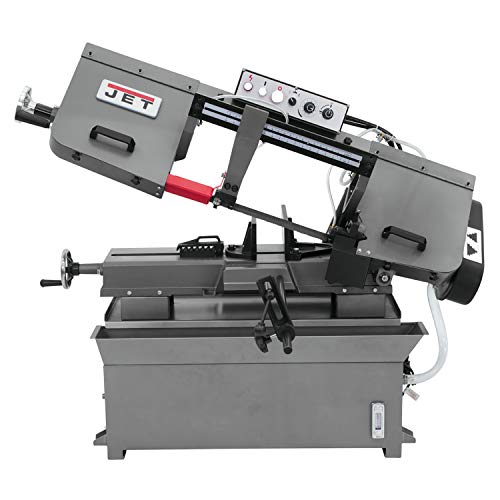
The HBS-916 is the pick for a shop that needs a serious industrial saw but does not have a 230-volt circuit. It runs on 115 or 230-volt single-phase power, prewired for 115 volts, so it can run from a standard household circuit with a suitable breaker, making it the most flexible saw here from an electrical standpoint. The cutting window is 9 by 16 inches, with 9-inch round capacity at 90 degrees, and the motor is 1.5 horsepower.
Four blade speeds, 82, 132, 170, and 235 surface feet per minute, cover the common range for steel and aluminum, changed by moving the belt between pulleys. The 1-inch-wide bi-metal blade, 119.5 inches long, runs on 13-inch wheels with carbide blade guides on parallel double-row ball bearing support. A self-propelled blade brush keeps the blade clear of chips, the fully adjustable hydraulic downfeed holds a steady feed rate, and coolant is distributed through the blade guides. The oversized chip tray is removable for cleaning.
The vise is a quick-positioning design that swivels to 45 degrees for miter cuts, the material stop is built in for repeat cuts of the same length, and a large handwheel with a built-in gauge handles blade tensioning. At more than 800 pounds, the HBS-916 is a floor-standing machine in the same weight class as the larger saws here, needing the same level floor and delivery plan.
The trade for the 115-volt flexibility is a smaller window and a smaller motor than the 10 by 18 inch saws, and a shop that regularly cuts 10-inch round stock will outgrow the 9-inch capacity. For a shop cutting 9-inch stock and under on standard power, the HBS-916 brings the hydraulic downfeed, the coolant system, and the rigid frame of the industrial class without demanding a new circuit. See it on Amazon: B000GAPLWQ.
The J-7040 is the heaviest-duty saw in this roundup, and it is the only one that needs three-phase power. Its 2-horsepower motor runs on 230-volt three-phase service, so the first question for any buyer is whether the shop has three-phase power available. If it does not, this saw cannot run. If it does, the J-7040 repays the requirement with a drivetrain built for continuous production work: a heavy-duty transmission with hardened and ground gears running in an oil bath, which handles sustained load and heat far better than a belt drive alone.
The cutting window is 10 by 16 inches, with 10-inch round capacity at 90 degrees and at 45 degrees, and the variable-speed drive covers 100 to 350 surface feet per minute without belt changes. The 1-inch-wide blade runs through a six-point guide system with cam follower bearings on eccentric shafts, the most rigid guide arrangement in this roundup. The vise is a patented three-jaw design with a rapid-action moveable jaw, clamping irregular stock faster and holding it more securely than a standard two-jaw vise. The control panel swings away from the work area.
At 927 pounds and 75.5 inches long, the J-7040 is one of the longest saws here and needs a clear run of floor on both sides for long stock. The oil-bath transmission adds a maintenance item the belt-drive saws do not have: the oil level needs periodic checking, and the oil needs changing on the schedule in the manual.
The J-7040 suits a production shop with three-phase service that cuts metal all day and wants the most durable drivetrain in this class, and it is also the pick for a shop cutting a lot of irregular stock, where the three-jaw vise earns its keep on every cut. Note that JET sells this model in more than one voltage configuration, including a 460-volt variant, so the exact model and voltage on the listing page should be confirmed before ordering. See it on Amazon: B002SDCVYK.
The MBS-1018-1 is the dual-mitering pick in this roundup, the only saw here that miters in both directions. The head pivots 45 degrees to the right and 60 degrees to the left, so a shop can cut compound angles and mirrored miters without flipping the stock or re-clamping. The cutting window is 10 by 18 inches, with 10-inch round capacity at 90 degrees and at 45 degrees, and 6-inch round capacity at 60 degrees. The 2-horsepower motor runs on 230-volt single-phase power, putting the largest window in this roundup on the most common industrial circuit.
The 1-inch-wide blade runs on 14.25-inch wheels, with blade speed set by belt position and coolant fed through the blade guides. The vise holds stock square through the full swing of the head. At 79 by 36 by 46 inches and 1,034 pounds net weight, it is the longest saw in the roundup, and a forklift is the practical way to move it.
Dual mitering is worth paying for only when the work demands it. A shop building handrails, frames, and structures with angles in both directions will use it every week, while a shop that cuts mostly square crosscuts will not; for that shop the HBS-1018W gives the same window and motor on the same circuit without the dual-mitering mechanism. JET also sells this saw as the MBS-1018-3, a three-phase version, so the single-phase model number and 230-volt rating should be confirmed on the listing page before ordering. See it on Amazon: B01MYFLOU5.
How to Choose an Industrial Metal Band Saw
Cutting capacity first. Read the window as a rectangle at 90 degrees, plus the round capacity at 90 and 45 degrees. A 10 by 18 inch window cuts 10-inch round stock and wide flat sections, while a 9 by 16 inch window tops out at 9-inch round. Measure the largest stock the shop cuts in a normal month and choose a window with room above it.
Electrical supply second. This is the check that eliminates picks. The HBS-916 runs on 115-volt power, the HBS-1018W, J-7020M, and MBS-1018-1 run on 230-volt single-phase power, and the J-7040 needs three-phase power. Confirm the panel, the breaker, and the outlet before ordering, and confirm the circuit is dedicated, since a saw sharing a circuit with other large machines will trip breakers under load. Without a 230-volt circuit, the HBS-916 is the only pick here that applies.
Blade speed and blade choice. Hard steels cut slowly and soft metals cut faster. Variable-speed saws such as the J-7020M and J-7040 change speed with a dial, while step-pulley saws such as the HBS-1018W and HBS-916 change speed by moving a belt. Either arrangement works; the variable-speed drive is faster to adjust, and the belt drive has fewer parts to fail. Blade tooth pitch matters as much as speed: at least three teeth should be in the cut at all times, which means fine teeth for thin-wall tubing and coarse teeth for thick solid stock. Keep two or three blade pitches on hand.
Hydraulic downfeed and coolant. Every saw in this roundup has both, and they are what separate an industrial saw from a hobby saw. The hydraulic downfeed holds a steady feed rate so the blade cuts at an even tooth load, and the coolant keeps the blade and the work cool while flushing chips from the kerf. Check that the downfeed is adjustable with its own valve and that coolant flows through the blade guides.
Vise and mitering. A quick-positioning vise saves time on every cut, and a vise that swivels to 45 degrees covers most miter work. The J-7020M goes further by swiveling the head instead of the vise, which keeps the stock clamped while the angle changes. The MBS-1018-1 goes furthest of all, mitering 45 degrees one way and 60 degrees the other. Match the arrangement to the work: square crosscuts need only a good vise, single-direction miters need a swiveling vise or head, and mirrored angles need dual mitering.
Weight, floor, and delivery. These saws weigh 800 to more than 1,100 pounds and arrive on a pallet by freight. The shop needs a level concrete floor, a clear path from the delivery point to the installation point, and a way to move the machine, usually a forklift or an engine hoist. Plan the layout with long stock in mind: a saw cutting 20-foot lengths needs clear floor on both sides, and a mitering saw needs clearance for stock at an angle.
The wider market. The Ellis 1600 is the classic machine in this class, with a 10-inch round capacity and a dual-mitering head. Ellis sells through machinery suppliers rather than through Amazon listings, so it is not a pick here, but its capacity and mitering range are the standard the picks are measured against.
Setting Up and Keeping the Saw Cutting True
A new industrial saw needs a careful first setup: level the machine, check blade tension with the built-in gauge, and check the blade guides on both sides. Run the first cuts slowly on scrap stock of the same material the shop cuts most, and check the cut for square. A cut that drifts usually points to blade tension, guide adjustment, or a dull blade, in that order.
Blade break-in matters: a new bi-metal blade should run at a reduced feed rate for the first few cuts so the teeth form a proper edge. A blade pushed hard from the first cut will lose teeth early and cut rough for the rest of its life. Keep the coolant topped up and mixed to the maker’s ratio, clean the chip tray regularly, and replace a worn blade brush, since a brush that no longer clears chips lets them weld to the blade.
Blade life is the main running cost of a band saw, and it is controlled mostly by the operator: the right blade speed for the material, the right tooth pitch for the section, a steady downfeed, and clean coolant decide whether a blade lasts weeks or months. A blade that cuts crooked, cuts slowly, or leaves a rough edge should be changed, not forced. Keep spare blades on hand in the pitches the shop uses most.
Frequently Asked Questions
Can a wood band saw cut metal?
A wood band saw runs too fast for most metals and lacks the rigid frame, the slow speeds, and the coolant system that metal cutting needs, so a metal-cutting blade on a wood saw wears quickly and cuts poorly. The saws in this roundup run at 82 to 350 surface feet per minute, far slower than a wood saw, and that slow speed is what makes clean metal cuts possible.
How much floor space does an industrial band saw need?
The saw itself is roughly 65 to 79 inches long and 25 to 36 inches deep, and it weighs 800 to more than 1,100 pounds. The working footprint is larger: allow clear floor on both sides for the longest stock the shop cuts, plus room to load and unload, and extra clearance for stock at an angle on a mitering saw.
What size saw does a small fabrication shop need?
A shop cutting stock up to 9 inches round on standard household power should look at the HBS-916. A shop with a 230-volt circuit cutting 10-inch stock should look at the HBS-1018W or the J-7020M, depending on how much miter work it does. A shop with three-phase power cutting at high volume should look at the J-7040.
Disclosure: As an Amazon Associate, we earn from qualifying purchases.
J
JD's Woodworks Editorial Team
We compare specs, warranty terms, long-term owner feedback and street pricing before anything earns a spot. Rankings are never paid.
Affiliate disclosure. As an Amazon Associate we earn from qualifying purchases at no extra cost to you. Prices accurate as of the date shown.
Miter saw vs table saw: compare crosscuts, rip cuts, accuracy, space, and value to choose the right saw for your shop and your first woodworking projects.
Compare five solar portable generators for shops, campsites, and outages, covering battery size, output, solar charging, outlets, and what to check first.
The best portable CNC machines for small shops and shared spaces, compared by footprint, weight, work area, and setup. Compact benchtop picks for wood, acrylic, and soft metal.
Find the best Penn Industries dust collector on Amazon: the PSI Woodworking DC3XX blower and the DC725 tabletop unit, compared on airflow, pressure, and shop fit.
Find the best mortising chisel bits for clean square mortises in this guide: hollow-chisel sets and singles compared by size, shank, steel, and machine fit.
Find the best drill press base for your shop. Compare rolling stands and mobile bases by capacity, footprint, casters, locking, and setup before you buy.
Find the best dewalt planer dw734 blades for your 12-1/2-inch thickness planer. Compare OEM and aftermarket 3-knife sets, steel types, and fit before you buy.

 3. JET HBS-916
 4. JET J-7040
 5. JET MBS-1018-1