Key takeaways
- Compare the best hook knives for spoon carving with specs on blade steel, curve radius, handedness, and handle wood, plus a clear guide to choosing.
What's inside
As an Amazon Associate I earn from qualifying purchases. This post may contain affiliate links at no extra cost to you.
Table of Contents
- Quick Answer
-
- Flexcut KN52 Sloyd Hook Knife
-
- Flexcut KN26 Right-Handed Hook Knife
-
- Flexcut KNL26 Left-Handed Hook Knife
-
- LEONTOOL Hook Knife with Leather Sheath
-
- Flexcut KN36 Radius Knife
- How to Choose
- Who Should Skip
- FAQ
- Conclusion
- Product and ASIN Reference
A hook knife does a job no straight blade can: it reaches inside the bowl of a spoon, a kuksa, or a small cup and pares the hollow smooth with controlled pull cuts. Choosing the wrong one, though, is easy. Hook knives come in right- and left-handed versions that are not interchangeable, in tight and open curves that suit different bowl sizes, and in grinds that behave differently in the cut.
This guide compares five hook knives sold as individual tools rather than bundled kits, so each pick can be matched to a carving hand, a bowl size, and a budget tier: a premium single-bevel sloyd hook, the classic right- and left-handed Flexcut hooks, a budget stainless option with a sheath, and a radius knife for shallow hollows.
As an Amazon Associate, we earn from qualifying purchases.
Quick Answer
For most spoon carvers, the Flexcut KN52 Sloyd Hook Knife is the strongest single pick: its single-bevel 1095 high-carbon steel hook and cherry hardwood handle suit both roughing and finishing cuts in spoon bowls. Right-handed carvers on a mid-range budget should look at the Flexcut KN26, left-handers at its mirror twin, the KNL26, and anyone watching cost at the LEONTOOL hook knife.
1. Flexcut KN52 Sloyd Hook Knife

The KN52 is Flexcut’s sloyd-style hook knife, built around a single-bevel hook blade in 1095 high-carbon steel and a cherry hardwood handle. The single bevel is the detail that matters most here: with the bevel riding against the wood, the edge tracks through the curve of a spoon bowl in a slicing pull cut, which gives the carver fine control over how much material each pass removes. That makes the KN52 a good match for carvers who hollow green or seasoned spoon blanks and want one hook that can open a bowl and then clean it up.
Flexcut grinds its carving edges ready to cut from the package, and the 1095 steel responds well to stropping, so maintenance is a strop-and-compound routine rather than frequent trips to a stone. The cherry handle fills the palm, which helps during the repeated pull strokes that bowl hollowing involves. As the premium pick here, the KN52 suits carvers who own a sloyd knife for the outside of the spoon and want a dedicated hook for the inside.
Specs
- Model: KN52
- Blade steel: 1095 high-carbon steel
- Bevel: Single bevel
- Handle: Cherry hardwood
- Blade length: Not stated
- Handedness: Right-handed pull-cut profile
- Tier: Premium
2. Flexcut KN26 Right-Handed Hook Knife

The KN26 is the long-running standard in the Flexcut hook knife line: a compact curved blade in 1095 high-carbon steel on an ergonomic ash handle. Where the KN52 takes a sloyd approach, the KN26 is a pure hook knife, with the edge curving up and back toward the handle so the cut happens on the pull stroke. That geometry is what lets it scoop the inside of a spoon bowl, deepen a kuksa, or clean up the inside of a cup without the handle colliding with the rim.
The ash handle is contoured for the palm-and-finger grip most carvers use on a hook knife, and the blade arrives razor sharp from Flexcut, ready to carve. Because the KN26 is ground for right-handed use, left-handed carvers should not simply flip it over, since the edge geometry works against them; the KNL26 below exists for exactly that reason. In the mid-range tier, the KN26 is the straightforward recommendation for a right-handed carver buying a first dedicated hook knife.
Specs
- Model: KN26
- Blade steel: 1095 high-carbon steel
- Bevel: Hook profile, right-handed grind
- Handle: Ash wood
- Blade length: Not stated
- Handedness: Right-handed
- Tier: Mid-range
3. Flexcut KNL26 Left-Handed Hook Knife

Left-handed carvers are often told to make do with a right-handed hook knife or a double-edged model, and neither compromise cuts as cleanly as a true mirror-image tool. The KNL26 is that tool: it is the left-handed counterpart of the KN26, with the same 1095 high-carbon steel hook blade and ergonomic ash handle, ground so the bevel and edge suit a left-handed pull cut.
Listing data for the KNL26 gives a blade length of 7/8 inch, a compact hook that favors control in small to medium spoon bowls over fast stock removal in large bowls. The short blade also makes the knife easier to manage while learning hook knife technique, because there is less edge in the cut at any moment. For a left-handed carver, this is the pick that avoids the awkward reversed grip entirely. It sits in the mid-range tier alongside its right-handed twin.
Specs
- Model: KNL26
- Blade steel: 1095 high-carbon steel
- Bevel: Hook profile, left-handed grind
- Handle: Ash wood
- Blade length: 7/8 inch
- Handedness: Left-handed
- Tier: Mid-range
4. LEONTOOL Hook Knife with Leather Sheath
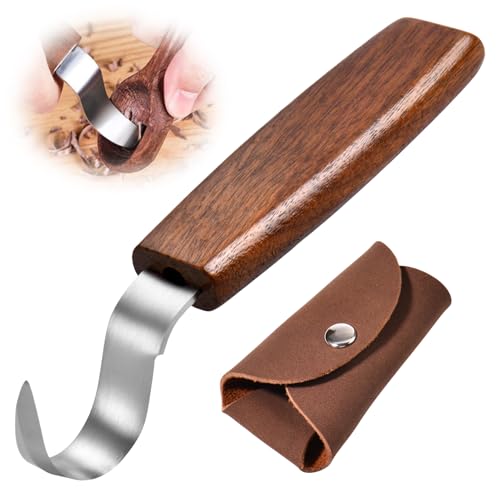
The LEONTOOL hook knife is the budget entry in this roundup, and it makes a different set of trade-offs from the Flexcut tools. Its curved blade is stainless steel rather than high-carbon steel, which lowers the sharpening frequency advantage of carbon steel but removes the rust worry that comes with storing a carbon blade in a damp workshop or taking it outdoors. The handle is walnut wood with an ergonomic shape, and the listing includes a leather sheath, a small but practical extra on tools at this tier, where sheaths are often sold separately.
The listing describes the knife as suited to spoons, bowls, and cups for beginners and experienced carvers alike. Stainless hook knives generally need a stone rather than just a strop once the edge dulls, so maintenance is a little more involved than with the 1095 blades above. Blade length and handedness are not stated in the listing data, so buyers who need a confirmed left-handed grind should choose the KNL26 instead. For a first hook knife bought to test the hobby, the LEONTOOL is the low-commitment route in.
Specs
- Model: Not stated
- Blade steel: Stainless steel
- Bevel: Curved hook profile
- Handle: Walnut wood
- Blade length: Not stated
- Included: Leather sheath
- Tier: Budget
5. Flexcut KN36 Radius Knife

The KN36 Radius Knife is the specialist in this group. Rather than a deep hook, it carries a curved-bevel radius blade in 1095 high-carbon steel, sized at 1.5 inches, on an ergonomic curved ash handle. A radius knife bridges the gap between a straight sloyd blade and a full hook: the curved bevel lets the edge follow shallow concave surfaces, so it cleans up the gentle hollow of a serving spoon, the inside of a shallow bowl, or the transition where a spoon bowl meets its neck.
Flexcut describes the blade as flexible, and that slight flex helps the edge stay engaged through long paring strokes instead of digging in at the ends of the curve. The KN36 is not a replacement for a true hook knife on deep kuksas or narrow cups, where a tighter hook radius is needed. It earns its place as a second knife: carvers who own a deep hook and find it leaving ridges in shallow work will get smoother finishing cuts from the radius profile. It sits in the mid-range tier.
Specs
- Model: KN36
- Blade steel: 1095 high-carbon steel
- Bevel: Curved bevel, radius profile
- Handle: Ash wood
- Blade length: 1.5 inches
- Handedness: Not stated
- Tier: Mid-range
How to Choose
Handedness comes first, because it cannot be worked around. A right-handed hook knife has its bevel ground for a right-handed pull cut; using it in the left hand puts the flat of the blade against the wood and makes the edge skate or dig. Buy the version that matches the hand that will hold the knife, which is why this roundup lists the KN26 and KNL26 as separate picks rather than one pick with a note.
Curve radius comes second. A tight hook, like the compact blade on the KNL26, turns inside small spoon bowls and cups but removes wood slowly in a large bowl. An open curve or a radius profile, like the KN36, covers more surface per stroke and leaves a smoother finish on shallow hollows, but cannot reach the bottom of a deep, narrow kuksa. Match the curve to the vessels carved most often.
Steel choice is third. The 1095 high-carbon steel in the Flexcut knives takes a keen edge and restores it with stropping, but it can rust if stored wet. The LEONTOOL’s stainless blade trades some of that easy maintenance for corrosion resistance. Finally, consider bevel style: a single-bevel hook like the KN52 tracks predictably in the cut, while double-bevel hooks cut on both push and pull strokes at the cost of some control.
Who Should Skip
Carvers who mainly make flatware handles, figures, or relief work do not need a hook knife at all; a sloyd knife and detail knife cover that work, and a hook blade will sit unused. Anyone who hollows bowls on a lathe or with power carving burrs should also skip this category, since those methods remove interior wood far faster than any hand hook.
A hook knife is also the wrong purchase for carvers unwilling to learn its specific grips. Hook knives cut toward the thumb and body in several standard grips and demand deliberate technique while learning. If that learning curve is unappealing, a bent gouge used with two hands offers a more forgiving route into hollowing spoons.
FAQ
What is the difference between a hook knife and a sloyd knife?
A sloyd knife has a straight or gently curved blade and shapes the outside of a spoon: the handle, the back of the bowl, and the outline. A hook knife has a strongly curved blade that reaches inside the bowl and pares the hollow. Spoon carving normally uses both, one for the exterior and one for the interior.
Can a left-handed carver use a right-handed hook knife?
It is possible but not advisable. The bevel on a right-handed hook knife is ground so the edge engages on a right-handed pull cut. In the left hand, the geometry works against the cut, which reduces control and increases the force needed. A true left-handed model such as the KNL26 is the safer and cleaner-cutting choice.
How do you sharpen a hook knife?
The inside curve of a hook blade cannot be sharpened on a flat stone. Carvers maintain the edge by stropping the bevel on a profiled leather strop or a dowel wrapped in abrasive paper. High-carbon blades like the Flexcut models respond well to regular stropping with compound and rarely need more.
What size hook knife is best for a first spoon?
A compact hook with a blade around 7/8 inch to 1.5 inches is the easiest starting point, because a shorter edge stays under control in a small spoon bowl. Larger, more open hooks remove wood faster in big bowls but punish sloppy technique. Most beginners are better served by control first and speed later.
Conclusion
The right hook knife matches the carving hand, the bowl size, and the maintenance routine a carver will actually keep up. The Flexcut KN52 is the premium single-bevel choice, the KN26 and KNL26 cover right- and left-handed carvers in the mid-range, the LEONTOOL lowers the cost of entry with a stainless blade and included sheath, and the KN36 Radius Knife finishes the shallow hollows a deep hook handles poorly. Pick by handedness first, then by curve.
Product and ASIN Reference
| Product | ASIN |
|---|---|
| Flexcut KN52 Sloyd Hook Knife | B078NF46Y2 |
| Flexcut KN26 Right-Handed Hook Knife | B000ZRW9Z2 |
| Flexcut KNL26 Left-Handed Hook Knife | B001BPEK9U |
| LEONTOOL Hook Knife with Leather Sheath | B0FLPFQJC8 |
| Flexcut KN36 Radius Knife | B00FG5L3NW |
Related guides
More from Amazon
Programs that pair well with the guide above. Offers and eligibility are set by Amazon and may change.
A free business account with business pricing and bulk-buying tools for work, shop or home office.
Create a business accountFree shipping on eligible items, Prime Video and more. Eligible new members can start with a free trial.
Start a Prime free trialAudiobooks and podcasts to listen to on the go. Eligible new members can start with a free trial.
Try Audible freeAd-free music streaming. Eligible new subscribers can start with a free trial.
Try Music Unlimited freeAs an Amazon Associate we earn from qualifying purchases.