
Key takeaways
- Compare six best hydraulic presses for home shops, from 6-ton to 50-ton H-frame models, with tonnage guidance, specs and safety tips.
What's inside
As an Amazon Associate I earn from qualifying purchases. This post may contain affiliate links at no extra cost to you.
For most home shops, the best hydraulic press is the VEVOR 20-Ton H-Frame with the two-speed pump and pressure gauge. Twenty tons covers bearings, bushings, U-joints and light straightening, and the second pump speed saves a lot of pumping before the ram touches the work. A hydraulic shop press is a frame, a bottle-jack-style cylinder and an adjustable bed that lets you push, pull, bend or straighten parts with controlled force. If your jobs are smaller, the 6-ton and 12-ton VEVOR models fit tighter floor space, while the two 50-ton machines are for heavy fabrication and shops with the electrical capacity to match.
This guide ranks six presses by what the listings state, explains how to match tonnage to the work, and flags the points worth confirming on each product page before you commit.
Quick List
- VEVOR 12 Ton H-Frame – best for bushings, ball joints and light straightening in a small garage
- VEVOR 20 Ton Two-Speed – best all-around press for a home shop
- Jojoka 20 Ton Carbon Steel – best for buyers who want stamping plates and an overload valve called out
- VEVOR 50 Ton Electric – best for heavy forming where hand pumping would be tiring
- HPDMC 50 Ton H-Frame – best for large, heavy parts with included floor press plates
- VEVOR 6 Ton H-Frame – best for light pressing and hobby-scale repair work
Which One Is Right for You?
| If you… | Choose |
|---|---|
| Want one press that handles most garage jobs | VEVOR 20 Ton Two-Speed |
| Press small bearings, bushings and pins only occasionally | VEVOR 6 Ton or VEVOR 12 Ton |
| Want a 20-ton frame with the overload valve named in the listing | Jojoka 20 Ton |
| Straighten or form thick steel regularly and have a strong circuit | VEVOR 50 Ton Electric |
| Need maximum frame size and force with a manual or bottle-jack style setup | HPDMC 50 Ton |
| Have very limited space and light work | VEVOR 6 Ton |
Most buyers land on 12 or 20 tons. Moving to 50 tons only makes sense if you already know you will use it, because the frame is much larger, heavier and harder to place in a typical garage. The electric model also adds a power requirement that the manual presses avoid.
All 6 Picks in Detail
1. VEVOR 12 Ton H-Frame – Best for Light Garage Pressing
As an Amazon Associate we earn from qualifying purchases at no extra cost to you.

This is the middle step between a hobby press and a full 20-ton machine. The listing describes a heavy-duty steel H-frame with an adjustable height bed and movable plates, aimed at bending, straightening and stamping. Twelve tons works out to roughly 24,000 pounds of force, which is plenty for wheel bearings in a hub, suspension bushings that are not rusted solid, and small U-joints.
In practice, the 12-ton class is where many garage owners settle because it forgives the occasional oversized job without demanding the floor space of a bigger frame. Set the bed height so the ram travels only a short distance, use proper bearing or bushing drivers that match the part diameter, and back the work with flat support plates on both sides of the press. Take it slowly: a clean, well-lubricated fit should move steadily, and a part that suddenly needs much more pressure is a warning to stop and check alignment.
It suits a one-car garage owner who works on a few vehicles a year and wants something that pays for itself the first time a bearing needs to come out without a hammer.
- 12-ton hydraulic capacity
- H-frame construction in heavy-duty steel
- Adjustable-height work bed
- Movable plates for bending and straightening
- Floor-standing layout
Pros
- Enough force for most routine automotive pressing
- Smaller footprint than 20-ton frames
Cons
- Stubborn, corroded press fits can exceed its capacity
- Pump speed details are not stated; confirm on listing
Compared with the 20-ton VEVOR, you give up headroom and the faster pump, but you also give up a lot of weight and floor space.
2. VEVOR 20 Ton Two-Speed – Best All-Around Home Shop Press

Twenty tons is the standard size for good reason. It handles nearly everything a home mechanic or fabricator throws at a press, and this model adds a two-speed pump and a pressure gauge. The two-speed pump closes the gap between ram and part quickly, then switches to a slower, higher-force stage, so you are not pumping a long stroke just to make contact.
Another practical benefit of the 20-ton class is how it handles mixed work. One afternoon it might press a rear axle bearing, the next it might flatten a bent bracket or seat a bushing in a control arm. The adjustable bed and movable plates in this kind of H-frame make those changes quick, and the gauge helps you notice when a job is asking for more force than you expected. If you only buy one press and want it to last through years of changing projects, this is the capacity class most people end up wishing they had started with.
The gauge matters more than it looks. Pressing a bearing with a visible pressure reading helps you tell a normal press fit from a part that is binding, and it gives you a repeatable number when you are making several identical parts.
- 20-ton capacity, which equals roughly 40,000 pounds of force
- Two-speed pump
- Pressure gauge
- H-frame in heavy-duty steel
- Adjustable floor-standing bed
Pros
- Fast approach stroke saves effort
- Gauge gives feedback during pressing
Cons
- Takes more floor space than a 12-ton
- Gauge scale and accuracy should be confirmed on the listing
Next to the Jojoka 20-ton, this one offers the two-speed pump and gauge, while the Jojoka lists stamping plates and an overload valve.
3. Jojoka 20 Ton Carbon Steel – Best for Stamping Plates and Overload Protection

The Jojoka lists carbon steel construction, an adjustable worktable, stamping plates and a safety overload valve. An overload valve is a relief valve that opens when pressure exceeds the design limit, which helps prevent you from pushing the jack past its capacity. It is not a substitute for judgment, but it is a useful safeguard when you are leaning on a stubborn part.
The stamping plates mentioned in the listing point to forming and marking work as well as pressing. Forming jobs behave differently from bearing jobs: the force builds gradually as metal yields, then can release suddenly, so keep the work centered and consider a guard in front of the press. Confirm the plate size and how they attach on the product page, since the title does not give dimensions. Buyers who do mostly bearing work will care less about the plates and more about the pump behavior, so weigh the two before choosing.
It suits a shop that wants a conventional 20-ton frame with a clear safety feature and accessory plates for forming and stamping work, and does not need a two-speed pump.
- 20-ton hydraulic capacity
- Carbon steel H-frame
- Adjustable worktable
- Stamping plates included per the listing
- Safety overload valve
Pros
- Overload valve is named in the listing
- Accessory plates broaden the range of jobs
Cons
- Pump speed and gauge are not mentioned; confirm on listing
- Plate dimensions are not stated in the title
The nearest alternative is the VEVOR 20-ton, which trades the named overload valve for a two-speed pump and a gauge.
4. VEVOR 50 Ton Electric – Best for Heavy Forming with Power Assist

This is a different class of machine. The listing describes a 50-ton electric hydraulic press with a 2.2 kW motor on 110V and an automatic fast ram movement. The motor does the pumping, which is a real advantage when you are straightening shafts, forming plate, or pressing large assemblies all day.
Think about the whole installation before ordering. A press this size should sit on a flat, strong concrete slab, ideally anchored, with clear space for long stock to pass through the frame. Because the motor does the pumping, you can concentrate on holding and aligning the workpiece instead of working a handle, which improves control on long straightening jobs. Check the listing for pressure-release controls and how the fast-ram stage hands over to full force, and plan for hearing and eye protection around the motor and pump.
Power is the key consideration. A 2.2 kW load at 110 volts draws about 20 amps, so it needs a dedicated circuit sized for it, not a shared garage outlet with a compressor or heater on it. Check the listing for the cord, plug and breaker requirement, and have an electrician confirm your wiring if you are unsure.
- 50-ton capacity, roughly 100,000 pounds of force
- 2.2 kW electric pump on 110V
- Automatic fast ram movement
- H-frame in heavy-duty steel
- Adjustable work bed
Pros
- No hand pumping for heavy work
- Large force reserve for forming and straightening
Cons
- High current draw on a standard-voltage circuit
- Large, heavy machine that needs a solid floor and space
Against the HPDMC 50-ton, this adds motorized operation; the HPDMC keeps things simpler and mechanical.
5. HPDMC 50 Ton H-Frame – Best for Large, Heavy Parts

The HPDMC is a 50-ton H-frame press that the listing says comes with floor press plates. The title is short, so many details are not stated: pump type, bed adjustment range and gauge all need confirming on the product page. What the name does tell you is the frame class and that plates are part of the package.
Because the listing title is brief, treat this model as a shortlist candidate rather than a final pick until you have read the full specification fields. Look for the bed opening width, maximum daylight between bed and ram, ram stroke, the type of jack or pump and whether a gauge is fitted. Those numbers decide whether it can accept the parts you have in mind, such as truck axle housings or long shafts. A press of this size also deserves proper floor anchoring and a plan for lifting heavy workpieces onto the bed.
It suits a shop with a real need for large capacity, such as agricultural equipment repair, trailer axles or heavy fabrication, and the floor space to hold a machine that size.
- 50-ton nominal capacity
- H-frame construction
- Floor press plates included per the listing
- Pump type: confirm on listing
- Bed opening and stroke: confirm on listing
Pros
- Very high capacity for the heaviest jobs
- Plates included for supporting work
Cons
- Overkill for typical bearing and bushing work
- Limited detail in the listing title
Compared with the VEVOR electric 50-ton, expect less automation and more physical effort per press.
6. VEVOR 6 Ton H-Frame – Best for Hobby-Scale Jobs
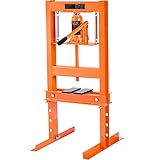
The smallest press here uses the same listing format as the 12-ton: a heavy-duty steel H-frame, an adjustable bed and movable plates for bending, straightening and stamping. Six tons is about 12,000 pounds of force. That is enough for small bearings, pins, pulleys and light sheet work, and it is a sensible choice if your projects are on the scale of motorcycle, bicycle, lawn equipment or jewelry-size forming.
The best use for a press this small is as a second, lighter machine or a first press for someone who is mainly learning. Pressing pins, small bearings, pulleys and bushings on lawn equipment, bicycles and small engines is well within its range. Keep the work centered, avoid pushing the ram to the end of its stroke and treat any part that resists as a sign to stop and rethink rather than pump harder. If you later add a larger press, this one still earns its place on the bench for delicate jobs.
It is not a good fit for automotive hub bearings or any job where you are unsure of the force required, because running out of capacity halfway through is frustrating and can damage parts.
- 6-ton hydraulic capacity
- H-frame in heavy-duty steel
- Adjustable bed height
- Movable plates
- Compact floor-standing size
Pros
- Smaller and easier to place
- Lowest capacity-related risk for delicate parts
Cons
- Easily outgrown
- Not suited to most automotive pressing
If you can spare the floor space, the 12-ton VEVOR is the safer next step up from this one.
Specs Compared
| Model | Capacity | Frame | Drive | Notable listed features |
|---|---|---|---|---|
| VEVOR 12 Ton | 12 ton | H-frame, steel | Hydraulic; pump type confirm on listing | Adjustable bed, movable plates |
| VEVOR 20 Ton Two-Speed | 20 ton | H-frame, steel | Two-speed pump | Pressure gauge |
| Jojoka 20 Ton | 20 ton | H-frame, carbon steel | Hydraulic; pump type confirm on listing | Stamping plates, overload valve, adjustable worktable |
| VEVOR 50 Ton Electric | 50 ton | H-frame, steel | Electric, 2.2 kW, 110V | Automatic fast ram movement |
| HPDMC 50 Ton | 50 ton | H-frame | Confirm on listing | Floor press plates |
| VEVOR 6 Ton | 6 ton | H-frame, steel | Hydraulic; pump type confirm on listing | Adjustable bed, movable plates |
How We Chose These
We worked from the product listings rather than from bench work. First we checked that every press has a stated tonnage and an H-frame layout, because those two facts determine what it can safely do. Then we compared the features each listing actually names: pump speed, gauge, overload valve, plates and motor details. We favored presses where the listing explains what the machine includes, and we flagged any that leave key details out. Capacity range also mattered, so the set runs from hobby size to heavy fabrication and gives a sensible step at each level. Where a spec is missing from a listing title, we say so and tell you to confirm it on the product page.
What to Look For
Match tonnage to the job
One ton of hydraulic capacity equals about 2,000 pounds of force. A 6-ton press therefore delivers around 12,000 pounds, a 12-ton about 24,000, a 20-ton about 40,000 and a 50-ton about 100,000. Most wheel bearings, ball joints, bushings and U-joints in passenger vehicles press in and out well within a 12- to 20-ton range, provided the parts are clean and properly supported. Rusted-in parts, large pulleys and anything heat-fit can need much more, which is where a heating torch and penetrating oil help more than extra tonnage.
A sensible rule of thumb: pick a press that is about twice your typical estimated need. If you expect to regularly press at 8 to 10 tons, a 20-ton frame leaves comfortable margin. Running a press near its limit every time shortens its life and leaves you no room when a part binds.
Frame, bed and daylight
The H-frame is the standard layout because the two uprights keep the load in line. Look at the bed opening width, the height range of the adjustable bed and the stroke of the ram. A press with a short stroke may not reach a deep part even when the capacity is adequate. Heavier steel and wider bases also reduce flex under load. If the listing does not state the dimensions, confirm them before you buy, particularly if you plan to press long shafts or tall assemblies.
Pump type: manual, two-speed or electric
A basic manual pump works fine for occasional jobs. A two-speed pump adds a fast approach, which saves time when the ram has a long way to travel. An electric pump removes the effort entirely and holds pressure steadily, which is helpful when you are straightening long parts or forming plate. Electric models need a power supply that matches their draw: a 2.2 kW motor on 110V pulls roughly 20 amps, so plan on a dedicated circuit and avoid extension cords.
Safety features and habits
A pressure gauge and an overload valve help you stay inside the machine’s limits. Neither replaces good practice. Wear safety glasses and a face shield, keep hands out of the pinch zone, and use support plates or pins that are rated for the load. Parts can release suddenly under pressure, and cast pieces, hardened bearings and brittle fasteners can shatter. Place a shield or heavy blanket in front of the work when pressing anything that could fail, and never stand directly in line with the ram.
Worked example: pressing a hub bearing that needs roughly 6 to 8 tons. A 12-ton press would work but leaves limited reserve if the bearing is seized. A 20-ton press leaves enough margin that you can stop, reposition and apply penetrating oil without worrying about the limit.
Floor space, weight and anchoring. Presses are tall and heavy. Check the overall height and weight, confirm your door and ceiling clearance, and put the machine on a level concrete floor. Many users bolt the base down so the press cannot walk or tip under load. Leave room around it for long workpieces.
Accessories that make a press more useful
The press itself is only half the setup. A set of bearing and bushing drivers, flat support plates, V-blocks for round stock and a few steel spacers let you handle a wide range of parts safely. Without them, people improvise with sockets and scrap metal that can crack or shoot out under load. Plan to add these accessories to your project list, and check which plates and adapters each listing includes so you do not buy duplicates.
Lubrication and maintenance matter too. Keep the ram clean, check the hydraulic fluid level periodically as the manufacturer directs, and inspect the frame welds and pins for cracks or bending before heavy work. A press that has been overloaded or dropped should be inspected carefully before it goes back into service.
Questions
What size hydraulic press does a home garage need?
For general automotive and repair work, a 12-ton or 20-ton press covers most jobs. The 20-ton adds margin for stubborn parts. Go to 6 tons only for light, small-part work.
Is a 50-ton press too much for a home shop?
Usually yes, unless you do heavy fabrication or work on large equipment. The frame is big and heavy, and the force can damage small parts if you are not careful. Most home users are better served by a 20-ton unit.
Can I run an electric hydraulic press on a normal outlet?
Not safely in every case. A 2.2 kW motor on 110V draws about 20 amps, which can trip a shared 15-amp circuit. Use a dedicated circuit that matches the listing and avoid extension cords.
What does a two-speed pump do?
It gives a fast, low-force stage to bring the ram to the work and a slower, high-force stage for the actual press. That cuts down on pumping when the ram has a long travel.
Do I need a pressure gauge?
It is not required, but it helps. A gauge lets you see how much force a press fit takes and gives you a repeatable reference for batches of parts.
How do I press parts safely?
Wear eye and face protection, support the part on rated plates or pins, keep your hands clear and stay out of line with the ram. Stop and reassess if a part binds instead of adding more pressure.
Update History
- October 20, 2026 – Initial publication; product set drawn from current catalog listings.
- Check the product page for current specifications and availability before buying.
Sources
- Retailer listing titles and specification fields for each press
- Manufacturer-style product descriptions for shop presses, used to understand typical features such as overload valves and two-speed pumps
- General electrical rule: power equals voltage times current, used for the 2.2 kW current estimate