
Key takeaways
- Compare six best metal bandsaws for home shops, from compact JET 5 x 6 saws to 8 x 14 geared head, with blade, speed and power tips.
What's inside
As an Amazon Associate I earn from qualifying purchases. This post may contain affiliate links at no extra cost to you.
The JET 8 x 14 geared head horizontal band saw is the best overall metal bandsaw in this group for a serious home shop. Its 1 HP motor, geared-head drive and larger cutting capacity suit steel bar, tube and angle stock that smaller saws struggle with. A metal bandsaw is a saw with a narrow, continuous blade that cuts steel, aluminum and other metals in a controlled, mostly straight line, usually with the stock clamped in a vise. If you cut less material or have limited space, the VEVOR 7 x 12 and the compact JET 5 x 6 and 5 x 8 models are smaller options, and one listed JET is a large vertical bandsaw that sits outside the usual home-shop metal-cutting class.
Quick List
- VEVOR 7 x 12 Horizontal/Vertical – best for value and a wide cutting window with a mitering head
- JET HVBS-56 5 x 6 – best for small shops that want to switch between horizontal and vertical cutting
- WEN BA4664 with Stand – best for entry-level cutting of light stock with a stand included
- JET Elite EVBS-20 20-Inch Vertical – runner-up, a large vertical three-phase bandsaw for shops with that power
- JET HBS-814GH 8 x 14 Geared Head – best overall for heavier, frequent cutting
- JET J-3130 5 x 8 – best for steady, no-frills horizontal cutting at moderate size
Which One Is Right for You?
| If you… | Choose |
|---|---|
| Cut steel bar, tube and angle weekly and want power in reserve | JET HBS-814GH |
| Want the biggest listed cutting window for the least outlay | VEVOR 7 x 12 |
| Want one small saw that can be set up for horizontal or vertical work | JET HVBS-56 |
| Are just getting started and need a stand included | WEN BA4664 |
| Want a simple horizontal saw with a bit more capacity than 5 x 6 | JET J-3130 |
| Have three-phase 230V power and need a big vertical saw | JET Elite EVBS-20 |
For most hobbyists, the real choice is between the VEVOR 7 x 12 and the JET horizontal saws. The VEVOR lists a larger rectangular capacity and a 1.1 kW motor; the JETs bring a longer track record, specific horsepower figures and, in the HBS-814GH, a geared drive. Read the voltage line carefully, because one model on this list needs three-phase power that most homes do not have.
All 6 Picks in Detail
1. VEVOR 7 x 12 Horizontal Band Saw – Best for Value and Cutting Window
As an Amazon Associate we earn from qualifying purchases at no extra cost to you.

The VEVOR lists a 7 x 12 inch rectangular cutting capacity, a 1.1 kW motor, 110/220V operation and a 0 to 45 degree adjustable angle. The listing also describes vertical cutting capability, which turns the saw into a stand-up cutter for small pieces you want to feed by hand. That mix of capacity and flexibility is its main attraction.
It suits a home fabricator who cuts square and round tube, flat bar and structural shapes for projects like trailers, gates and racks, and who wants the bigger window without paying for a larger-brand machine. Dual voltage is helpful if you ever move the saw to a shop with a 220V outlet.
When you first set up a new saw, check the vise for squareness to the blade with a combination square and make a test cut in scrap tube. If the cut is out of square or wanders, adjust the vise jaw, the blade guides and the tension per the manual. A few minutes of setup makes every later cut cleaner.
- 7 x 12 inch rectangular cutting capacity
- 1.1 kW motor
- 110/220V
- 0 to 45 degree angle adjustment
- Horizontal cutting with vertical cutting option
Pros
- Large capacity listed for the class
- Angle head and dual voltage add flexibility
Cons
- Blade speed options and blade size are not stated; confirm on listing
- Out-of-the-box setup and alignment may need attention
Compared with the JET HBS-814GH, it offers similar window sizes on paper but a less proven drive; the JET adds a geared head.
Because the listing is light on drive details, check what blade length it takes and how many blade speeds the saw offers before you buy blades. Metal cutting depends heavily on blade speed, and a saw with only one fixed speed is a poor match for stainless steel and for soft aluminum. A saw with a hydraulic or spring-assisted feed control will also cut straighter than one that drops under its own weight.
2. JET HVBS-56 5 x 6 Horizontal/Vertical – Best for Switching Modes in a Small Shop

The JET HVBS-56 is listed as a horizontal and vertical metal cutting band saw with a 1/2 HP motor on 115/230V single-phase power. The 5 x 6 designation describes its capacity class: a modest window suited to light fabrication. The combination of horizontal and vertical operation is the draw, since it gives you a production-style cut-off saw and a contour saw for small parts in one footprint.
It suits a hobby metalworker or a woodworker who now and then needs to cut steel, or a garage fabricator with limited space. Remember that a half-horsepower motor works fine for small stock but benefits from a patient feed rate on thick or hard material.
- 5 x 6 inch capacity as named in the listing (confirm round and rectangular limits)
- 1/2 HP motor
- 115/230V single phase
- Horizontal and vertical operation
- Brand: JET
Pros
- Dual-mode use in a small footprint
- Single-phase, dual-voltage motor suits home circuits
Cons
- Smaller window than the 7 x 12 or 8 x 14 saws
- Switching between modes takes setup time
Next to the J-3130, this one trades some capacity for the ability to run vertically.
Think about how often you would actually flip the saw into vertical mode. If most of your cutting is straight cut-off work, a dedicated horizontal saw is simpler to use and keep aligned, and the extra mode may go unused. If you often cut small curved or irregular parts out of sheet and plate, the vertical option becomes the reason to buy this model.
3. WEN BA4664 with Stand – Best Entry-Level Saw for Light Stock
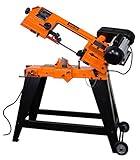
The WEN BA4664 is a metal band saw sold with a stand, which makes it a practical starter option: you can set it up on the shop floor without building a bench. The listing title does not give capacity, horsepower or blade speeds, so those specifics need to be confirmed on the product page. WEN’s metal saws in this class are generally aimed at small-diameter round stock and tube.
It suits someone who wants to cut conduit, small angle, EMT, threaded rod and light bar for repair work and craft projects, not production work. Expect to feed it slowly and clamp the stock firmly.
- Stand included
- Metal-cutting band saw
- Capacity: confirm on listing
- Motor and voltage: confirm on listing
- Blade speed range: confirm on listing
Pros
- Stand included in the package
- Approachable size for beginners
Cons
- Key specifications are not stated in the title
- Likely limited for heavy or thick material
It is the lightest-duty choice here; step up to the JET J-3130 if you expect bigger stock.
Because the stand is part of the offer, you save the time and effort of building a base. Check that the stand bolts to the saw securely and that it is stable when you load long stock. A saw that rocks while cutting will wander off line and wear blades quickly.
4. JET Elite EVBS-20 20-Inch Vertical – Runner-Up for Large Vertical Work, Not a Typical Home Metal Saw

This one does not fit the usual home-shop metal bandsaw profile, and it is placed here as a runner-up. The listing describes a JET Elite 20-inch vertical bandsaw with a 2 HP motor and 230V three-phase power. A 20-inch class vertical bandsaw is a large machine, commonly used for resawing and contour work in woodworking shops, and three-phase power is rare in homes. The listing does not describe it as a dedicated metal-cutting saw, so confirm blade options and speed ranges before assuming it is suitable for metal.
It suits a shop that already has three-phase power, or that plans to use a phase converter, and needs a large throat for contour cutting.
- 20-inch vertical class
- 2 HP motor
- 230V three-phase
- Elite series from JET
- Metal-cutting speeds and blades: confirm on listing
Pros
- Large throat and substantial motor
- Strong build class for contour work
Cons
- Three-phase power needed
- Not marketed here as a dedicated metal-cutting machine
For actual metal cut-off work, the JET HBS-814GH or any horizontal saw on this list is a more direct fit.
5. JET HBS-814GH 8 x 14 Geared Head – Best Overall for Heavier Cutting

The JET HBS-814GH is listed as an 8 x 14 inch geared head metal cutting horizontal band saw with a 1 HP motor on 115/230V single phase. Geared-head drives are chosen for their durability and steady power delivery, and they usually provide stepped blade speeds so you can match the saw to the material. Confirm the exact speed steps on the product page.
It suits a home shop that cuts a lot of structural steel and wants the saw to keep up. A 1 HP motor has the reserve to keep the blade moving through thicker sections, and the larger window handles wide flat bar and larger tubing.
A geared-head saw also tends to be quieter and more consistent under load than a belt-driven one, since power transfers through hardened gears rather than a slipping belt. The trade-off is that you change speeds by moving a lever or shifting gears instead of just swapping a belt on a pulley, so read the manual for the correct procedure. Keep the gearbox topped up with the lubricant the maker specifies.
- 8 x 14 inch capacity as named in the listing
- 1 HP motor
- 115/230V single phase
- Geared head drive
- Horizontal cutting
Pros
- Strong motor and drive for the class
- Large cutting window
Cons
- Heavy and takes up bench or floor space
- Needs a proper circuit when running on 115V
It outclasses the J-3130 on capacity and power; the trade is size and weight.
Running on 115V, a 1 HP motor can draw a double-digit amount of current, so wire it on a circuit that suits the nameplate and avoid thin extension cords. If you can run 230V, the draw is roughly halved and the motor starts more easily. Always confirm the voltage wiring instructions in the manual before changing the motor configuration.
6. JET J-3130 5 x 8 Horizontal – Best for Steady Moderate-Size Cutting

The J-3130 is a straightforward horizontal band saw listed at a 5 x 8 inch capacity, 1/2 HP and 115/230V single phase. It is a classic benchtop-class cut-off saw: place the stock in the vise, set the feed and let the saw do the work. The simplicity is the appeal, since there are fewer mode changes and fewer settings to get wrong.
It suits a home shop that mostly cuts bar, tube and angle up to a few inches and wants a tidy, dependable saw without the cost or bulk of a bigger machine.
Saws in this class typically use a gravity feed with an adjustable feed-rate control, so the cut speed is set by how fast the head is allowed to descend. A slower feed in harder material extends blade life and keeps the cut straight. Before each cut, check that the vise grips the stock firmly, the blade guides are set close to the material and the blade is tracking properly on the wheels.
- 5 x 8 inch capacity as named in the listing
- 1/2 HP motor
- 115/230V single phase
- Horizontal band saw
- Brand: JET
Pros
- Simple operation and moderate size
- Single-phase, dual-voltage motor
Cons
- Lower power than the 1 HP saw
- No vertical mode
Against the HVBS-56, you give up vertical cutting in exchange for a larger horizontal capacity.
Specs Compared
| Model | Capacity | Motor | Voltage | Orientation | Other |
|---|---|---|---|---|---|
| VEVOR 7 x 12 | 7 x 12 in rectangular | 1.1 kW | 110/220V | Horizontal, vertical cutting option | 0 to 45 degree angle |
| JET HVBS-56 | 5 x 6 in class | 1/2 HP | 115/230V, single phase | Horizontal and vertical | Confirm blade speeds on listing |
| WEN BA4664 | Confirm on listing | Confirm on listing | Confirm on listing | Confirm on listing | Stand included |
| JET Elite EVBS-20 | 20-inch vertical class | 2 HP | 230V, three phase | Vertical | Metal-cutting use: confirm on listing |
| JET HBS-814GH | 8 x 14 in class | 1 HP | 115/230V, single phase | Horizontal | Geared head |
| JET J-3130 | 5 x 8 in class | 1/2 HP | 115/230V, single phase | Horizontal | Confirm blade speeds on listing |
How We Chose These
We built this list from the product listings and from published blade and machine selection guidance. We started with what each listing actually states: cutting capacity, motor power, voltage and orientation. Then we asked a practical question for each saw: does it suit a home or small-shop setting with ordinary single-phase power? The three-phase vertical model failed that test and is labeled as a runner-up for that reason. We also weighed how clearly each listing described the drive, because blade speed control matters more in metal than in wood. Where a listing leaves out a figure, we say to confirm it on the product page rather than guess.
What to Look For
Capacity: read the window, not just the headline
Capacity figures like 5 x 6 or 8 x 14 describe the largest rectangular stock that fits the vise at a straight cut. Round capacity is usually smaller than the long side of the rectangle, and mitered cuts reduce it again, often substantially at 45 degrees. If you cut 4 inch square tube at an angle, a saw with a nominal 5 inch window can be too small. A good rule is to choose a saw with a window at least one size above your largest regular stock.
Motor power, drive and blade speed
Metal bandsaws are limited by blade speed as much as by horsepower. Published blade guides commonly suggest roughly 200 to 300 surface feet per minute for mild steel, noticeably slower for stainless steel, and much faster for aluminum, though the exact numbers vary between suppliers. A saw with only one speed cannot serve all three well. A geared head or stepped pulley arrangement gives you the speed range you need. Half-horsepower saws are fine for small stock; step up to 1 HP or more if you routinely cut thick sections or hard alloys.
Blades, tooth pitch and teeth in the cut
Tooth pitch is measured in teeth per inch, or TPI. The core rule is to keep at least three teeth in the cut at all times so the teeth do not strip. A worked example: cutting 1/2 inch mild steel plate with a 14 TPI blade puts about seven teeth in the cut, which is comfortable. Thin-wall tube and angle need a finer pitch, in the range of 14 to 24 TPI, while solid bar and thick sections use a coarser pitch of roughly 6 to 10 TPI. Bi-metal blades are the standard choice for home shops because they resist heat and wear better than carbon blades. Break in a new blade by feeding gently for the first several cuts.
Power supply and safety
Match the saw to your electrical service. Single-phase 115/230V motors, like those on the horizontal JET saws, suit most homes. Three-phase machines need either three-phase service or a converter. On 115V circuits, larger motors draw substantial current, so use a dedicated circuit and a short heavy cord if you must. Always clamp the stock firmly, keep guards in place, wear eye protection and avoid loose clothing and gloves near the moving blade. Support long stock on a roller stand at the same height as the vise so the cut does not bind.
Coolant helps as well. A small amount of cutting fluid or wax lubricant extends blade life, particularly on stainless steel and aluminum, and reduces the heat that dulls teeth.
Whichever saw you choose, plan to keep spare blades on hand. A blade that is dull, overheated or twisted will cut poorly no matter how good the machine is, and a new bi-metal blade is the simplest upgrade you can make. Keep a small container of cutting fluid or wax stick nearby, wipe chips off the table after each session to avoid rust and always unplug the saw before changing the blade or adjusting the guides.
Questions
Is a horizontal or vertical metal bandsaw better for a home shop?
A horizontal saw is better for cutting stock to length because the weight of the saw feeds the blade through a clamped piece. A vertical saw is better for contour cutting and hand-feeding small parts. Combination saws try to do both and are useful when space is limited.
Can I use a wood bandsaw to cut metal?
Only with the right blade and speed, and many wood bandsaws run too fast for steel. Non-ferrous metals such as thin aluminum can sometimes be cut with a suitable blade, but check the manufacturer’s guidance first. A dedicated metal saw with slower speeds is safer and cuts better.
What does 5 x 6 mean on a band saw?
It describes the largest stock that fits at a straight 90 degree cut, usually height by width for rectangular material. The usable size shrinks at mitered angles, and round capacity may be smaller.
Do I need 220V for a metal bandsaw?
Not for the saws on this list that support 115V, but running 230V where possible reduces current draw. Check each listing and manual for wiring details. Three-phase machines are a different case and need three-phase supply.
How do I choose a blade?
Match the TPI to the stock thickness so at least three teeth are in the cut, and use bi-metal blades for general steel work. Slower speeds suit stainless steel, and coarser blades suit aluminum.
Why does my saw cut crooked?
Common causes include a dull blade, too much feed pressure, loose guides or a poorly clamped workpiece. Slow the feed, check blade tension and guide alignment, and make sure the stock cannot shift.
Update History
- October 20, 2026 – Initial publication; product set drawn from current catalog listings.
- Check the product page for current specifications and availability before buying.
Sources
- Retailer listing titles and specification fields for each saw
- Published band saw blade selection guides from saw blade suppliers, used for general speed and tooth-pitch ranges
- General electrical practice for motor circuits and voltage selection