
Key takeaways
- A guide to the best anvils for hobby blacksmiths: VEVOR 116, 55 and 25 lb cast steel anvils and small bench blocks, plus sizing and mounting tips.
What's inside
As an Amazon Associate I earn from qualifying purchases. This post may contain affiliate links at no extra cost to you.
The VEVOR 55-pound single horn anvil is the sensible best overall pick for a hobby blacksmith who needs a real forging surface without a shop-floor budget or a fixed stand, while the 116-pound VEVOR is the better long-term anvil if you have the space and a sturdy stump. Weight is the main facet that matters: an anvil’s mass absorbs hammer blows, so heavier anvils move less metal-energy into the bench and rebound more of it into your workpiece. This guide covers six listings, from a serious 116-pound cast steel anvil down to three small bench blocks that are better suited to jewelry and light metalwork than to forging.
Quick List
- VEVOR 116 lb Single Horn Cast Steel Anvil – best for a permanent forge setup with a dedicated stand
- VEVOR 9 lb Single Horn Cast Steel Anvil – best as a compact travel or bench anvil for small projects (light-duty)
- Mini Horn Anvil Bench Block (cast iron) – best for jewelry-scale work and shaping, a runner-up for forging
- VEVOR 55 lb Blacksmith Anvil – best overall for a first forging anvil
- Hyecen 3 lb Mini Horn Anvil Set with Rubber Hammer – best for jewelry making and craft, not for blacksmithing (runner-up)
- VEVOR 25 lb Single Horn Cast Steel Anvil – best for small knife, hook and bracket work on a budget
Which One Is Right for You?
| If you… | Choose |
|---|---|
| want a first anvil that can handle general forging with a 2 to 3 lb hammer | VEVOR 55 lb |
| have a permanent shop, a heavy stump and want the most mass for the money | VEVOR 116 lb |
| make small hooks, hardware and decorative pieces and need to move the anvil often | VEVOR 25 lb |
| need something to tuck into a bag for demonstrations or very small work | VEVOR 9 lb |
| make jewelry and want a small shaping block | Mini Horn Anvil Bench Block |
| want a starter set with a hammer for jewelry or craft metalwork | Hyecen 3 lb Set |
For genuine blacksmithing, treat the 25 lb as the practical floor and the 55 lb and 116 lb as the serious choices. The 9 lb, the cast iron bench block and the Hyecen 3 lb set are listed here because they appear in the same category, but they are small-scale tools, and a beginner who buys one expecting to forge steel bars will be disappointed.
All 6 Picks in Detail
1. VEVOR 116 lb Single Horn Cast Steel Anvil – Best for a Permanent Forge Setup
As an Amazon Associate we earn from qualifying purchases at no extra cost to you.

This is the largest anvil in the group, a single horn cast steel anvil weighing 116 pounds, with a large countertop and a stable base according to the listing. For a hobbyist who has committed to forging as a regular activity, mass is the most valuable feature, and this one offers more of it than the others combined. A large flat face gives room for drawing out stock and working larger pieces, while the horn handles curves and scrolls. Plan on a dedicated stand or a thick hardwood or steel base, because it is far too heavy to sit on a workbench.
A worked example shows why the extra weight matters. A smith swinging a 2.5 lb hammer would, by the common 50-to-1 guideline, want an anvil near 125 lb, so the 116 lb VEVOR is close to that ideal while a 25 lb anvil is a fifth of it. In practice the heavy anvil feels dead and quiet under the hammer, while the light one rings, hops and tires your hand. That difference is the reason many forum veterans say to buy the heaviest anvil you can mount, then build the stand around it.
- Weight: 116 lb (per the title); some reseller descriptions mention a 110 lb class, so confirm on the product page
- Construction: cast steel, single horn, high-hardness face per the listing
- Features: large countertop (working face) and stable base
- Reseller data for this size lists a pritchel hole and a larger hardy hole; confirm sizes on listing
- Hardness rating: not stated in the sources we checked; confirm on listing
Pros
- Plenty of mass for efficient forging
- Large face for bigger stock
Cons
- Heavy to move and requires a strong stand
- Hardness is not clearly documented
It is the upgrade path from the 55 lb model: choose it if you already know you will keep forging for years and have a place to leave it.
2. VEVOR 9 lb Single Horn Cast Steel Anvil – Best as a Compact Travel Anvil (Light-Duty)

The listing calls this a compact single horn cast steel anvil with a stable base, labeled for forge tools and equipment. At nine pounds it is a small-scale anvil, so it is not a primary forging surface. A light mass bounces and walks when hit with a heavy hammer, so it is best used for tiny work, straightening, fine shaping, cold work on thin material or as a portable second anvil for demonstrations. Treat it as an accessory to a larger anvil rather than a first anvil for blacksmithing.
Where a nine-pound anvil earns its place is in the margins of a shop. Straightening a bent nail, setting a rivet, dressing a small chisel or dishing a tiny piece of copper are all jobs where a heavy anvil is overkill and a light block is handy. Clamp it in a vise or bolt it to a thick board so it cannot jump, and expect noise, because a small mass rings loudly.
- Weight: 9 lb (per the title)
- Construction: cast steel, round horn, per the listing
- Design: compact with a stable base
- Hardy and pritchel holes: confirm on listing
- Hardness rating: confirm on listing
Pros
- Easy to carry and store
- Useful for small shaping tasks and demonstrations
Cons
- Too light for forging steel bar with a normal hammer
- Will move on a bench unless clamped or bolted
Compared with the 25 lb VEVOR, this is portable but far less capable, so choose it only as a supplementary tool.
3. Mini Horn Anvil Bench Block – Best for Jewelry-Scale Shaping (Runner-Up for Forging)
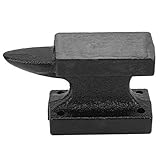
This listing is a mini cast iron horn anvil bench block, with the text positioning it for jewelry making and workbench use. It is not an anvil in the blacksmithing sense. Cast iron is more brittle than cast or forged steel, and a small bench block can chip if struck hard with a steel hammer. It belongs in a jewelry kit, next to a ring mandrel, rather than in a forge area. We include it as a runner-up because it appears in the category, but if your goal is forging, look elsewhere.
If you are tempted by the low weight and size for forging, consider what happens at the first hot blow: the block skitters on the bench, the small face leaves no room for the workpiece, and a brittle casting risks chipping at the edge. Used as intended, with a light chasing or planishing hammer on annealed copper, silver or brass wire and sheet, it is a perfectly useful small tool and takes up almost no space.
- Material: cast iron, per the title
- Type: mini horn anvil bench block, jewelry-scale
- Weight and dimensions: confirm on listing
- Face finish and hardness: confirm on listing
- Suggested use: light shaping of soft metals such as copper, silver and brass
Pros
- Small and inexpensive way to shape wire and sheet
- Fits on a bench or in a drawer
Cons
- Not intended for hot forging
- Cast iron can chip under heavy blows
The Hyecen set is its nearest alternative, and it adds a small hammer for people starting jewelry or craft work.
4. VEVOR 55 lb Blacksmith Anvil – Best Overall for a First Forging Anvil

At 55 pounds (25 kg), this VEVOR listing is described as a single piece of iron with square holes, intended for blacksmiths and metalworkers. It sits in the middle of the range, heavy enough to give you a stable forging surface for small and medium stock when it is firmly mounted, and light enough to be moved by one person for storage. For most hobbyists making knives, hooks, hinges and decorative pieces, a 50 to 60 lb class anvil is a realistic first purchase. VEVOR’s own product pages describe other cast steel anvils at around 50 HRC, but this listing’s title says iron, so confirm the material and hardness on the product page.
Sizing up the horn and face matters at this weight. Because 55 pounds is still modest, the face is relatively short, so plan on working shorter bars or heating in sections. Fasten it to a stump with heavy lag screws or through-bolts, or sit it on a steel frame with rubber or wood damping under the feet to quiet the ring. If the material turns out to be softer than you want, light peening of the edges is a sign to stop hitting directly with a hardened hammer face.
- Weight: 55 lb (25 kg) per the title
- Material: described as single-piece iron in the title; confirm steel versus iron on listing
- Features: square holes (hardy and pritchel), per the title
- Face dimensions: confirm on listing
- Hardness rating: confirm on listing
Pros
- A genuine forging-class weight for a modest outlay
- Square holes accept hardy tools and support work like bending jigs
Cons
- Still light for heavy hammering of large stock
- Material description needs checking
It is the sweet spot between the 25 lb and the 116 lb, and the better first anvil unless you know you want the heavier one.
5. Hyecen 3 lb Mini Horn Anvil Set with Rubber Hammer – Best for Jewelry and Craft (Not for Blacksmithing)

The Hyecen set bundles a three-pound forged iron mini horn anvil with a rubber hammer, aimed at jewelry making, craft metalwork and small forge kits. A three-pound block is a bench tool for shaping wire, flattening small pieces and teaching, not an anvil for forging heated steel. We list it as a runner-up because it shows up in the anvil category, but it should not be your main anvil. A rubber hammer is useful for shaping soft metals without marring them, though it will do nothing to hot steel.
Think of this as a teaching and finishing kit. A rubber or small jewelry hammer lets you curve sheet into a bangle, flatten a ring blank or tap out a dent in a thin copper piece with little risk of marking it. If your longer-term plan is forging, buy this kit only if you also want to try jewelry, and put the larger share of the budget toward a 25 lb or heavier steel anvil.
- Weight: 3 lb (per the title)
- Material: forged iron, per the title
- Included: rubber hammer and a jewelry hammer or block set, per the title
- Intended use: jewelry and craft work
- Face size and hardness: confirm on listing
Pros
- Complete starter set for small craft projects
- Compact and quiet to use
Cons
- Far too light for forging
- Included hammers are not blacksmith hammers
If you want something a little more substantial than the mini bench block, this set is the one, but both are far from the VEVOR 25 lb in capability.
6. VEVOR 25 lb Single Horn Cast Steel Anvil – Best for Small Forging Projects on a Budget

A 25-pound cast steel anvil with a rugged round horn and a stable base, this listing is the entry point for real forging. VEVOR’s own pages for this size cite about 50 HRC on the working surface, a working face of roughly 12 by 2.5 inches and a rebound above 70 percent; treat those as manufacturer claims. Twenty-five pounds is light, but it is enough for small hot work such as hooks, nails, small tools and skewers if you mount it firmly to a stump or steel stand and use a light hammer.
A practical use case: an afternoon of making S-hooks, coat hooks and fire pokers from quarter-inch round or square stock. A 25 lb anvil can do that, provided it sits on a heavy base and you keep your hammer around 1.5 to 2 lb. Move up in weight when you start drawing out larger bars or making knives, since the anvil will start to move and sap your blows.
- Weight: 25 lb (per the title)
- Construction: cast steel, round horn, per the listing
- Reported working face: about 12.3 by 2.5 inches (manufacturer figure)
- Reported hardness: about 50 HRC (manufacturer figure); confirm on listing
- Mounting: stable base; fasten it down before use
Pros
- Light enough to move and store
- Real cast steel and a horn for bending
Cons
- Limited mass means more bounce and rebound with heavy hammers
- Narrow face restricts larger work
Choose it over the 9 lb for actual forging, and over the 55 lb if budget, weight or space is the constraint.
Specs Compared
| Product | Weight | Material | Horn | Best role |
|---|---|---|---|---|
| VEVOR 116 lb | 116 lb | Cast steel | Single round horn | Primary forging anvil |
| VEVOR 9 lb | 9 lb | Cast steel | Single round horn | Light-duty, portable |
| Mini Horn Anvil Bench Block | Confirm on listing | Cast iron | Mini horn | Jewelry-scale shaping |
| VEVOR 55 lb | 55 lb (25 kg) | Single-piece iron per title; confirm | Horn; confirm on listing | First forging anvil |
| Hyecen 3 lb Set | 3 lb | Forged iron | Mini horn | Jewelry and craft |
| VEVOR 25 lb | 25 lb | Cast steel | Single round horn | Small forging projects |
How We Chose These
We assembled this roundup by reading product titles, listing bullets and manufacturer product pages, then sorting each anvil by weight class and material. The criteria were stated mass, construction (cast steel versus cast or forged iron), the presence of a horn and tool holes, how clearly the listing states hardness or working-face size, and whether the product is actually suited to forging. Where a listing targets jewelry or craft rather than blacksmithing, we say so and place it as a runner-up. This guide is based on research, so any specification a listing does not state is marked for you to confirm on the product page.
What to Look For
Weight Is the Main Spec
An anvil works because its mass resists the hammer blow, so more weight means more of your swing goes into the hot steel instead of into moving the tool. A frequently cited rule of thumb among smiths is that the anvil should weigh roughly 50 times the weight of the hammer head. With a 2 lb hammer that suggests about 100 lb, though many hobbyists work happily on 50 to 100 lb anvils with lighter hammers. Anvils below 25 lb tend to bounce and shift, and those under 10 lb are best understood as bench blocks rather than forging tools.
Cast Steel, Cast Iron and Forged Anvils
Cast steel anvils, like the VEVOR models with a hardened face, are tough enough to take a steel hammer. Cast iron, used in many small bench blocks, is more brittle and can chip or crack, so it is best for light shaping of soft metals. Traditional anvils are forged, often with a hardened steel face welded to a body; those are uncommon among budget listings. If a listing says only “iron” without more detail, check the product page, because “iron” can refer to cast iron or ductile iron, and the difference matters for durability.
Face, Horn and Holes
The flat face is where most work happens, so a longer and wider face is more useful than a long horn. The horn is for bending curves and scrolls. A hardy hole, usually square, holds cutting and bending tools, and a smaller pritchel hole is for punching and holding stock. For a first anvil, you want at least a hardy hole and a smooth, flat face with reasonably crisp edges. Rounded edges are friendlier for bending, while sharp edges can mark stock.
Hardness and Rebound
Hardness is usually given on the Rockwell C scale. Listings for several VEVOR cast steel anvils cite about 50 HRC for the working surface, a value in the range commonly used for tool faces. A quick field test used by smiths is the ball-bearing rebound test: drop a steel ball onto the face and see how high it bounces. A good anvil returns a large share of the drop height, and a dead or soft face returns little. Manufacturer claims vary between listings, so treat them as nominal until you can check the anvil yourself.
Mounting and Safety
An anvil that moves wastes energy and is a hazard. Mount heavy anvils on a stump or steel stand at about knuckle height, which is close to the height of your fist with your arm hanging at your side. Bolt or strap smaller anvils to a heavy base. Wear eye protection, hearing protection and natural-fiber clothing, keep a clear space around the anvil, and never strike a hardened anvil face with a hardened hammer, because chips can fly off.
Setting Up a Safe Forge Corner
An anvil is only one part of the setup. You also need a forge or heat source, tongs that fit your stock, a quench bucket and a clear floor. Keep the anvil within a step or two of the forge so hot metal does not cool while you carry it, and leave a clear arc behind you for the hammer swing. Fire-resistant clothing, closed leather shoes, safety glasses and hearing protection are the baseline. Keep a bucket of water and a fire extinguisher nearby, work outdoors or in a well-ventilated space, and never forge on a concrete floor that has not cured, because trapped moisture can cause spalling.
Questions
What size anvil do I need as a beginner?
For general hobby forging, 50 to 100 pounds is a good range. A 25-pound anvil works for small items if firmly mounted, while anything below 10 pounds is a bench block. Choose the heaviest anvil you can mount safely.
Are cheap cast steel anvils any good?
They can be serviceable for hobby work, especially at 25 to 116 pounds, if the face is flat and hard enough. Quality varies between units, so check the face and hole sizes when it arrives and run a ball-bearing rebound test if you can.
Can I use a mini anvil for forging?
Not for hot forging steel. Mini anvils under about 10 pounds are for jewelry and cold shaping of soft metals, because they move under the hammer and cannot absorb heavy blows.
How should I mount an anvil?
Set it on a stump, a thick hardwood block or a steel stand so the face sits roughly at your knuckle height when you stand. Fasten it with straps, bolts or chains so it cannot walk, and keep the base wide for stability.
Do I need a hardy tool?
Not at first. A hardy tool fits the square hole and is used for cutting and bending; it helps once you are comfortable at the forge. Check that the hole size on your anvil matches any hardy tooling you plan to buy.
How do I care for an anvil?
Keep the face dry and lightly oiled to prevent rust, brush off scale after use and avoid striking it with another hardened tool. Light surface rust can be wiped away with a wire brush and oil.
Update History
- October 20, 2026 – Initial publication; product set drawn from current catalog listings.
- Check the product page for current specifications and availability before buying.
Sources
- Manufacturer product pages for VEVOR cast steel anvils
- Retailer listing titles and specification fields for each anvil and bench block