
Our Top Picks

What's inside
As an Amazon Associate I earn from qualifying purchases. This post may contain affiliate links at no extra cost to you.
The VEVOR 6.5-inch swivel bench vise is the best overall pick here for general metalworking, because it combines a wide 6.5-inch jaw, a 5-inch opening, a built-in anvil and a swivel base that lets you turn the work without unbolting anything. It is not the only strong choice: the Wilton 550P suits shops that value a long-established brand, and the Wilton 6-inch Apprentice stands out for jaw width and pipe capacity. A bench vise is the fixed clamp that holds metal while you cut, file, bend or drill it, and the jaw width is the first number to compare. This guide covers six vises from 4 to 6.5 inches.
Quick List
- Wilton 6-inch Apprentice Vise (WVA6) – best for a wide jaw, deep throat and big pipe capacity from a known brand
- VEVOR 6-inch Swivel Bench Vise – best for general fabrication with a locking 360-degree base
- VEVOR 6.5-inch Swivel Bench Vise – best overall for home and garage metalworking
- PONY 4-inch Heavy Duty Bench Vise – best for a compact bench or tight workspace
- Wilton 550P Multi-Purpose Vise – best for shops that want a swivel base, rotating head and replaceable jaws
- Nakkaa 5-inch Ductile Iron Bench Vise – best for mid-size jobs with a lockable swivel base
Which One Is Right for You?
| If you… | Choose |
|---|---|
| work on welded frames, brackets and mixed fabrication and want one general-purpose vise | VEVOR 6.5-inch |
| clamp pipe often and want a wide jaw with a deep throat | Wilton 6-inch Apprentice (WVA6) |
| want a vise that turns both at the base and the head and has replaceable jaws | Wilton 550P |
| need a 6-inch class vise with a locking swivel base and a bundled anvil face | VEVOR 6-inch |
| have a small bench or a modest budget and light-to-medium work | PONY 4-inch |
| want a middle size, lockable swivel and ductile iron construction | Nakkaa 5-inch |
Start with the jaw width that matches your usual stock and the bench you have. Four-inch vises suit small parts and tight benches, five-inch models handle most garage work, and six inches or more give you leverage for pipe, bar and larger weldments. Beyond size, material (ductile iron versus gray cast iron) and swivel features are the main differentiators.
All 6 Picks in Detail
1. Wilton 6-inch Apprentice Vise (WVA6) – Best for a Wide Jaw and Pipe Work
As an Amazon Associate we earn from qualifying purchases at no extra cost to you.

The Wilton Apprentice 6-inch vise has little detail in its listing title, so most of what we know comes from the product data and Wilton’s materials. Reported specs point to a 6-inch jaw width, about a 6-inch opening, a throat depth near 3.75 inches, pipe capacity from roughly 1/4 to 3 inches and a ductile iron body, with an anvil surface on the back. It weighs about 25.7 pounds, which is lighter than the swivel models and suggests a fixed base. It fits a smaller shop or one that wants a wide jaw without extra weight.
Because the listing itself is sparse, treat the figures above as a starting point and read the product page for the exact dimensions and base design before you buy. If the vise turns out to have a fixed base, that is not a drawback for the work it is best at: sawing, filing, pipe threading and general repair, where rigidity counts for more than flexibility. A lighter body also means you can bolt it to a modest bench without worrying about racking the top.
- Jaw width: 6 in (per the model name)
- Opening and throat: about 6 in and 3.75 in per the product data; confirm on listing
- Pipe capacity: about 1/4 to 3 in per the product data; confirm on listing
- Material: ductile iron per the product data; confirm on listing
- Swivel base: not stated in the sources we found; confirm on listing
Pros
- Generous jaw width, opening and pipe range for its weight
- Established brand with an anvil face
Cons
- Listing offers little detail
- No confirmed swivel base
Against the Wilton 550P, the Apprentice has the larger jaw and the lighter body, while the 550P adds swivel features.
2. VEVOR 6-inch Swivel Bench Vise – Best for General Fabrication with a Locking Base

The VEVOR 6-inch vise has a 6-inch jaw width, a 5.9-inch jaw opening, a 360-degree swivel locking base and a built-in anvil. The listing calls out heavy-duty ductile iron construction. The swivel base lets you rotate the vise to any angle without moving the work, which helps with long bars and awkward shapes. It is a good fit for a hobbyist who fabricates, repairs equipment and occasionally clamps pipe, and who wants a larger jaw than the typical 4-inch starter.
Two details are worth checking when it arrives: how smoothly the screw runs through its full travel, and whether the locking lever on the swivel base holds the head from creeping under load. Budget castings can show rough edges or casting flash, which is easy to dress with a file. Use it for cutting, filing, bending bar and holding parts for welding prep, and keep heavy hammering to the anvil face rather than the jaws.
- Jaw width: 6 in
- Jaw opening: 5.9 in
- Base: 360-degree swivel with a locking mechanism
- Material: ductile iron per the title; confirm body details on listing
- Extras: built-in anvil; clamping force and weight, confirm on listing
Pros
- Large jaw and lockable swivel base
- Anvil surface for light hammer work
Cons
- Check the finish and fit on arrival, since budget castings vary
- Jaw plates may need replacing eventually
It is almost a smaller sibling of the 6.5-inch VEVOR; take the 6.5 if you want the extra jaw width and the stated clamp force.
3. VEVOR 6.5-inch Swivel Bench Vise – Best Overall for Home and Garage Metalworking

This VEVOR model has a 6.5-inch jaw width, a 360-degree swivel base and a stated 5620 pounds of clamping force, and it is marketed for pipe repair and metalworking. VEVOR’s product pages describe a 5-inch maximum jaw opening, a 3-inch throat and ductile iron construction, with a weight of about 39 pounds, and say the head rotates as well as the base. That is a sizable, stable vise for a garage bench, and the extra jaw width is helpful when you clamp angle iron or larger flats.
A useful way to size it: a 6.5-inch jaw holds a 6-inch wide flat bar fully across its face, which keeps the part from rocking while you grind or file. The 3-inch throat gives room for tall workpieces, and the pipe jaws handle common plumbing and conduit sizes. If you plan to bolt the vise to a wooden bench, add a steel backing plate underneath so the 39-pound body and the force of the clamp do not pull the bolts through the top.
- Jaw width: 6.5 in
- Opening and throat: about 5 in and 3 in per manufacturer pages; confirm on listing
- Base: 360-degree swivel; head rotation per manufacturer pages
- Clamp force: 5620 lb claim from the manufacturer
- Weight: about 39 lb per manufacturer pages
Pros
- Wide jaw and strong stated clamp force
- Swivel base and head offer many work angles
Cons
- A bit heavy; mount to a robust bench
- Clamp force is a manufacturer claim, not a measured value
Against the Wilton 550P, it gives more jaw width and a higher clamp claim, while the Wilton offers a longer brand track record.
4. PONY 4-inch Heavy Duty Bench Vise – Best for Compact Benches
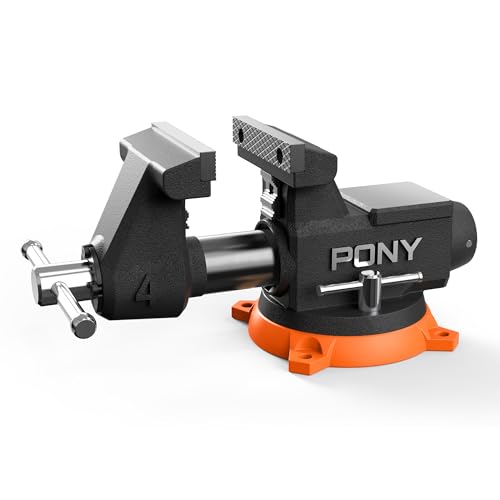
PONY’s 4-inch heavy duty vise claims 4400 pounds of clamping force and comes with a 360-degree rotatable base and an anvil, according to its title. A 4-inch jaw is the smallest in this group, which makes it a sensible choice for small workshops, apartment balconies, boat lockers and anyone whose work involves smaller parts. It will handle sawing, filing and light bending, though it is not the vise for large pipe or heavy weldments.
Smaller vises are often underrated. For electronics enclosures, brackets, model-making, knife handle work and small engine repair, a 4-inch jaw is plenty, and the lower weight lets you mount it on a portable bench or a workstation that you move around the garage. If you often find yourself reaching for a bigger vise to hold a pipe or a long bar, though, spend the extra on the 5-inch or 6-inch classes now rather than upgrading later.
- Jaw width: 4 in
- Clamp force: 4400 lb claim from the title
- Base: 360-degree rotatable
- Extras: anvil surface, per the title
- Weight, jaw opening and material: confirm on listing
Pros
- Compact, with a swivel base
- Good for small work on a small bench
Cons
- Limited jaw width for larger stock
- Material and weight need checking on the listing
The Nakkaa 5-inch is the nearest step up in size, with a larger jaw and a lockable swivel.
5. Wilton 550P Multi-Purpose Vise – Best for Swivel Base, Rotating Head and Replaceable Jaws
The Wilton 550P (stock number 28824) has a 5-1/2-inch jaw width, a 5-inch maximum jaw opening and a 2-3/4-inch throat, as the title states. Wilton’s materials describe a 360-degree swivel base, a rotating head indexed at 30-degree steps, replaceable serrated steel jaws, a V-jaw for round stock and a built-in anvil. It weighs about 40 pounds, with gray cast iron in the body and ductile iron in the base. It is a familiar choice for mixed metalworking and light fabrication.
The replaceable jaw faces are a real advantage on a working vise. Serrated jaws wear and fill with metal dust, and swapping them restores grip without replacing the whole casting. The built-in anvil is fine for light straightening and riveting. Mounting needs four bolts through a solid bench, and the swivel lock should be snug before you start hard work, because the 360-degree base can shift if it is left loose.
- Jaw width: 5-1/2 in
- Jaw opening: 5 in; throat: 2-3/4 in
- Base and head: 360-degree swivel base and a rotating head per Wilton
- Pipe jaws: about 5/8 to 2-1/4 in per Wilton
- Weight: about 40 lb per Wilton
Pros
- Brand with long record and replaceable jaws
- Rotating head plus swivel base
Cons
- Narrower jaw than the 6-inch models
- Gray cast iron body is more brittle than ductile iron
Choose it over the Nakkaa if replaceable jaws and the head rotation matter, or over the VEVOR 6.5 if brand reputation does.
6. Nakkaa 5-inch Ductile Cast Iron Bench Vise – Best for Mid-Size Jobs with a Lockable Swivel

The Nakkaa is a 5-inch bench vise in ductile cast iron with a lockable 360-degree swivel base. Five inches is a practical middle size, wide enough for most repair and fabrication, and compact enough for a typical garage bench. The listing title also gives a total weight in the 16-pound range, though the number is cut off, so confirm it on the product page. A lighter vise is easier to carry, but a lower weight can also mean less mass to damp vibration.
Mid-size vises like this suit a person who does a mix of tasks: cutting conduit, holding a bracket for welding, filing a part to fit and holding a piece for drilling. Because the listing gives few numbers, request or read the dimensions of the jaw opening and the weight before you commit, and compare them to your bench height and thickness. If those numbers fit your workspace, the lockable swivel and ductile iron body make it a sensible all-rounder.
- Jaw width: 5 in
- Material: ductile cast iron, per the title
- Base: lockable 360-degree swivel
- Total weight: in the 16 range per the title; confirm unit on listing
- Jaw opening and clamp force: confirm on listing
Pros
- Ductile iron body at a middle size
- Locking swivel base
Cons
- Less published detail than the Wilton and VEVOR listings
- Lower weight than the larger vises
Next to the PONY 4-inch, it offers more jaw width, while the VEVOR 6-inch gives more capacity still.
Specs Compared
| Product | Jaw width | Jaw opening | Base | Material | Clamp force claim |
|---|---|---|---|---|---|
| Wilton 6-inch Apprentice (WVA6) | 6 in | About 6 in; confirm on listing | Confirm on listing | Ductile iron per product data | Confirm on listing |
| VEVOR 6-inch | 6 in | 5.9 in | 360-degree swivel, locking | Ductile iron per title | Confirm on listing |
| VEVOR 6.5-inch | 6.5 in | About 5 in per manufacturer | 360-degree swivel | Ductile iron per manufacturer | 5620 lb |
| PONY 4-inch | 4 in | Confirm on listing | 360-degree rotatable | Confirm on listing | 4400 lb |
| Wilton 550P | 5-1/2 in | 5 in | 360-degree swivel plus rotating head | Gray iron body, ductile base per Wilton | Confirm on listing |
| Nakkaa 5-inch | 5 in | Confirm on listing | Lockable 360-degree swivel | Ductile cast iron | Confirm on listing |
How We Chose These
This list is built from listing titles, product pages and manufacturer specification fields. The criteria were jaw width and opening, base type, construction material, stated clamp force, whether an anvil face or replaceable jaws are included and how completely each listing documents these points. We favored vises that suit metalworking tasks such as holding bar, tube and angle for cutting, filing and bending. This is a research-based roundup, so clamp-force numbers are shown as manufacturer claims, and any value a listing does not state is marked for you to confirm on the product page.
What to Look For
Jaw Width, Opening and Throat
Jaw width is the length of the clamping faces, and it sets the largest flat or bar you can hold securely. Jaw opening is how far the jaws spread, which limits the thickness of a part. Throat depth is the distance from the top of the jaws down to the slide, which determines how deep a part can sit before it hits the body. For general metalworking, a 5 to 6.5-inch jaw with a 5-inch opening is a comfortable range; four-inch vises are for small parts and light work.
Ductile Iron Versus Gray Cast Iron
Gray cast iron is stiff and damps vibration but is brittle, so a hard hammer blow on the jaw edge can crack it. Ductile iron has a different structure that allows some flex before failing, which is why it is the preferred material for the body and moving jaw on vises that will take occasional hammer use. Steel is stronger still but heavier and more costly. If a listing says only “cast iron”, ask whether it is gray or ductile; the product page should say.
Swivel Bases and Rotating Heads
A swivel base lets the whole vise turn on the bench; a rotating head, on models that offer it, lets the jaws turn on the base. These features are convenient for long bars, pipe and weldments, but each adds a joint that can loosen with heavy use. Look for a locking mechanism that can be tightened firmly, and check that the base has at least four mounting holes. For heavy hammering, many fabricators prefer a fixed-base vise because it is more rigid.
Clamping Force Claims
Manufacturers list clamping force in pounds, and figures such as 4400 or 5620 are usually claims rather than values from a standard test. Treat them as relative guides rather than limits. A worked example: if a part needs 500 pounds of clamping force to resist a drill, any of the vises here has an enormous margin, so the real limits are the jaw width, the opening and whether the bench can hold the vise without flexing.
Mounting and Bench Strength
A vise is only as steady as the bench under it. Bolt it through the benchtop with grade 5 or better bolts, washers and a backing plate, positioned at the front corner so long stock can hang over the edge. A good rule of thumb is to mount the vise so the top of the jaws sits near your elbow height, about 38 to 42 inches from the floor for most adults. Add soft jaw covers when you clamp finished surfaces, and avoid using a cheater pipe on the handle because it can overstress the screw.
Jaw Faces, Pipe Jaws and Soft Covers
Most metalworking vises ship with serrated steel jaw plates that bite into the stock for a firm grip. That grip is excellent for rough work but leaves marks, so keep a pair of magnetic soft jaws or folded aluminum sheet on hand for finished parts. Pipe jaws, usually a small V-shaped section cut into the jaw, center round stock so it does not roll under a saw. Check whether the plates are replaceable and whether the listing states a pipe capacity range, because those details decide how long the vise stays useful.
Questions
What size vise do I need for metalworking?
A 5 to 6-inch jaw is a good all-round size for home and garage work. Choose 4 inches for small bench work and 6.5 inches or more if you clamp pipe and large bars regularly.
Is a swivel base worth it?
For most people, yes, because it lets you turn the work without unbolting the vise. For heavy hammering, a fixed base is more rigid, so consider how you work.
Can I hammer on the anvil face of a vise?
Light hammering is fine on the anvil face of the vise, but avoid heavy blows or striking the jaws, because castings can crack. Use a real anvil for forging.
How do I protect finished work in a vise?
Use soft jaw covers made of aluminum, copper or rubber, or put a scrap of wood between the jaws and the part. This prevents the serrated jaw faces from marking the surface.
How should I mount a vise?
Bolt it through a thick, solid bench, ideally with washers and a backing plate. Place it at the front edge so long stock can hang down, and check the bolts for tightness after the first few heavy uses.
What maintenance does a vise need?
Keep the screw and slide clean and lightly oiled, brush off metal chips and wipe the jaws after use. Replace worn jaw plates where the vise supports them.
Update History
- October 20, 2026 – Initial publication; product set drawn from current catalog listings.
- Check the product page for current specifications and availability before buying.
Sources
- Manufacturer product pages for Wilton and VEVOR bench vises
- Retailer listing titles and specification fields for each vise