
What's inside
- Laser Etching vs. Engraving: Why the Distinction Matters for Buying
- Wavelength Is the Real Deciding Factor
- Best Picks by Situation
- Spec Comparison at a Glance
- Decision Matrix: Match Your Situation to a Machine
- Getting the Crispest Shallow Mark: Settings That Matter More Than Power
- Ownership Realities Listings Don’t Mention
- FAQ
- Related Guides
As an Amazon Associate I earn from qualifying purchases. This post may contain affiliate links at no extra cost to you.
The best laser etching machine for clean surface marking in 2026 is a diode or galvo fiber unit in the 10–20W range for coated metals and wood, or a 40–60W CO2 machine for glass — because shallow, crisp marks depend more on wavelength absorption and spot control than raw power.
As an Amazon Associate we earn from qualifying purchases at no extra cost to you.


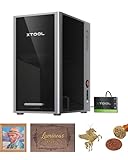
Laser Etching vs. Engraving: Why the Distinction Matters for Buying
Laser etching and laser engraving are often used interchangeably in product listings, but they describe different physical outputs. Etching melts or ablates only the surface layer — typically removing 0.001 inches or less — producing a high-contrast mark without cutting into the substrate. Engraving vaporizes material to a measurable depth, often 0.005 to 0.125 inches, creating a recessed groove you can feel.
For clean surface marking on coated metal (powder-coated tumblers, anodized aluminum), glass, and finished wood, you want the etching behavior: minimal depth, maximum contrast, no charring halo. That means a machine tuned for fast, low-power passes rather than deep material removal. The practical consequence: an overpowered machine run incorrectly is worse for etching than a modest one with fine speed and line-interval control.
Wavelength Is the Real Deciding Factor
Before comparing models, understand which laser type marks which material cleanly:
- Diode lasers (445–455nm, blue): Excellent on wood, leather, and coated metals where the coating absorbs the visible light. They cannot mark bare metal or glass directly — on glass they need a coating or paint layer.
- Fiber lasers (1064nm, infrared): The best laser marking machine choice for bare metals — stainless, aluminum, brass. They produce crisp, permanent marks with almost no depth. Compact galvo fiber units like the xTool F1 Ultra bring this capability to desktop sizes.
- CO2 lasers (10.6μm): The standard for glass, acrylic, and wood etching. A 40–55W CO2 machine frosts glass cleanly at low power where a diode simply won’t interact.
The cleanest etching setup for a mixed-material shop is either a dual-source machine (diode + fiber, like the xTool F1 Ultra) or a mid-range CO2 unit covering glass and wood, supplemented by a fiber marker if bare-metal work matters.
Best Picks by Situation
Best for wood and coated metal (hobby to small business): diode lasers
Desktop diode etchers in the 10–22W class — the xTool D1 Pro, Ortur Laser Master 3, and Atomstack A24 Pro are representative — produce razor-sharp etchings on bamboo, maple, slate, and anodized/powder-coated metal. For pure marking, look at spot size: a compressed 0.08×0.08mm spot with 0.01mm positioning accuracy yields noticeably finer line work than older 0.15mm-spot units. Expect to pay roughly $400–$1,200 in this class.
Best for metal marking: galvo fiber/dual units
Galvo machines steer the beam with mirrors rather than moving a gantry, so marking speeds jump from ~10,000mm/min on a gantry diode to over 4,000mm/s on a galvo. The xTool F1 (diode + IR dual source) and F1 Ultra (20W fiber + 20W diode) and entry-level Monport and ComMarker fiber markers (20–30W) etch serial numbers and logos on stainless and brass in seconds. Market range: roughly $1,500–$4,500 for desktop fiber units.
Best for glass and larger wood panels: CO2 machines
A 40–55W CO2 desktop machine — OMTech Polar/Light Maker class, Monport 40W/55W, or Glowforge for the premium plug-and-play tier — etches glass at low power (10–20% power, high speed) producing a uniform frost rather than chips. CO2 also resolves fine detail on wood without the scorch marks diodes can leave on resinous species. Expect roughly $900–$3,000 for desktop CO2, more for Glowforge-class ecosystems.
Spec Comparison at a Glance
| Machine (type) | Source | Work area | Max marking speed | Spot / precision | Best surface |
|---|---|---|---|---|---|
| xTool D1 Pro 20W (diode) | 455nm diode | ~430×390mm | ~24,000mm/min | 0.08×0.10mm | Wood, coated metal |
| Ortur Laser Master 3 (diode) | 450nm diode, 10W | ~400×400mm | ~20,000mm/min | 0.05×0.1mm class | Wood, slate, leather |
| xTool F1 (dual) | 10W diode + 2W IR | 115×115mm | ~4,000mm/s | Galvo, ~0.001mm repeat | Metal, coated metal, wood |
| Monport/ComMarker 20W fiber | 1064nm fiber | ~110×110mm | ~7,000mm/s | Galvo | Bare metal, plastics |
| OMTech/Monport 55W CO2 | 10.6μm CO2 | ~500×300mm | ~600mm/s | ~0.1mm typical | Glass, wood, acrylic |
| Glowforge Aura/Spark (diode) | Diode, 6–10W class | ~300×300mm | Moderate | ~0.1mm | Wood, craft materials |
Decision Matrix: Match Your Situation to a Machine
| Your situation | Recommended type | Typical budget |
|---|---|---|
| Hobbyist, wood signs and coasters only | 10W diode gantry | $400–$700 |
| Tumbler/mug marking side business | 10–22W diode + rotary (coated blanks) or fiber for stainless | $600–$2,500 |
| Serial numbers and logos on bare metal | 20–30W galvo fiber | $1,800–$4,500 |
| Glassware, cutting boards, acrylic signs | 40–55W desktop CO2 | $900–$3,000 |
| Mixed materials, limited space, occasional use | Dual-source galvo (diode + IR) | $1,500–$2,500 |
| Production throughput, deep engraving too | 80W+ CO2 or 50W+ fiber | $5,000+ |
Getting the Crispest Shallow Mark: Settings That Matter More Than Power
On every machine type, etching quality comes from four variables:
- Focus accuracy. A 0.5mm focus error on a diode visibly softens edges. Re-focus on every material change and use the focus gauge — never eyeball it.
- Line interval. For filled shapes, set interval to match your spot size (~0.08mm for compressed-spot diodes). Wider intervals leave visible banding.
- Speed over power. For clean etches, run fast at low power and add a second pass if contrast is insufficient, rather than one slow hot pass that chars edges.
- Material prep. On bare metal with a diode, a marking compound or a coat of dark spray paint (washed off afterward) creates the absorption the wavelength needs. On glass with CO2, a damp paper towel over the surface eliminates micro-chipping.
Ownership Realities Listings Don’t Mention
Consumables: Diode modules degrade — expect output loss after roughly 10,000 hours of rated life, less if run at max continuously. CO2 glass tubes last roughly 1,000–3,000 hours and cost a few hundred dollars to replace; RF metal tubes cost more upfront but last far longer. Fiber sources are the most durable, commonly rated beyond 100,000 hours.
What wears first: Gantry belts stretch and introduce wobble at roughly the one-year mark of regular use — check tension quarterly. Lens and mirror surfaces on CO2 machines cloud from smoke residue; clean them with lens tissue and isopropyl weekly or etching quality degrades before any hardware fails.
Ventilation is not optional: Etching coated metal releases compounds from the coating; etching wood produces fine particulate. Budget for an inline fan and ducting or a fume extractor ($150–$600) — this is the most common skipped purchase and the most regretted.
Common beginner mistakes: etching glass at too high power (causes flaking instead of frost), skipping air assist on wood (scorched halos), and assuming higher wattage automatically means better marks — for etching specifically, a 10W diode run correctly often beats a 40W unit run aggressively.
FAQ
Can one machine etch metal, glass, and wood?
No single wavelength does all three cleanly. A dual-source galvo (diode + IR/fiber) covers metal and wood; add a CO2 machine for glass, or accept coated-surface workarounds.
Is a laser etcher the same as an etching laser cutter?
Not quite. Diodes under ~10W mark beautifully but cut only thin stock. If you need both etching and cutting, look at 20W+ diodes or CO2 machines, which handle engraving, etching, and through-cuts with one source.
What’s a realistic cost per etch?
Trivially low. A 20W diode marking a 50×50mm logo consumes roughly 0.02kWh — well under a cent of electricity. Real per-unit cost is blank material plus your time; a coated tumbler etch takes 2–8 minutes depending on size and spot quality.
Do I need a laser marking machine or a laser engraver for product labels?
For shallow, high-contrast marks that won’t wear off, a fiber marking machine is the correct tool for metal; a diode is sufficient for wood and coated products. “Marking” in the industrial sense implies surface-level permanence — exactly what these sources deliver.