
What's inside
As an Amazon Associate I earn from qualifying purchases. This post may contain affiliate links at no extra cost to you.
Laser etching is a surface marking process where a focused laser beam melts the top layer of a material — typically to a depth of less than 0.001 inches — creating a high-contrast mark without removing significant material. It sits between laser engraving (which vaporizes material to carve a deeper cavity) and laser marking (which only discolors the surface with no perceptible depth at all). If you’ve ever seen crisp white lettering on anodized aluminum or frosted text on a stainless tumbler, that’s etching at work.
As an Amazon Associate we earn from qualifying purchases at no extra cost to you.

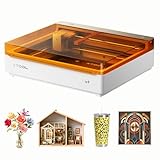

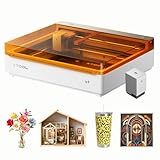
How Does Laser Etching Work?
The physics is simpler than the marketing suggests. A laser source — usually a fiber, CO2, or diode laser — focuses light energy into a spot roughly 0.001 to 0.004 inches in diameter. When that spot hits the material, surface temperature spikes past the melting point in milliseconds. The material doesn’t vaporize (that’s engraving); it melts and rapidly re-solidifies, and that rapid heating-cooling cycle changes the surface texture and reflectivity. On metals, the result is a frosted or raised-looking mark. On coated or painted surfaces, the etch often just ablates the coating to reveal the contrasting base material underneath.
Three variables control what you get:
- Power — how much energy hits the surface per pulse. Too low and the mark is faint; too high and you’re engraving, not etching.
- Speed — how fast the galvo mirrors or gantry move the beam. Slower passes mean more dwell time and deeper melting.
- Frequency (pulse rate) — measured in kHz. High frequency with lower power gives smooth surface melting; low frequency with high peak power punches deeper.
This is why the same 20W fiber laser can either frost a logo onto steel or carve a serial number you can feel with a fingernail — it’s settings, not magic.
Etching vs. Engraving vs. Marking: The Real Differences
These three terms get used interchangeably in product listings, which causes real confusion when you’re shopping. Here’s what actually separates them:
| Process | Typical Depth | Material Removed? | Surface Feel | Best For |
|---|---|---|---|---|
| Laser marking | 0 (surface color change only) | No | Completely smooth | Annealed marks on steel, barcodes, medical parts |
| Laser etching | Up to ~0.001 in (0.025 mm) | Minimal — melting, not vaporizing | Slightly textured, usually can’t be felt | Logos, graphics, anodized aluminum, coated metals |
| Laser engraving | 0.001–0.125+ in (0.025–3+ mm) | Yes — vaporized | Visible cavity, tactile depth | Wood signs, deep serial numbers, stamps, gun parts |
The practical distinction: if a part will see abrasion, paint, or repeated handling and the mark must survive, you engrave. If you want maximum contrast and speed on thin materials or coatings, you etch. If the surface must stay perfectly intact (sterile instruments, bearing races), you mark via annealing.
Where Etching Wins — and Where It Doesn’t
Etching is the right choice in specific situations, and the wrong one in others:
- Anodized aluminum: Etching removes or bleaches the dye layer in one pass, producing bright white marks at very high speeds. This is the single best use case.
- Wood: Technically most “wood etching” is shallow engraving — wood chars rather than melts. Light passes on maple or cherry give fine photo-like detail; deeper passes give cut-able depth.
- Glass and ceramics: Lasers micro-fracture the surface rather than etch it, producing a frosted look. Beautiful for awards, but the mark can weaken thin glass.
- Deep-wear applications: Skip etching. A floor jack’s serial plate or a tool die that rubs against stock needs engraved depth.
- PVC/vinyl: Never — burning releases chlorine gas, which corrodes the machine and is dangerous to breathe.
How to Laser Etch: A Practical Workflow
The process is the same whether you’re running a 10W diode desktop unit or a 50W fiber machine:
- Prepare the artwork. Convert logos or text to vector (SVG/DXF) or high-resolution bitmap (600+ DPI). Clean artwork in, clean mark out — the laser faithfully reproduces every flaw.
- Pick your starting parameters. For etching, bias toward high speed and moderate power. On a 20W diode over anodized aluminum, 3,000–5,000 mm/min at 60–80% power is a typical starting point; for wood, 2,000–4,000 mm/min at 40–60%.
- Run a material test grid. Etch a small grid varying speed and power (most software, like LightBurn, generates these automatically). Pick the cell with the best contrast and no charring.
- Set focus precisely. A 1–2 mm focus error widens the spot and softens detail. Use the machine’s focus gauge every time you change material thickness.
- Etch, then inspect. One light pass beats one heavy pass for surface finish. If contrast is low, add a second pass rather than slowing down.
Choosing a Machine for Etching
Your material dictates the laser type more than budget does:
| Your Situation | Laser Type | Typical Power | Market Price Range |
|---|---|---|---|
| Hobbyist, mostly wood/leather, occasional coated metal | Diode | 5–20W optical | $300–$1,200 |
| Small shop, tumblers, knives, metal tags daily | Fiber | 20–50W | $2,000–$6,000 |
| Wood signs, acrylic, glass, large panels | CO2 | 40–100W | $1,500–$8,000 |
| Mixed shop needing both metal and organics | Dual-source (e.g., xTool F1 Ultra class) | 20W diode + 20W fiber | $3,500–$5,500 |
A diode laser cannot etch bare metal (it reflects the 450nm wavelength), and a CO2 struggles on metal too — that’s what fiber lasers are for. Buying the wrong wavelength is the most expensive beginner mistake.
Ownership Realities
- What wears first: Lens and protective window (clean with isopropyl and lint-free wipes — a dirty lens scatters the beam and ruins contrast), then the diode module itself (~10,000 hours typical) or CO2 tube (1,000–8,000 hours depending on quality).
- Fume extraction: Etching wood and coatings produces real smoke. Budget for an inline fan and venting, or a filter unit ($200–$600).
- Common mistake: Chasing more power instead of better focus and a proper test grid. Most ugly marks are parameter problems, not hardware problems.
FAQ
Is laser etching permanent?
On bare metal and wood, yes — the surface itself is changed. On coatings, the mark lasts as long as the coating. It’s not as abrasion-proof as deep engraving.
Can a diode laser etch metal?
Bare metal, no — the wavelength reflects. Anodized or painted metal, yes, by removing the coating layer.
How deep is a laser etch?
Generally under 0.001 inch (0.025 mm) — visible to the eye, usually not to the touch.