
What's inside
As an Amazon Associate I earn from qualifying purchases. This post may contain affiliate links at no extra cost to you.
Best Portable Bandsaws: Cutting Capacity, Power, and Portability
For installation work and frequent cuts away from the shop, choose a cordless portable bandsaw sized for the stock you handle; for larger or longer shop cuts, favor a corded deep-cut model, and for steel tubing or conduit, prioritize a compact saw that is easy to control. The best fit depends less on headline power than on throat capacity, blade dimensions, weight, and how often you can recharge or reach an outlet.
Portable bandsaw comparison
These established models illustrate the main trade-offs. Capacities and weights below are manufacturer-published specifications; weight may vary with battery, blade, or included configuration. Verify the exact model variant before buying.
As an Amazon Associate we earn from qualifying purchases at no extra cost to you.
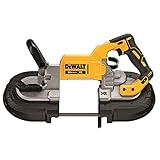


| Model | Power | Blade size | Maximum cut capacity | Approx. tool weight | Best fit |
|---|---|---|---|---|---|
| Milwaukee M18 FUEL Deep Cut Band Saw 2729-20 | 18V battery | 44-7/8 × 1/2 × 0.020 in | 5 × 5 in | About 14.5 lb bare | Deep cuts at installation sites |
| DEWALT DCS374B deep-cut bandsaw | 20V MAX battery | 44-7/8 × 1/2 × 0.020 in | 5 × 4-3/4 in | About 12.4 lb bare | Large stock, with a relatively light bare tool |
| Makita XBP02Z portable bandsaw | 18V battery | 32-7/8 × 1/2 × 0.020 in | 2-1/2 in round; 2-5/8 × 2-5/8 in rectangular | About 9.0 lb bare | Smaller metal stock and overhead handling |
| Milwaukee 6232-21 deep-cut bandsaw | 120V corded | 44-7/8 × 1/2 × 0.020 in | 5 × 5 in | About 14.5 lb | Repeated shop cuts near an outlet |
Published specifications can change between model revisions. Bare-tool weights are not directly comparable to a ready-to-cut setup: add the battery for cordless models, and account for the cord and work position on corded ones.
Choose by the work, not just the biggest capacity
For installation and service calls: cordless deep cut
A 5 × 5-inch capacity is useful when a job includes large conduit, threaded rod bundles, pipe, or framing components. A deep-cut cordless saw can handle those jobs without an outlet, but its battery and larger frame add fatigue during long overhead cuts. Check both the battery-platform cost and whether you already own compatible packs.
For a one-off cut, a smaller saw may be easier to position. For regular work, consider a second battery and charger part of the purchase rather than assuming one pack will cover a full day. Runtime depends heavily on material, blade condition, cut length, and battery capacity; manufacturers’ cut-per-charge figures are not a reliable promise for every job.
For metal stock and overhead work: compact cordless
A compact model such as the Makita XBP02Z trades capacity for maneuverability and a shorter blade. That is often a sensible exchange for electricians and mechanics cutting smaller conduit, angle, pipe, or threaded rod. Its lower bare weight helps, but a battery still changes the balance. Test the grip and sightline if precise cuts matter.
Compact does not mean suitable for every metal-cutting task. Measure the largest stock in its actual orientation, including any clamp or fixture. A rectangular workpiece may fit on its narrow side but not on its wide side.
For repeated cuts in a shop: corded deep cut
A corded deep-cut saw avoids battery swaps and is a practical choice for a fixed work area with dependable power. It can make repeated cuts in steel or other appropriate stock, but it is still a handheld saw: use a stable support, secure the work, and guide the blade rather than forcing it. If your shop needs accurate, repeatable square cuts throughout the day, compare it with a stationary bandsaw and a proper cutting fixture.
Capacity and blade size: the fit check that prevents a bad buy
“Cut capacity” usually describes the maximum workpiece envelope, not a guarantee that every shape at that size will be convenient to cut. Before choosing, write down the largest round diameter and the largest rectangular width and height you need. Compare each with the manufacturer’s capacity, then leave clearance for positioning the saw and supporting the stock.
Blade length must match the saw; it is not a flexible upgrade. Width and thickness affect tracking and durability, while tooth pitch affects the cut. A coarse pitch generally clears chips better in thicker stock; finer teeth are better suited to thinner sections. Use a blade specified for the material, and avoid letting thin-walled tubing vibrate or crush in the cut.
Power, upkeep, and ownership costs
Cordless convenience has a continuing cost: batteries, chargers, and eventual pack replacement. Corded tools are less convenient at remote sites but do not stop for recharging. Compare complete system cost, not bare-tool price. As broad market guidance, portable bandsaws range from a few hundred dollars for many bare cordless tools or corded models to several hundred dollars more for premium kits with batteries and chargers; promotions and regional pricing vary.
Blades are the main routine consumable. For example, if a $20 blade makes 200 comparable cuts, its blade cost is about $0.10 per cut; if poor technique or unsuitable teeth wear it out after 80 cuts, that rises to $0.25. This excludes labor and material, but shows why blade choice and handling can matter more than a small difference in purchase price.
- Keep chips out of the mechanism: Brush or vacuum debris from the blade guides and wheel area with the tool disconnected or battery removed. Packed chips can interfere with tracking and accelerate wear.
- Check tracking and blade condition: Follow the manual for blade installation and tension. Replace a dull, damaged, or wandering blade rather than compensating by pushing harder.
- Support the work: Clamp stock close to the cut and support long offcuts. Uncontrolled movement can pinch the blade or twist it off line.
- Let the blade cut: Excessive feed pressure increases heat and can shorten blade life. Use a steady feed appropriate to the material.
For woodworking, a portable bandsaw is mainly a tool for cutting metal hardware and job-site components; it is not a substitute for a wood bandsaw with a table, fence, and woodworking blade. Keep sparks and hot metal away from sawdust, finishes, and other combustible shop materials.
Quick decision guide
| Your situation | What to prioritize | Likely choice |
|---|---|---|
| Occasional small cuts, tight budget | Correct capacity, standard blade availability, no unnecessary battery kit | Compact corded or bare cordless tool, depending on outlet access |
| Frequent installation work away from power | Battery platform, capacity for largest stock, a spare pack | Cordless deep-cut model |
| Overhead cuts or limited space | Low ready-to-use weight and balanced grip | Compact cordless model, if its capacity is sufficient |
| High-volume cutting at one shop station | Continuous power, repeatable support, blade supply | Corded deep-cut handheld saw, or a stationary saw for production work |
Bottom line
Choose a cordless deep-cut bandsaw when job-site access and larger stock matter most, a compact cordless saw when control and reduced bulk take priority, and a corded deep-cut saw for repeated shop cuts near power. Before ordering, confirm the largest workpiece fits, price the complete power system, and check that replacement blades in the required size and tooth pitch are readily available.