
What's inside
As an Amazon Associate I earn from qualifying purchases. This post may contain affiliate links at no extra cost to you.
Choosing among the best rated inverter generators in 2026 is harder than it should be. Buyers need clean, quiet power for RVs, job sites, and home backup, but spec sheets vary wildly in how they report wattage, noise, and fuel flexibility. A generator that runs a refrigerator and a space heater may fail the moment you add a compressor, and one that sounds tolerable in a review video may be unbearable in a crowded campsite at 6 a.m.
What separates a solid pick from a mediocre one comes down to three things: honest continuous output ratings, real fuel versatility, and whether the CO safety shutoff actually integrates with your panel or your RV’s transfer switch. Beyond that, build quality and long-term parts availability matter more than most marketing copy suggests. We compared published specs, prices, and owner feedback to narrow these eight models down to what each does best.
As an Amazon Associate we earn from qualifying purchases at no extra cost to you. Product prices and availability are accurate as of the date shown and are subject to change.


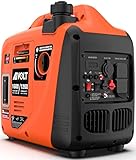


Quick Picks
| Product | Best for | Price |
|---|---|---|
| WEN DF680iX | Full RV or EV backup on a mid-range budget | $798 |
| Westinghouse 8200 Tri-Fuel | Whole-home backup with natural gas hookup | $1399 |
| WEN DF480iX | Lightweight dual-fuel camping and tailgating | $647 |
| Oxseryn 4400 Open Frame | Emergency backup at the lowest price | $289.99 |
| Oxseryn 4400 Eco Mode | Quiet job-site work on a tight budget | $309.99 |
| AIVOLT 1600 | Ultralight backpacking-style camping | $329.39 |
| Westinghouse 4000 Dual Fuel | RV-ready quiet operation with parallel option | $799 |
| Westinghouse 12000 Tri-Fuel | Large-home backup with transfer switch | $1949 |
How We Picked
We evaluated wattage honesty (peak versus running ratings), fuel type flexibility, noise character, and the presence of a CO shutoff or sensor. Owner-reported reliability over one to three seasons weighed alongside published warranty terms. We also factored in whether parallel capability and transfer switch readiness are real features or marketing afterthoughts, because those determine whether a generator fits your actual use case or only sounds impressive on paper.
The 8 Best Rated Inverter Generators in 2026
WEN DF680iX
This unit targets RV owners and homeowners who need enough headroom for an EV charger or a full compressor without paying Westinghouse-tier prices. At 6800 watts peak and dual-fuel capability, it bridges the gap between portable backup and whole-home readiness.
- Pro: Fuel shut-off plus CO Watchdog gives layered safety that many competitors charge a premium for.
- Pro: Electric start and RV-Ready outlets mean you can plug into a 30-amp pedestal without adapters.
- Con: Owner reports note the CO sensor occasionally triggers on cold mornings, requiring a reset before restart.
Skip this one if you need natural gas hookup; it handles gasoline and propane only.
Westinghouse 8200 Tri-Fuel
The 8200-watt tri-fuel is the pick for anyone with a natural gas line at the property who wants transfer-switch-ready backup without the jump to a 12,000-watt unit. Low THD keeps sensitive electronics safe, and the parallel capability lets you stack two later if loads grow.
- Pro: Three fuel options plus remote start provide redundancy that dual-fuel units cannot match.
- Pro: CO sensor and transfer switch readiness are standard, not add-ons.
- Con: At $1399, it costs nearly double the WEN DF680iX for a single additional fuel type.
Skip this if your primary need is RV camping rather than fixed home backup; the weight and noise profile favor stationary use.
WEN DF480iX
Aimed at campers and tailgaters who want dual-fuel versatility without hauling the DF680iX. At 4800 watts and noticeably lighter, it fits in a mid-size SUV trunk and powers a refrigerator, lights, and a small A/C unit.
- Pro: Quiet and lightweight for its wattage class, making it easy to move between sites.
- Pro: Fuel shut-off and CO Watchdog included at a price well under the 6800-watt sibling.
- Con: No parallel capability, so you cannot add a second unit for heavier loads.
Skip this if you regularly need to run two large appliances simultaneously; the headroom is limited.
Oxseryn 4400 Open Frame
For buyers who want the lowest possible entry point into inverter-style power for emergency use, this open-frame model undercuts every other unit on the list. EPA compliance means you can legally use it in most states.
- Pro: Unbeatable price-to-wattage ratio for budget-conscious emergency prep.
- Pro: 30-amp outlet makes it RV-compatible despite the open-frame design.
- Con: Open frame means noticeably louder than enclosed inverter models in the same wattage range.
Skip this if noise matters at all in your use case; a nearby campsite or residential area will make its presence known.
Oxseryn 4400 Eco Mode
A refinement of the open-frame above, this variant adds ECO mode to throttle fuel consumption at light loads. The extra twenty dollars buys quieter operation and better run times on half loads.
- Pro: ECO mode meaningfully extends fuel runtime when you are running only a fridge or lights.
- Pro: Low-noise claim is more credible than the standard open-frame version due to the throttle management.
- Con: Still lacks CO shutoff or sensor, which is a real safety gap for enclosed spaces.
Skip this if you need CO protection or plan to operate near sleeping areas in a tent or camper.
AIVOLT 1600
At 28 pounds and 1600 watts, this is the smallest, lightest option here and the only one genuinely suited to car camping where weight is the primary constraint. It powers a small fridge, phone chargers, and LED lights without complaint.
- Pro: Super quiet and ultra-portable; one person can carry it with ease.
- Pro: Price is competitive for the noise level and weight class.
- Con: 1600 watts means zero headroom for anything with a startup surge beyond a small compressor.
Skip this entirely if you need to run an RV air conditioner, power tools, or any appliance above 1200 watts continuous.
Westinghouse 4000 Dual Fuel
Westinghouse’s mid-size dual-fuel unit hits the sweet spot for RV owners who want remote start, parallel capability, and a CO sensor without the tri-fuel price premium. It runs a 15,000 BTU A/C unit comfortably.
- Pro: Remote electric start and parallel capability at a price competitive with non-Westinghouse equivalents.
- Pro: CO sensor provides automatic shutoff, important for RV-adjacent use.
- Con: No natural gas option, limiting its role as a fixed-backup generator compared to the 8200.
Skip this if you already have a natural gas line and want one generator to cover all fuel scenarios.
Westinghouse 12000 Tri-Fuel
The 12000-watt monster is for whole-home backup on properties with natural gas service. Transfer switch ready out of the box, it can carry a household through extended outages running multiple AC units, well pumps, and full kitchen loads.
- Pro: Highest wattage and most fuel flexibility in this lineup, making it the definitive home-backup choice.
- Pro: Low THD and parallel capability mean future-proofing if your load grows.
- Con: At $1949, it is the most expensive unit here by a wide margin.
Skip this if your needs are limited to an RV or a single room; the cost and size are overkill.
Buying Guide
Running Watts Versus Peak Watts
Manufacturers quote peak wattage first because it looks better on a spec sheet. Running watts are what matter for sustained load. When comparing the best rated inverter generators, subtract the peak-to-running gap and ask whether the running figure covers your actual draw. A unit rated 4400 peak may only sustain 3600 running, and motor-start surges can push a refrigerator compressor past that ceiling momentarily.
Fuel Type and Transfer Switch Readiness
Dual-fuel and tri-fuel options give you redundancy when gasoline supply is disrupted during extended emergencies. But fuel flexibility only pays off if the generator can connect to your home’s electrical system. Transfer switch readiness means the unit has the right receptacle configuration and grounding to feed a subpanel legally and safely. Without it, you are limited to extension cords and manual selection, which adds risk and inconvenience.
Noise and CO Safety
Enclosed inverter designs are inherently quieter than open-frame models at equivalent wattage. For RV and campsite use, a difference of a few decibels translates directly into neighbor tolerance. CO shutoff sensors are now a baseline expectation at mid-range pricing, but not all brands include them. If you operate near sleeping areas or in enclosed spaces, prioritize models with a certified automatic shutoff over those without.
Our Verdict
Top pick: the Westinghouse 8200 Tri-Fuel. It covers the widest range of real-world scenarios with natural gas redundancy, CO sensing, transfer switch readiness, and parallel capability in a single unit that still fits a standard garage bay.
Budget pick: the Oxseryn 4400 Open Frame at $289.99. It is not quiet, but for garage-bound emergency use where noise is secondary, nothing else approaches its watt-per-dollar value.
Condition for another winner: if your primary use is car camping where weight and volume dominate your decision, the AIVOLT 1600 is the only unit here that a single person can carry comfortably to a remote site.
FAQ
Can an inverter generator run sensitive electronics like laptops and medical devices?
Yes. Inverter generators produce low total harmonic distortion, typically under five percent, which is safe for electronics that would flicker or fail on a conventional generator. Look for a THD spec below six percent for reliable operation with CPAP machines, computers, and audio equipment.
What does “RV Ready” actually mean?
It means the generator includes a 30-amp twist-lock or standard RV receptacle so you can plug directly into an RV pedestal or camper cord without an adapter. It does not automatically mean the unit is quiet enough for campground noise ordinances, so check decibel ratings separately.
Do I need parallel capability, and what happens if I add a second unit?
Parallel capability lets you combine two identical generators to double your output and runtime. If your load is fixed and modest, you do not need it. If you anticipate adding a second compressor, welder, or expanding your RV’s electrical needs, choose a model that supports it now rather than upgrading later.
Is a CO sensor the same as a carbon monoxide alarm?
No. A CO sensor built into the generator automatically shuts the engine off when dangerous gas levels are detected nearby. A standalone CO alarm only sounds and requires you to manually stop the generator. For safety near sleeping areas, the integrated automatic shutoff is the stronger protection.