
What's inside
As an Amazon Associate I earn from qualifying purchases. This post may contain affiliate links at no extra cost to you.
The best surface thickness planer for most home workshops is the DeWalt DW735, while the Makita 2012NB is the better choice when lower noise and easier carrying matter more than maximum width; occasional users on a tighter budget should look at a two-speed 12½-inch benchtop model such as the Triton TPT125.
As an Amazon Associate we earn from qualifying purchases at no extra cost to you.


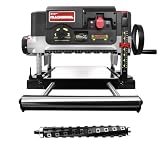
What to compare before buying a surface thickness planer
A thickness planer does not flatten a warped board by itself: it makes the top face parallel to the face already riding on the bed. Start with one flat reference face, then compare the machine’s maximum stock thickness, maximum width, minimum thickness, feed rates, cutterhead, and chip extraction. These details matter more than a headline motor rating when you are sizing flooring, cabinet parts, or rough-sawn furniture boards.
| Planer | Maximum width | Maximum thickness | Feed rates | Cutterhead | Approx. weight | Best suited to |
|---|---|---|---|---|---|---|
| DeWalt DW735 | 13 in | 6 in | 96 or 179 cuts/in | Three-knife disposable blades | 92 lb | Frequent stock preparation and wide boards |
| Makita 2012NB | 12 in | 6 3/32 in | 8.5 or 17 ft/min | Two-knife disposable blades | 61.9 lb | Portable workshops and quieter operation |
| Triton TPT125 | 12½ in | 6 in | 16 or 30 ft/min | Two-knife disposable blades | 65 lb | Occasional use and value-conscious buyers |
| Metabo DH330 | 12.99 in | 6 in | 7 or 13.5 m/min | Two-knife disposable blades | 35.5 kg | Metric-market workshops and heavier-duty use |
Specifications can vary by voltage and market, so confirm the model number before purchase. The useful comparison is not simply “more power”: it is how the feed mechanism, cutterhead, knives, and dust port work together on the board sizes you actually use.
Best picks by workshop situation
Best all-rounder: DeWalt DW735
The DW735 is the strongest general recommendation for a fixed benchtop setup. Its 13-inch capacity handles nominal 12-inch boards with a little more practical clearance than a 12-inch machine, and the two feed speeds give you a useful choice between faster dimensioning and a finer finish. The slower 96-cuts-per-inch setting is preferable for figured wood or a final pass; the faster 179-cuts-per-inch setting removes stock more quickly.
Its three-knife cutterhead distributes the cut across more edges than a two-knife design, and the knives can be rotated or replaced when dull. The trade-off is weight, noise, and a high purchase price—typically around $650–$850 depending on package and market. It also produces a large volume of chips, so a dust collector with a suitable hose and adequate airflow is much better than relying on the included chip-ejection fan alone.
Best for portability and lower noise: Makita 2012NB
The Makita 2012NB is approximately 30 pounds lighter than the DW735 and has a smaller footprint, making it easier to store or carry to a job. Its “Interna-Lok” style pressure-bar arrangement is designed to reduce snipe, although setup and support still matter. The two feed speeds are 8.5 and 17 feet per minute, and the lower speed is useful when chasing a cleaner finish rather than maximum throughput.
This is a good fit for a woodworker processing cabinet components, shelves, and modest furniture parts a few times per month. Its 12-inch width accepts most nominal 10- and 12-inch boards, but there is less margin for boards that are slightly oversized after rough milling. Expect roughly $550–$750 in current general-market pricing.
Best budget choice for occasional use: Triton TPT125
The Triton TPT125 offers a 12½-inch width, a 6-inch maximum thickness, and two feed rates of approximately 16 and 30 feet per minute. That combination is useful when the main task is bringing construction lumber or rough boards to a consistent dimension without paying for a premium professional machine.
Its lighter two-knife cutterhead is adequate for normal softwood and hardwood work, but disposable knives and careful depth-of-cut control become more important as the machine ages. It is most attractive when used intermittently: a hobbyist may accept more frequent cleanup, slower setup, and somewhat more visible snipe in exchange for a typical market range of about $350–$500.
Best heavier European-market option: Metabo DH330
The Metabo DH330 has a 330 mm, or approximately 12.99-inch, maximum width and a 152 mm, or approximately 6-inch, maximum thickness. Its metric feed rates of 7 and 13.5 metres per minute make it a practical choice where Metabo service and parts are readily available. It is a substantial machine at about 35.5 kg, so it is better on a dedicated stand than on a shelf that must be cleared after every use.
Head-to-head: what the numbers mean on real boards
Maximum stock thickness and width
All four machines in the table can accept stock around 6 inches thick. That does not mean a 6-inch hardwood beam is a sensible job for a portable planer. Thick stock requires shallow passes, sound infeed and outfeed support, and a dust system that will not clog. For common ¾-inch cabinet boards, 1-inch shelves, and 1½-inch furniture parts, capacity is rarely the limiting factor.
Width is more consequential. A nominal 12-inch board may measure 11¾ inches, but rough lumber can contain a high spot or irregular edge that exceeds the rated opening. A 13-inch planer offers useful clearance, while a 12-inch model remains sufficient for most boards prepared at a jointer or on a router sled.
Feed rate and surface quality
Feed rate affects both productivity and finish. A faster setting is helpful during the first dimensioning passes, but it can leave more pronounced scalloping, particularly in hard or figured timber. Use the slower setting for the last pass when the machine provides one. Regardless of feed speed, remove only about 1/32 inch per pass on difficult hardwood and reduce the cut further near the final dimension.
For example, if a board starts at 1 inch and the target is ¾ inch, remove 1/16 inch from each face rather than attempting to remove ¼ inch in one pass. That reduces motor load, limits tear-out, and gives the feed rollers a better chance of maintaining a steady board speed.
Snipe control
Snipe is the shallow dip often left at the leading or trailing end of a board. It is caused by the board lifting or dropping as it enters or leaves the pressure rollers, not only by poor machine design. Planers with locking cutterhead columns or anti-snipe pressure arrangements can reduce the problem, but none eliminates the need for support.
- Set infeed and outfeed tables level with the planer bed.
- Support long boards at exactly bed height rather than allowing them to droop.
- Keep the cutterhead locked after setting the depth when the model provides a lock.
- Feed the next board closely behind the first only when the manual permits it.
- Leave extra length—often 2 to 4 inches—on valuable boards and cut the snipe away afterward.
Noise and dust extraction: the overlooked ownership costs
Benchtop planers are loud machines. Ear protection should be standard, and a workshop located near living areas will benefit from choosing a lighter-duty machine with a lower operating noise level where possible. Published sound figures are not always measured under the same conditions, so treat a small decibel difference cautiously. The cutterhead, motor load, and chip-ejection fan all contribute to the actual sound at the operator’s position.
Dust extraction is equally important. A planer produces chips rather than fine sanding dust, but the volume is large enough to block a narrow hose quickly. A 4-inch dust-collector connection is preferable for repeated work; a shop vacuum can work for short cuts if the adapter seals well and the filter is cleaned frequently. Never let a packed chip chute force material back toward the cutterhead, where it can affect feed and finish.
Durability and maintenance realities
Knives are usually the first consumable. Reversible disposable knives are convenient, but they are not economical to keep using after hitting a nail, screw, or embedded grit. Rotate or replace them as a matched set so the cutterhead remains balanced. Dull knives increase noise, tear-out, motor load, and the temptation to take overly deep cuts.
Feed rollers eventually become glazed with resin and dust. Clean them according to the manual without soaking bearings or using a solvent that attacks rubber. Waxing the planer bed with a suitable non-silicone paste can reduce friction, but avoid leaving a slippery residue on surfaces that will later be glued. Inspect the elevation screws, column guides, belt, and cutterhead fasteners periodically. A machine that drifts in height or develops uneven feed should be serviced before compensating with deeper cuts.
Decision matrix
| Your situation | Most suitable choice | Why | Main compromise |
|---|---|---|---|
| Weekly furniture work, fixed workshop, boards up to 13 in | DeWalt DW735 | 13-in capacity, three knives, two useful feed rates | Heavy, loud, and relatively expensive |
| Limited storage or frequent transport | Makita 2012NB | About 62 lb and effective snipe-control design | 12-in width and two-knife cutterhead |
| Occasional projects and controlled budget | Triton TPT125 | Useful 12½-in capacity and two feed rates | Less refined ownership and finish control |
| Metric market, heavier permanent installation | Metabo DH330 | 330-mm capacity and strong general-purpose format | Bulky and dependent on local parts support |
For most buyers, choose the DeWalt when throughput and capacity outweigh portability. Choose the Makita when the planer must be moved or stored regularly. Choose the Triton when annual usage is modest and the budget is the deciding factor. Whichever surface thickness planer you select, spend part of the budget on a rigid stand, long support tables, spare knives, and proper extraction: those additions often improve final board quality more than moving up one motor size.