
What's inside
- Which Delta thickness planers are discontinued?
- Delta planer specifications versus current alternatives
- Choose by situation, not just by the lowest price
- Where Delta blades and parts still exist
- What wears first on a used Delta planer?
- A simple ownership-cost calculation
- Setup practices that prevent avoidable problems
- Related Guides
As an Amazon Associate I earn from qualifying purchases. This post may contain affiliate links at no extra cost to you.
The best answer for most buyers is to treat a used Delta thickness planer as a parts-and-condition purchase: the Delta 22-560, 22-580, 22-590, and 22-555 are legacy portable machines, while a current DeWalt DW735X, Makita 2012NB, or Ridgid R4331 is usually the safer choice when you need dependable knives, rollers, and service support.
As an Amazon Associate we earn from qualifying purchases at no extra cost to you.


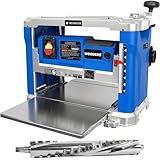
Which Delta thickness planers are discontinued?
Delta no longer has the broad portable planer range that made its older machines common in small shops. The models most often encountered on the used market include the 22-560, 22-580, 22-590, and 22-555. Availability can vary by country and seller, so check the model plate rather than relying on a listing title such as “Delta 13 inch thickness planer.”
- Delta 22-560: an older 12-1/2-inch portable planer, usually found with a two-knife cutterhead and a compact benchtop-style layout.
- Delta 22-580: a 13-inch portable planer with a more substantial cabinet and feed system than the smallest Delta models.
- Delta 22-590: another 13-inch Delta portable planer, commonly sold with a stand or folding support arrangement depending on the package.
- Delta 22-555: a later 13-inch portable planer that appears frequently in secondhand listings but is not a current mainstream Delta offering.
These machines are not interchangeable simply because they share a width. Cutterhead diameter, knife length, roller assemblies, belt dimensions, switches, and table parts can differ. Before buying a used thickness planer Delta machine, photograph the model label and compare the exact part number with a manual or parts diagram.
Delta planer specifications versus current alternatives
The table below compares practical buying dimensions rather than marketing claims. Capacities are nominal maximum widths; usable results also depend on board condition, knife sharpness, and feed support.
| Model | Maximum width | Maximum depth of cut | Motor / feed options | Approx. weight | Typical 2026 market range |
|---|---|---|---|---|---|
| Delta 22-560 | 12-1/2 in | About 1/8 in per pass | Portable single-speed design | About 70–90 lb | $150–$350 used |
| Delta 22-580 / 22-590 | 13 in | About 1/8 in per pass | Portable 15-amp class | About 90–120 lb | $200–$450 used |
| Delta 22-555 | 13 in | About 1/8 in per pass | 15-amp class, two-knife portable format | About 90–105 lb | $200–$450 used |
| DeWalt DW734 | 12-1/2 in | 1/8 in | 15 amp, three knives, fixed-speed feed | About 80 lb | $450–$600 new |
| DeWalt DW735X | 13 in | 1/8 in | 15 amp, three knives, two feed speeds | About 92 lb | $650–$850 new |
| Makita 2012NB | 12 in | 1/8 in | 15 amp, two-knife, compact design | About 62 lb | $600–$750 new |
| Ridgid R4331 | 13 in | 1/8 in | 15 amp, three-knife portable format | About 73 lb | $400–$600 new |
Specifications and prices can change, and used Delta machines are especially dependent on condition. The important comparison is that a current 13-inch machine gives almost the same width capacity as the Delta 22-580, 22-590, or 22-555, but normally offers easier access to replacement knives and support information.
Choose by situation, not just by the lowest price
| Your situation | Best fit | Why |
|---|---|---|
| Occasional hobby use and a tight budget | Clean used Delta or used DeWalt DW734 | Low entry cost, provided the rollers, cutterhead, and feed mechanism work correctly. |
| Frequent furniture work | DeWalt DW735X | Three knives and a slower finishing feed improve flexibility and reduce the temptation to take heavy passes. |
| Small shop or frequent moving | Makita 2012NB | Its roughly 62-pound weight is easier to store and carry than most 13-inch cabinet-style portables. |
| Want a current 13-inch machine at moderate cost | Ridgid R4331 or equivalent current 13-inch planer | Matches the Delta 13-inch capacity without depending on decades-old parts. |
| You already own Delta accessories | Repair your exact Delta model | Existing knives, tables, stand, and dust hood may make ownership economical. |
Where Delta blades and parts still exist
Replacement knives for older Delta planers can still be found through woodworking-tool parts suppliers, industrial knife suppliers, and secondhand marketplaces. Some parts are shared with related planer designs, but “fits a Delta 13-inch planer” is not enough information. Confirm knife length, thickness, hole pattern, bevel orientation, and whether the cutterhead accepts double-edged disposable knives or reversible knives.
Consumable parts are usually easier to source than structural parts. Expect better availability for knives, belts, brushes, bearings, and standard fasteners. Feed rollers, pressure bars, plastic covers, elevation gears, switches, and original dust hoods may be much harder to locate. A compatible generic belt or bearing can sometimes solve a problem, but a substitute should match dimensions, load rating, and electrical specifications.
For a used Delta, obtain the owner’s manual and parts breakdown before disassembly. Delta model numbers can look similar, and an apparently inexpensive machine becomes poor value if it needs a discontinued roller assembly or damaged cutterhead.
What wears first on a used Delta planer?
- Knives: Dull knives cause tear-out, ridges, and increased motor load. Replacing or sharpening them is normal maintenance, not evidence of failure.
- Feed rollers: Glazed, cracked, or dirty rollers slip and create snipe or uneven feeding. Clean resin before assuming the gearbox is defective.
- Drive belt: A loose or cracked belt can produce slipping, vibration, or inconsistent feed speed.
- Elevation mechanism: Dust and resin can make the thickness adjustment stiff. Do not force the handwheel; clean and lubricate according to the manual.
- Bearings and cutterhead: Grinding noise, side play, or heat near a bearing points to a more expensive repair.
Inspect a machine with the power disconnected. Turn the cutterhead by hand, check that the tables sit flat, rotate the feed rollers, and look for damaged electrical insulation. If possible, run a flat, clean board through it and measure both ends with calipers. A planer that cuts smoothly but leaves a small, repeatable snipe may need setup; one that stalls, sparks, or changes thickness unpredictably is a different proposition.
A simple ownership-cost calculation
Suppose a used Delta 22-580 costs $275, replacement knives cost $45, and a belt and basic cleaning supplies add $30. The initial outlay is $350. At 50 uses, that is $7 per use before electricity and wood. A current $700 planer used 150 times costs about $4.67 per use before consumables.
The newer machine is not automatically the bargain: the calculation only works if you will use it often enough and if the Delta needs those parts immediately. For occasional work, a sound used Delta can be excellent value. For weekly production, the cost of downtime and difficult parts can outweigh the purchase-price difference.
Setup practices that prevent avoidable problems
- Place the planer on a rigid, level surface and support long boards at the infeed and outfeed sides.
- Clean resin from the tables and rollers before adjusting anything.
- Use a shallow first pass, especially with wide, figured, or cupped stock.
- Measure board thickness at several points rather than trusting the depth scale alone.
- Rotate or replace knives as soon as the cut becomes rough; forcing dull knives increases strain on the feed and drive system.
- Use dust collection where practical, and stop to clear chips with the machine unplugged.
For most buyers, the decision is clear: choose a used Delta thickness planer when its condition is verifiable and the price leaves room for maintenance; choose a current 13-inch alternative when reliability, parts access, and regular use matter more than the lowest initial cost. The Delta 13 thickness planer models can still do excellent work, but their value now depends less on the badge and more on the exact machine in front of you.