
As an Amazon Associate I earn from qualifying purchases. This post may contain affiliate links at no extra cost to you.
Sand is the most demanding surface a tire can face. Whether you are pushing a loaded kayak cart across a beach, running a UTV through dunes, or racing a 1/10-scale truck on a backyard sand pit, the wrong tire will dig, slip, or shred within minutes. The right one floats, bites, and carries momentum where ordinary rubber simply fails.
The problem is that “sand tires” covers a wildly inconsistent range of products. A set of RC paddle tires costs less than a lunch for two, while a full-size UTV sand kit runs into the hundreds. Beyond price, tread geometry, ply construction, wheel diameter, and bead design all change how a tire behaves on loose terrain. We compared published specs, current pricing, and recurring owner feedback across eight options that represent the full range buyers actually encounter, from hobby-grade replacements to full-size ATV and UTV setups.
As an Amazon Associate we earn from qualifying purchases at no extra cost to you.




![ITP Sand Star (2ply) ATV Tire Front [21x7-10]](https://m.media-amazon.com/images/I/41quNt4o89L._SL160_.jpg)
Quick Picks
| Product | Best for | Price |
|---|---|---|
| AMORIL RC Paddle Tires | Budget 1/10 scale RC sand runs | $35.99 |
| Bonnlo Replacement Balloon Wheels | Kayak and canoe carts on soft sand | $84.99 |
| VEVOR Beach Balloon Wheels | Lightweight cart upgrades with included pump | $72.90 |
| Tusk Sand Lite Front & Rear (14″) | Mid-size UTV dune riding on a value budget | $571.96 |
| Tusk Sand Lite Front & Rear (15″) | Larger UTV sand setups needing more sidewall | $647.94 |
| Pro-Line Racing Sand Paw HP | Scale RC truck realism with dedicated sand tread | $39.99 |
| Ocelot Sand Snake Rear | Single-rear replacement for ATV sand work | $63.97 |
| ITP Sand Star Front | ATV front-end steering in loose terrain | $99.39 |
How We Picked
We narrowed this category using four criteria. First, tread design had to be purpose-built for sand, meaning paddles, aggressive open blocks, or low-pressure balloon profiles rather than generic all-terrain patterns that pack and lose grip. Second, size and fitment needed to be clearly stated so buyers could match them to their specific vehicle without guessing. Third, construction quality mattered: ply count, material type, and bead security all affect how long a sand tire survives abrasive grit. Fourth, we weighed each product against its price bracket to separate genuinely useful value from cheap components that fail on first contact with sharp shells or rocks buried under the surface.
The 8 Best Tires For Sand in 2026
AMORIL RC Paddle Tires (4PCS)
These hexagon-measure replacement wheels fit 1/10 scale trucks like the RZ001 and deliver a functional paddle pattern at a price that makes them essentially disposable. For hobbyists who run sand occasionally and do not want to invest in a premium RC tire set, they fill the gap.
- Pros: Very affordable entry point; paddle design bites into loose material far better than standard RC road tires.
- Cons: Rubber compound is soft and wears quickly on abrasive sand, with owners reporting reduced grip after moderate use.
Skip these if your RC truck sees rocky terrain or you need tires to last multiple seasons.
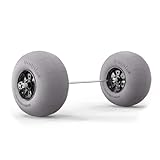
Bonnlo Replacement Balloon Wheels 12″
These large-diameter balloon tires mount onto kayak dollies, canoe carts, and similar beach wagons. The wide, low-pressure profile allows the wheel to sit on top of sand rather than sink. A free air pump is included, which matters because balloon tires need regular inflation adjustments.
- Pros: Excellent flotation on soft sand; axle compatibility is broad for cart-style applications.
- Cons: Bulky when deflated and difficult to store in small vehicles; puncture risk is real on shell-strewn beaches.
Skip if your cart uses a different axle diameter or you primarily roll on packed hardpack where standard wheels suffice.
VEVOR Beach Balloon Wheels 13″
VEVOR’s offering is the direct competitor to the Bonnlo set, bumping diameter slightly and switching to TPU construction rather than conventional rubber. The included pump and two-pack format make it a complete cart upgrade in one order.
- Pros: Larger diameter improves clearance over ruts and obstacles; TPU resists UV degradation better than rubber.
- Cons: TPU can feel stiffer at low pressures, and some owners report the bead seats less securely than expected.
Skip if your cart frame has minimal clearance and the larger diameter interferes with the body or handle.
Tusk Sand Lite Front and Rear Tire Set (14″ wheels)
This full set pairs a ribbed front for steering precision with a fourteen-paddle rear for maximum forward thrust, sized for mid-range UTV platforms. It targets riders who want a dedicated dune tire without jumping to the largest available profile.
- Pros: The front-rear tread pairing is well-matched for predictable handling in loose sand; paddle count gives strong bite without excessive rolling resistance.
- Cons: Mounting and balancing add to the cost, and some owners note the sidewalls feel thin against sharp dune grass roots.
Skip if your UTV already runs 15″ wheels and you need taller sidewalls for additional ground clearance.
Tusk Sand Lite Front and Rear UTV Tire Set (15″ wheels)
The 15-inch variant upsizes both diameters and paddle count compared to the 14″ set, adding a fifteen-paddle rear and a slightly taller ribbed front. This is the choice for larger UTVs or riders who need more sidewall to absorb sudden drops in washed-out dunes.
- Pros: Taller profile and extra paddle bite provide noticeably improved flotation in deep, soft sand; handles aggressive throttle without breaking traction.
- Cons: Premium price reflects the larger tire mass; heavier rotating weight slightly reduces top-end acceleration.
Skip if your vehicle clears 14″ wheels adequately and you prefer a lighter, faster-spinning setup.
Pro-Line Racing Sand Paw HP Belted
Mounted on Raid Black wheels with removable hexes for 12mm and 14mm axles, these scale RC tires use a dedicated sand paw tread pattern and a belted construction that adds durability over softer alternatives.
- Pros: Belted carcass resists deformation at speed, improving cornering stability on loose surfaces; removable hex design simplifies tire swaps.
- Cons: Higher price than basic paddle sets; the scale profile looks realistic but does not float as aggressively as a pure paddle on very deep sand.
Skip if you only run on shallow dusting and need maximum paddle bite at the lowest cost.
Ocelot Sand Snake 8 Paddle Rear Tire
This single rear tire targets ATV owners who need a dedicated sand rear without replacing the front set. The eight-paddle design is aggressive for its class, and the 20-inch diameter suits many sport and utility quads.
- Pros: Affordable for a single replacement; paddle configuration generates strong forward bite in deep sand.
- Cons: Sold individually, so you need two for a full axle, and paddle patterns are inherently unbalanced for street or hardpack use.
Skip if you ride a mixed-surface trail system where paddles will pack with mud and lose effectiveness quickly.
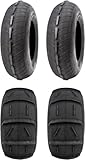
ITP Sand Star (2ply) ATV Tire Front
The Sand Star is a front-specific tire with a 2-ply construction designed for steering response in loose terrain. The ribbed and siped tread pattern keeps the front end predictable without the aggressive bite of a rear paddle.
- Pros: 2-ply carcass keeps weight low and steering feel sharp; the pattern resists plowing sand into the tread at speed.
- Cons: Thin plies sacrifice sidewall durability against rocks and curbs; front-only design means you must source a matching rear separately.
Skip if your ATV takes abuse from rocky washes or you want a tire that doubles as a general-purpose replacement.
Buying Guide
Tread Pattern: Paddle, Ribbed, or Balloon
Paddle tires push material rearward with each rotation, creating thrust but sacrificing all-surface versatility. Ribbed and siped patterns provide steering control for front axles without the drag penalty of full paddles. Balloon tires rely on low pressure and wide contact patches to float rather than dig, making them ideal for carts but unsuitable for powered vehicles at speed. Match the pattern to the axle position and vehicle type before considering anything else.
Sizing and Fitment
Every tire in this roundup exists in a specific size that locks it to a vehicle class. RC tires are defined by hex diameter and wheel width, cart tires by axle bore and overall diameter, and ATV/UTV tires by the three-number system of height, width, and rim. Buying the wrong size is the single most common failure point. Confirm your current tire markings or your manufacturer’s recommended range before ordering.
Construction Quality and Longevity
Sand is abrasive. It is not just loose; it is often mixed with crushed shells, gravel, and salt that accelerate rubber breakdown. Ply count, compound hardness, and bead design determine whether a tire lasts a season or three runs. TPU offers UV resistance but can lack sidewall strength. Lower plies save weight and cost but puncture more easily. A higher price does not guarantee longer life, but a suspiciously low one almost always does.
Our Verdict
The top pick for full-size sand riding is the Tusk Sand Lite 15″ set, because the combination of taller sidewalls, fifteen-paddle rear bite, and matched front control delivers the most predictable performance in deep dune terrain. For a budget pick, the AMORIL RC Paddle Tires represent the lowest viable entry into purpose-built sand tread at just under $36, ideal for casual RC hobbyists who rotate tires frequently. If your primary use case is hauling a loaded kayak or canoe across a beach rather than powering through dunes, the VEVOR 13″ balloon wheels win outright due to the diameter increase and UV-resistant TPU at a lower price than the Bonnlo alternative.
FAQ
Can I use paddle tires on hard surfaces?
No. Paddle designs have large voids that pack and overheat on pavement or packed dirt, causing rapid and uneven wear. They are a single-purpose tool meant to be mounted before you hit sand and removed afterward.
Do balloon wheels need a special pump?
Most balloon tires work with a standard low-pressure pump or a compressed air source with a regulator, but the included pumps in these kits are calibrated for the low PSI these tires require. Running them at standard tire pressure will result in poor flotation and an uncomfortably harsh ride.
How many ply is best for sand tires?
Lower ply counts reduce weight and improve compliance, helping the tire conform to uneven sand surfaces. However, fewer plies mean less puncture and abrasion resistance. For occasional recreational use, 2-ply is adequate; for frequent riding or areas with buried debris, more plies provide meaningful durability.
Are RC sand tires different from full-size sand tires?
The underlying physics is the same: large open voids and paddle geometry displace loose material to generate forward thrust. The difference is scale, material, and intended speed. RC tires use softer compounds because the forces involved are far lower, while full-size tires must withstand dramatically more heat, load, and abrasion.