What's inside
As an Amazon Associate I earn from qualifying purchases. This post may contain affiliate links at no extra cost to you.
Why store sheet goods vertically?
A full 4-by-8-foot sheet of plywood or drywall is awkward to lift, hard to carry through a crowded shop, and easy to damage when leaned against a wall. Vertical storage keeps sheets accessible while using little floor space. It can also keep material off a damp concrete floor and reduce the chance of a stack tipping or bowing.
The trade-off is that a vertical rack needs a firm stop at the bottom and reliable support at the back. Without both, sheets can slide, lean too far, or put a heavy sideways load on a wall. A rack is only a compact solution if you can safely load it and remove sheets without lifting them over other material.
As an Amazon Associate we earn from qualifying purchases at no extra cost to you.
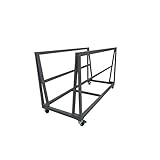
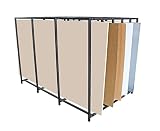
Choose a rack type that fits your shop
For a small workshop, the main choices are a wall-mounted rack, a freestanding rack, or a simple floor-built cradle. Wall racks save floor space but require sound framing and careful installation. Freestanding racks are easier to place and move, but take up more floor area. A floor-built cradle is inexpensive and can work well for a few sheets, though it offers less separation and protection.
Commercial racks may have adjustable dividers, casters, or dedicated slots for different sheet sizes. Those features are useful if you handle several materials regularly, but they add cost and can make the rack deeper. A basic vertical plywood storage rack is often enough for a home shop storing a small, predictable inventory.
| Rack type | Best for | Main advantage | Watch out for |
|---|---|---|---|
| Wall-mounted | Shops with clear wall space and known framing | Small floor footprint | Must be anchored into studs or structural blocking |
| Freestanding | Renters or shops where layout may change | Can be repositioned | Needs a wide, stable base and room to load |
| Floor-built cradle | A few sheets and a tight budget | Simple to build from scrap lumber | Offers fewer slots; check for movement and splinters |
Size the rack for real sheets
Standard construction plywood is typically 4 by 8 feet, but a rack should fit the largest panel you actually buy, including slightly oversized sheets. Measure the usable distance from the floor stop to the upper support, and check that a full sheet can lean without hitting lights, shelves, or a garage door track. Leave enough access in front to pull one sheet out without dragging its edge across a wall or neighboring panel.
Capacity is more than a sheet count. A 3/4-inch plywood panel can weigh roughly 60 to 70 pounds depending on species and construction; a stack of six can exceed 400 pounds. MDF and particleboard can be heavier, and drywall has different handling risks because its edges crumble. Check the rack’s stated load rating and the capacity of its anchors or base. If the manufacturer does not give a load rating, do not assume that a rack built for a few light panels is safe for a full stack of dense board.
Install it to resist tipping and sliding
For a wall-mounted rack, locate studs and fasten the rack into them, or add structural blocking first. Drywall anchors alone are not appropriate for a loaded sheet rack. Use the fasteners specified by the rack maker, and confirm that the rack sits level and does not flex under a modest test load before storing heavy sheets. If mounting to masonry, use anchors rated for the wall material and load rather than repurposing wood screws.
A freestanding rack needs a base broad enough to resist tipping when a sheet is removed from one side. Lockable casters can help with repositioning, but they do not make a narrow rack stable; keep the load low and lock the wheels before loading or unloading. A floor stop should be tall and strong enough to prevent sheets from creeping forward. Smooth, rounded contact surfaces help avoid denting veneer, while sharp screw tips and rough lumber can catch paper faces or splinter edges.
Protect the sheets and the shop
Store panels in a dry area with reasonably steady temperature and humidity. A rack does not prevent warping if one face is exposed to damp air or if water reaches the lower edge. Keep sheets clear of concrete, plumbing, and exterior walls that may collect condensation. Add thin padding where panels touch the rack, but avoid soft, uneven padding that lets a stack sag.
Keep the rack away from the table saw’s outfeed path, electrical panels, heaters, and walkways. A sheet sticking into an aisle is a collision hazard, especially in a compact shop. If the rack is near a dust collector or sanding station, protect stored material from airborne dust; dust trapped between panels can scratch finished faces. A simple cover can help, but leave the area ventilated and do not drape fabric near a heater or other ignition source.
What to buy—and when to build
Before ordering, measure the wall or floor area, confirm the sheet sizes you store, and decide how many panels need separate access. Look for a stated capacity, positive bottom stops, smooth contact points, and hardware suited to your mounting surface. If you store long offcuts as well as full sheets, choose a rack with adjustable dividers or add a separate bin; mixing short scraps into a full-sheet slot makes removal harder.
A purpose-built freestanding vertical sheet-goods rack makes sense when you need predictable slots or want to move the storage location. For a couple of sheets, a well-braced plywood storage cart may be convenient, but inspect its base width and caster locks before loading it. If you store only two or three sheets in one place, a simple cradle made from straight, sound lumber is usually the cheaper option. Build it with a secure back support, a positive floor stop, and enough width that the stack cannot rock. Do not save money by skipping anchoring or stability: a rack that tips can injure someone and ruin the material it was meant to protect.