What's inside
As an Amazon Associate I earn from qualifying purchases. This post may contain affiliate links at no extra cost to you.
A small dust collector can move plenty of air at the inlet and still perform poorly at the tool. The usual cause is pressure loss: every foot of hose, sharp bend, undersized fitting, clogged filter, and unnecessary separator makes the blower work harder. The goal is not simply to buy a larger collector. It is to build a short, smooth path that matches the tool and the blower.
As an Amazon Associate we earn from qualifying purchases at no extra cost to you.

Start With Airflow, Not Horsepower
Motor horsepower is a weak way to compare dust collectors. A collector’s useful performance depends on both airflow, measured in cubic feet per minute (CFM), and static pressure, measured in inches of water. A small shop vacuum may advertise high CFM with no hose attached, but lose much of it through a long hose and restrictive filter.
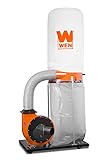
For many single-tool woodworking setups, a practical target is roughly 350 to 450 CFM at a 2-1/2-inch port for a router table, sander, or small saw hood. A 4-inch connection generally needs about 600 to 800 CFM to maintain good chip transport. These are working targets, not guarantees; the tool hood may be the limiting factor.
Before changing equipment, identify the collector’s actual inlet size and the tool’s port. Measure the hose inside diameter, not the outside diameter. A 2-1/2-inch hose has less than half the cross-sectional area of a 4-inch hose, so it cannot carry the same volume of air at the same velocity without much greater resistance.
Use the Largest Practical Hose
Use 4-inch hose or smooth 4-inch duct wherever the tool can accept it. Reserve 2-1/2-inch hose for portable tools with small ports, short runs, and modest chip production. Avoid reducing a 4-inch collector to 2-1/2 inches several feet before the tool; that small section can dominate the system’s pressure loss.
Keep flexible hose as short as possible. Corrugated interiors create turbulence and collect chips in the valleys. A 10-foot flexible hose can have substantially more resistance than a short length of smooth pipe, particularly when it is stretched poorly or allowed to sag. For a stationary machine, run smooth metal or rigid plastic ducting close to the tool, then use a short flexible connection for vibration and movement.
Avoid crushing hose under a machine or bending it into a tight loop. If a bend is necessary, use a broad-radius elbow. Two gentle 45-degree bends are usually better than one abrupt 90-degree elbow.
Remove Restrictions and Leaks
Dust collection systems often lose more performance at fittings than in the main hose. A sharp blast gate, narrow adapter, tee with a blocked branch, or reducer with a small internal opening can create turbulence. Choose fittings with a full, smooth bore, and trim adapters that leave a clean transition when practical.
Seal joints with foil HVAC tape or suitable sealant. Ordinary cloth duct tape eventually dries out and leaks. Leaks on the suction side allow room air to enter without collecting dust, while leaks after the blower can discharge fine dust into the shop. Check the collector lid, filter gasket, drum seal, blast gates, and tool connections.
Do not leave unused branches open. A blast gate should close firmly, but do not install one at every minor joint just because it is available. Each extra fitting adds cost and some restriction. A simple system serving one machine at a time can often use one main gate and a short connection to the tool.
Choose Ducting for the Job
| Option | Best use | Main advantage | Main drawback |
|---|---|---|---|
| 2-1/2-inch flexible hose | Portable sanders, routers, small saws | Cheap and easy to move | High resistance over long runs |
| 4-inch flexible hose | Short connections to stationary tools | More airflow with simple installation | Corrugations still restrict flow |
| Smooth rigid duct | Permanent runs and multiple machine branches | Lowest friction and cleaner routing | More planning and installation work |
| Thin-wall improvised pipe | Budget, temporary layouts | Low initial cost | May collapse, leak, or create static concerns |
For a single machine a short length of 4-inch dust collection hose is often the best value. If the run is permanent, smooth ducting is worth considering. Do not assume every plastic pipe is suitable for dust collection; use components intended for the application, bond and ground conductive systems as recommended by the manufacturer, and avoid creating an unverified electrical hazard.
Maintain the Filter and Separator
A clogged filter is one of the most common causes of pressure loss. Fine dust coating the filter surface reduces airflow even when the collector sounds normal. Clean the filter according to its instructions, inspect pleats for packed dust, and replace damaged or permanently loaded filters.
A cyclone or pre-separator can protect the main filter and reduce maintenance, but it is not free. The separator adds hose, fittings, and pressure loss. A good cyclone is worthwhile when you generate large volumes of chips or empty the collector frequently. For occasional sanding with a small shop vacuum, a separator may reduce filter loading enough to help, but a poorly sealed bucket and lid can make performance worse.
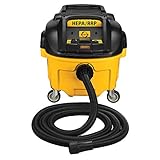
Use a filter rated for fine dust rather than relying on the collector’s motor size. A fabric bag that passes fine dust may keep the machine running while filling the shop air with particles. For a shop vacuum, a HEPA dust extractor filter can improve fine-dust capture, though it must be kept clean and may reduce airflow if it loads quickly.
Match the Tool and Use the System Correctly
Close every unused blast gate and turn the collector on before starting the tool. If the system serves one machine at a time, do not leave a second branch partly open. A partly open branch can steal a significant portion of the available airflow.
Improve the tool hood as well. A wide-open table-saw cabinet or poorly sealed router insert can allow air to enter from all directions while failing to capture dust at the cutting point. Seal large gaps, add a practical overarm hood where appropriate, and keep the pickup close to the source without interfering with the work.
Finally, test changes one at a time. Mark the hose routing, clean the filter, and compare dust left on the machine and floor. If a short, smooth 4-inch run performs worse than expected, the collector may lack the static-pressure capacity for that setup. At that point, replacing a restrictive fitting or filter is cheaper than adding more duct. A larger collector is justified only after the existing system is sealed, clean, and correctly sized.