
What's inside
- Cast vs. extruded plexiglass: the short answer
- Which laser cuts plexiglass?
- Clear, colored, and mirrored acrylic are not equivalent
- How cut quality changes with thickness
- Masking and air assist for a cleaner edge
- Ventilation is part of the cutting setup
- A practical decision matrix
- Can you laser cut glass?
- Ownership realities and common mistakes
- Related Guides
As an Amazon Associate I earn from qualifying purchases. This post may contain affiliate links at no extra cost to you.
Yes, you can laser cut plexiglass, but the cleanest results depend on using the right laser, acrylic type, thickness, masking, and ventilation. “Plexiglass” is a brand name often used for acrylic sheet, including both cast and extruded PMMA; it is not the same material as glass.
As an Amazon Associate we earn from qualifying purchases at no extra cost to you.


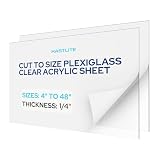
Cast vs. extruded plexiglass: the short answer
For display parts, lettering, signs, and pieces where the edge will be visible, cast acrylic is usually the better choice. It cuts with a smooth, flame-polished-looking edge and produces less melt-related distortion. Extruded acrylic is commonly less expensive and more consistent in thickness, making it useful for prototypes, templates, spacers, and high-volume parts where the edge appearance matters less.
| Criterion | Cast acrylic | Extruded acrylic |
|---|---|---|
| Typical sheet thicknesses | 1.5–25 mm, with many colors and specialty finishes | 1–12 mm commonly stocked; thicker sheets also available |
| Cut-edge appearance | Usually clearer, smoother, and more polished | Often acceptable, but more prone to melt beads or waviness |
| Engraving | Frosty, high-contrast surface engraving | Can engrave well, but may look less uniform depending on formulation |
| Dimensional consistency | Can vary slightly across a sheet | Typically very consistent because it is continuously manufactured |
| Machining behavior | Generally more forgiving for attractive cuts | May soften and deform sooner under excess heat |
| Best use | Signs, awards, displays, visible edges, premium parts | Jigs, prototypes, internal components, economical production |
Which laser cuts plexiglass?
A CO2 laser is the standard choice because acrylic absorbs its approximately 10.6-micron wavelength efficiently. A well-focused 40–60 watt CO2 machine can often cut 3–6 mm acrylic in one or several passes, while an 80–100 watt machine is more suitable for regular work in 6–12 mm material. Actual capacity varies with lens focal length, air assist, focus accuracy, sheet color, and the machine’s optical condition.
Blue diode lasers are a less dependable option for clear acrylic. Transparent sheet allows much of the visible blue light to pass through rather than absorbing it, so the beam may fail to start a cut or may produce inconsistent results. Opaque black, dark, or specially laser-compatible acrylic can behave better, but a diode machine should not be selected primarily for cutting clear sheet.
Fiber lasers are designed mainly for metals and are not a practical general-purpose choice for cutting acrylic. A CNC router, table saw, or scoring method may be more suitable when you need to process thick clear sheet and do not require a polished laser edge.
Clear, colored, and mirrored acrylic are not equivalent
Clear acrylic is straightforward for a CO2 laser, but the beam can pass through it and reflect from unsuitable surfaces beneath the workpiece. Use a honeycomb or knife-bed designed for laser cutting, and avoid shiny metal supports that can redirect the beam.
Opaque colored acrylic generally cuts predictably. White, pale, and translucent materials can require more power or slower speeds than dark sheets because they absorb less laser energy. Mirrored acrylic needs special care: the reflective coating may face upward or downward, and the manufacturer’s cutting guidance should be followed. Never assume that a decorative mirror film is laser-safe.
Confirm that the sheet is PMMA or acrylic before cutting. PVC, vinyl, unknown plastic, and some laminated materials can release corrosive or hazardous gases and can damage the machine. A material safety data sheet or manufacturer specification is worth checking when the label is unclear.
How cut quality changes with thickness
Thin acrylic, around 1.5–3 mm, is usually the easiest place to begin. It needs less energy, holds small details well, and is less likely to develop a tapered edge. At 4–6 mm, focus and air assist become more important, and a single slow pass is not always better than two faster passes. At 8–12 mm, cutting becomes much more machine-dependent. A longer-focus lens, careful alignment, and multiple controlled passes may be necessary, and the bottom edge may show more taper or residue.
A thicker sheet is not automatically a better sheet. If the part will be assembled with tabs, measure the actual material with calipers rather than relying on the nominal size. A sheet sold as 3 mm may measure approximately 2.8–3.2 mm. That difference can determine whether a press-fit joint works.
| Material thickness | Practical starting approach on a CO2 laser | Most likely issue |
|---|---|---|
| 1.5–3 mm | Moderate-to-high speed, low-to-moderate power, one pass | Overburned corners or melted fine details |
| 4–6 mm | Test a single pass, then compare with two faster passes | Incomplete underside cut and residue |
| 8–12 mm | Use a suitable lens, precise focus, strong extraction, and test coupons | Taper, heat distortion, and long cut times |
These are process ranges, not universal settings. Power and speed vary substantially between machines, so cut a small test grid from the same batch before committing a full sheet.
Masking and air assist for a cleaner edge
Apply low-tack paper masking to the top surface when smoke staining or deposits would be difficult to remove. Laser-compatible paper tape or the manufacturer’s protective film is preferable to thick vinyl tape. Press the masking flat without stretching it, and remove bubbles around small engraved details. For through-cuts, masking both sides can reduce smoke marks, but excessive layers may increase heat retention and interfere with the cut.
Do not leave factory plastic film on the sheet unless the supplier specifically identifies it as laser-compatible. Some films shrink, melt, or produce stubborn residue. Paper masking also makes smoke marks more visible and protects the face from scratches during handling.
Air assist helps clear smoke from the cut, cools the kerf, and reduces flare-ups. Too much airflow can sometimes disturb light masking or push residue into a polished edge, so adjust it rather than assuming maximum airflow is ideal. Keep the lens clean: acrylic smoke can deposit on optics, causing power loss and localized heating.
Ventilation is part of the cutting setup
Use an enclosed machine connected to an outdoor exhaust system or a properly rated filtration unit. The exhaust should move air from the enclosure rather than merely circulating it in the room. Acrylic fumes and smoke can irritate the eyes and respiratory system, and the odor is not a reliable safety indicator.
Never leave a laser cutting unattended. Acrylic can ignite if a cut stalls, the sheet shifts, air assist fails, or the focus is wrong. Keep the bed free of accumulated residue, inspect hoses and exhaust paths, and allow the machine to clear smoke before opening the enclosure. A suitable fire extinguisher and a functioning lid interlock are basic ownership requirements.
A practical decision matrix
| Your situation | Recommended material and setup | Why |
|---|---|---|
| First-time user with a CO2 laser | 3 mm cast acrylic, paper masked, air assist on | Easy to tune and gives visible feedback from the edge |
| Lowest material cost for prototypes | 3–6 mm extruded acrylic | Economical and dimensionally consistent |
| Premium sign or display part | Cast acrylic with masking and controlled extraction | Better-looking edges and engraving contrast |
| Small workshop with a diode laser | Use opaque laser-compatible acrylic, or choose a CO2 service | Clear sheet is unreliable with many blue diode systems |
| Frequent cutting above 6 mm | Higher-power CO2 laser with a suitable lens and tested air assist | Reduces repeated passes and heat buildup |
Can you laser cut glass?
For ordinary glass sheet, the answer is generally no—not in the same practical, through-cutting sense as acrylic. A typical CO2 laser can heat and mark some glass surfaces, and specialized industrial systems can create controlled fractures or process glass under tightly managed conditions. However, a hobby or general-purpose laser cutter should not be expected to cut a clean outline through window glass, mirror glass, or bottle glass.
So, can a laser cut glass? Specialized industrial equipment can process certain glass, but a normal workshop laser is not a substitute for a glass cutter, waterjet, or diamond saw. Can you cut glass with a laser cutter at home? Usually not safely or economically. For a transparent panel that looks like glass, clear acrylic or polycarbonate may be easier to fabricate, although polycarbonate generally does not produce the same clean CO2-laser edge and can discolor or melt.
Ownership realities and common mistakes
- What wears first: lenses, mirrors on some CO2 machines, air-assist components, exhaust filters, and bed surfaces collect residue or lose performance before the laser tube necessarily fails.
- Clean regularly: inspect the lens after smoky jobs, wipe appropriate optics with the manufacturer-approved method, and remove acrylic deposits from the bed.
- Do not chase speed blindly: excessive speed leaves an incomplete cut; excessive power or slow speed creates a wide, melted kerf and rounded corners.
- Use test coupons: test the same color, thickness, and supplier batch because pigments and additives alter absorption.
- Plan for kerf: measure the cut width and compensate in the design when making slots, press fits, or interlocking joints.
For most buyers, the dependable choice is a CO2 laser paired with 3 mm cast acrylic, careful masking, air assist, and strong exhaust. Choose extruded acrylic when price, uniform thickness, or prototype volume matters more than the appearance of the cut edge.