
What's inside
- High-Speed Laser Engravers: What Actually Determines Engraving Speed
- Why the headline speed can be misleading
- The six specifications that control real throughput
- Representative comparison by machine type
- Choosing by situation rather than by the largest number
- Autofocus and setup time are part of speed
- Who manufactures high-speed laser engraving machines?
- Ownership details that affect long-term throughput
- Related Guides
As an Amazon Associate I earn from qualifying purchases. This post may contain affiliate links at no extra cost to you.
High-Speed Laser Engravers: What Actually Determines Engraving Speed
The real speed of a high speed laser engraver is determined less by its advertised maximum and more by how quickly it can accelerate, move between details, deliver enough energy, and finish a job without extra setup or cooling delays.
Why the headline speed can be misleading
Laser manufacturers commonly quote a maximum scan speed in millimeters per second, such as 400, 600, or 1,000 mm/s. That number usually describes the fastest straight-line motion under favorable conditions. A detailed sign, photo, or batch of small parts rarely allows the machine to remain at that speed.
As an Amazon Associate we earn from qualifying purchases at no extra cost to you.



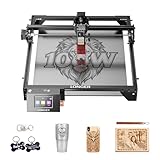
Actual production time includes several different movements:
- Laser-on scanning across the artwork
- Acceleration and deceleration at the ends of each line
- Travel with the laser switched off
- Passes at different power and speed settings
- Focusing, framing, loading, unloading, and cleaning
- Cooling or air-assist pauses where applicable
A machine rated at 1,000 mm/s may therefore finish a complex engraving only slightly sooner than a well-tuned machine rated at 600 mm/s. Conversely, on a large, simple filled rectangle, the faster system may show a substantial advantage.
The six specifications that control real throughput
1. Wattage determines how quickly material absorbs useful energy
Laser power matters most when cutting, marking dense materials, or engraving deeply. A higher-powered diode, CO2, or fiber laser can often use a faster pass while delivering the same energy to the workpiece. It may also complete a cut in fewer passes.
For engraving, however, more wattage does not automatically mean a faster result. If the material only requires a low-power surface mark, the motion system may be the limiting factor. Excess power can also darken wood unevenly, char edges, melt plastics, or require extra cleanup.
As a broad buying guide, low-power diode systems suit light wood, paper, leather, and coated surfaces. Mid-power diode systems offer more useful cutting capacity for thin plywood and similar sheet goods. CO2 machines are generally better suited to acrylic, glass marking with suitable methods, and faster work on many nonmetallic materials. Fiber systems are designed primarily for metals and certain engineered plastics, not general-purpose wood engraving.
2. Acceleration often matters more than maximum speed
Acceleration is how quickly the carriage reaches its commanded scan speed. It is especially important for small logos, text, ornaments, and photographic engravings, where the head repeatedly starts, stops, and changes direction.
Consider two machines scanning a 100 mm-wide design. If one needs 30 mm to accelerate and decelerate while the other needs 10 mm, the first machine spends a larger proportion of each line below its advertised speed. A high maximum speed has little value when the work area is small or the design contains many short strokes.
When comparing machines, look for acceleration specifications in mm/s², not just maximum speed. If the manufacturer does not publish acceleration, treat the speed claim as incomplete and look for independent time estimates based on a standard file.
3. Scan speed is only half of the motion calculation
The number of horizontal passes also affects the result. A 100 mm by 100 mm filled engraving at 0.10 mm line spacing requires approximately 1,000 scan lines. At 0.15 mm spacing, it requires about 667 lines, reducing motion time by roughly one-third.
That does not mean the widest possible line spacing is always best. Coarse spacing can create visible banding, particularly in photographs and smooth gradients. The correct setting depends on the beam, lens, material, and desired finish.
A useful approximate calculation is:
Motion time = total scan distance ÷ effective scan speed
If a design requires 100,000 mm of total scan distance and the machine averages 500 mm/s after accounting for acceleration, motion time is about 200 seconds, or 3 minutes 20 seconds. Add travel movements, focusing, loading, and any repeat passes to estimate the job’s actual cycle time.
4. Spot size controls detail, energy density, and practical speed
Spot size is the diameter of the focused laser beam. A smaller spot can produce finer text and sharper edges because energy is concentrated over a smaller area. It may also allow a faster-looking engraving at the same power because the mark is narrower and more defined.
Beam quality and focus are as important as nominal laser wattage. A poorly focused high-power beam can create a wide, scorched mark, while a well-focused lower-power beam may produce cleaner detail. A small spot is not universally better: it can make a job slower if the design requires many tightly spaced lines, and the usable focus range may be less forgiving.
When comparing machines, ask whether the stated spot size is measured at the center of the work area, whether it applies across the full bed, and whether the supplied lens is optimized for engraving or cutting.
5. Work area affects batch output, not just project size
A larger bed can increase throughput by allowing several pieces to be loaded and engraved in one cycle. This reduces repeated alignment and startup time. It does not necessarily make the laser head move faster.
For example, suppose one 100 mm coaster takes 90 seconds to engrave and 30 seconds to load and align. Four separate cycles take eight minutes. If four coasters fit on a larger bed and alignment remains consistent, one batch may take about six minutes total, saving two minutes without changing the laser’s scan speed.
Large work areas also introduce practical issues: heavier gantries may accelerate more slowly, the beam may be less uniform near the edges, and a larger enclosure requires more floor space and ventilation capacity.
6. Cooling protects consistency during long runs
Cooling rarely appears in a headline speed figure, but it affects production reliability. Diode modules need heat management to maintain stable output. CO2 tubes commonly use air or water cooling, while higher-power systems may require a dedicated chiller. If temperatures rise, the machine may need to pause, reduce power, or produce inconsistent marks.
For frequent production, compare the cooling system’s operating limits, recommended duty cycle, and maintenance requirements. A machine that finishes one fast sample but needs a long recovery period may have lower hourly throughput than a slightly slower system designed for continuous work.
Representative comparison by machine type
The figures below are practical ranges rather than specifications for one particular model. Exact performance varies with optics, material, firmware, and design complexity.
| Machine type | Typical useful power range | Common maximum scan speed | Best-suited materials | Production consideration |
|---|---|---|---|---|
| Entry diode | 5–10 W optical output | 200–400 mm/s | Wood, paper, leather, coated metal | Affordable, but cutting often requires multiple passes |
| Higher-power diode | 15–40 W optical output | 400–800 mm/s | Wood, leather, cardboard, some thin plywood | Good general-purpose option; ventilation and air assist matter |
| CO2 laser | 40–150 W tube power | 300–1,000 mm/s | Acrylic, wood, rubber, glass marking applications | Cooling and alignment add ownership requirements |
| Fiber laser | 20–100 W source power | 2,000–7,000 mm/s | Stainless steel, aluminum, brass, coated metals | Very fast on metal marking; not a substitute for a wood laser |
Choosing by situation rather than by the largest number
| Your situation | More important than headline speed | Sensible choice |
|---|---|---|
| Occasional signs and gifts | Simple setup, autofocus, enclosure, and safe exhaust | Enclosed diode system with approximately 10–20 W optical output |
| Weekly batches of wooden products | Acceleration, air assist, repeatable positioning, and batch-sized bed | Higher-power diode or CO2 machine with published workflow data |
| Frequent acrylic production | Wavelength compatibility, cooling, extraction, and cutting speed | CO2 laser with a suitable chiller and exhaust system |
| Small metal parts | Spot size, marking frequency, rotary compatibility, and enclosure | Fiber laser rather than a wood-focused diode machine |
| Limited workshop space | Footprint, ventilation route, and access for maintenance | Compact enclosed system, even if its maximum speed is lower |
Autofocus and setup time are part of speed
Laser autofocus can improve throughput when material thickness changes between jobs. A sensor or motorized mechanism measures the workpiece and positions the focus automatically, reducing manual gauge work and preventing wasted test passes.
Autofocus is not magic: warped boards, uneven surfaces, transparent materials, and incorrect height references can still cause errors. A manual focus system may be faster for an experienced operator producing many identical pieces, especially when a fixed jig keeps every item at the same height.
For repeat production, calculate the full cycle rather than only laser-on time. A machine that engraves in four minutes but takes three minutes to align and clean may be slower per item than a five-minute machine with a reliable jig and quick loading.
Who manufactures high-speed laser engraving machines?
Manufacturers in this market include desktop-focused brands such as xTool and Glowforge, industrial and professional suppliers such as Epilog Laser and Trotec Laser, and established CO2 equipment companies including OMTech. Their product ranges differ substantially, so the manufacturer name alone does not establish speed or suitability.
Ask each manufacturer for a complete production specification: maximum and recommended scan speed, acceleration, spot size, working area, duty cycle, cooling method, exhaust requirements, and time for a representative file on your material. That information is more useful than a single maximum-speed figure.
Ownership details that affect long-term throughput
- Optics and lenses: smoke residue gradually reduces optical performance. Inspect and clean them according to the manufacturer’s procedure.
- Air assist: a clean pump, dry air path, and correctly aimed nozzle reduce flame, soot, and edge discoloration.
- Belts and rails: dust, loose belts, and dry rails cause vibration, ghosting, and missed detail before they cause an obvious failure.
- Exhaust: blocked or undersized extraction increases odor, residue, and fire risk while slowing work through extra pauses.
- Material preparation: bowed plywood and inconsistent coatings create more failed pieces than modest differences in scan speed.
The best high-speed laser engraver for production is therefore the one that maintains a useful speed on your actual material, in your actual design size, for the length of your typical workday. Compare completed pieces per hour—including setup, cooling, loading, and cleanup—not the largest number printed on the specification sheet.