
What's inside
As an Amazon Associate I earn from qualifying purchases. This post may contain affiliate links at no extra cost to you.
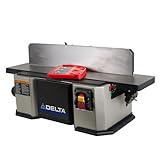
Choose a jointer by matching its cutting width to your widest boards, its bed length to the stock you need to flatten, and its footprint to the space you can spare; for most beginners working with furniture lumber, a 6-inch benchtop model is the practical starting point, while long or wide stock may call for a floor-standing jointer—or a different flattening method.
As an Amazon Associate we earn from qualifying purchases at no extra cost to you.


Start with the boards, not the machine
A jointer makes one face of a board flat, then squares an adjoining edge to that face. It does not reliably make a board’s opposite face parallel; that job belongs to a thickness planer. Before comparing machines, measure the lumber you expect to joint and note its typical length, width, species, and how often you’ll use it.
Width is the first hard limit: a 6-inch jointer cannot flatten the full face of an 8-inch board in one pass. You can sometimes work around a narrow capacity with a router sled, hand plane, or careful partial-width passes, but those approaches take setup or skill. For regularly flattening wide tabletops, a wider jointer or a dedicated alternative can be a better use of money and space.
Compare the features that affect real work
| Jointer type | Typical width | Bed length (approx.) | Typical weight (approx.) | Best fit |
|---|---|---|---|---|
| Benchtop | 6 inches | 28–36 inches | 50–80 lb | Small shops, occasional work, shorter boards |
| Floor-standing, 6-inch | 6 inches | 45–75 inches | 200–400 lb | Frequent work with longer, narrower stock |
| Floor-standing, 8-inch | 8 inches | 60–80 inches | 400–700 lb | Wider boards and regular furniture work |
These are broad market ranges, not guarantees. Confirm the exact machine’s capacity, table dimensions, weight, and whether its listed bed length includes the tables’ usable support area. Heavier machines are harder to move but generally stay put better under long or demanding cuts.
Width: leave room for variation
Choose a width based on the widest boards you expect to flatten, not just the lumber you own today. A 6-inch machine suits many common furniture parts and rough-sawn boards that can be ripped narrower first. An 8-inch jointer gives more room for wide panels, but costs more, weighs substantially more, and needs more floor space. Wider capacity is not automatically useful if your projects rarely call for it.
Bed length: support matters more on long stock
Long tables help keep a board registered as it enters and exits the cutterhead. Short benchtop tables can be adequate for manageable pieces, but a long board may teeter, making it harder to maintain a flat face. Roller stands can add support, yet they must be set carefully: a stand that is too high or low can steer the board and spoil the cut.
As a rough planning check, a board much longer than the jointer’s infeed table will require attentive handling and often auxiliary support. If you routinely flatten boards around 6–8 feet long, favor a longer-bed machine or plan for well-adjusted outfeed support and help managing the stock.
Cutterhead: compare the insert cost, not just the label
Many jointers use straight knives; some offer helical or spiral-style cutterheads with small indexed inserts. Straight knives can produce a good finish when sharp and properly aligned, but changing or setting them can take patience. Insert heads typically cost more up front and require replacement inserts when edges become dull or damaged. Rotating an insert to a fresh edge can reduce maintenance downtime, and small nicks may leave less conspicuous marks than a nicked full-width knife.
Check the price and availability of replacement knives or inserts before buying. Also check whether the cutterhead is compatible with the machine’s dust collection arrangement. Whichever type you choose, avoid feeding dirty or gritty reclaimed lumber without cleaning it first; grit dulls cutting edges and can damage the table surface.
Fence adjustment: look for repeatable squareness
The fence guides the edge cut and needs to stay square to the tables. Check how it tilts, locks, and returns to 90 degrees. A useful fence has a secure lock that does not shift when tightened, clear angle markings, and enough height to support the board safely. Markings are a starting point, not proof of accuracy: verify the fence with a reliable square before jointing edges for glue-ups.
Choose by your shop and workload
| Your situation | Practical choice | What to plan for |
|---|---|---|
| Beginner, limited budget, occasional projects | 6-inch benchtop jointer | Shorter bed; secure mounting and support for long boards |
| Regular furniture work, space for a permanent machine | 6-inch floor-standing jointer | Better support and stability, but still limited to 6-inch-wide faces |
| Frequent wide panels or stock over 6 inches | 8-inch floor-standing jointer | Higher purchase, moving, power, and space demands |
| Very small shop; only a few wide boards each year | Benchtop jointer plus hand-plane or router-sled option | Extra setup and labor instead of a larger permanent machine |
Check the full footprint before buying
The machine’s base is only part of the space it needs. Long boards project well beyond the tables, and you need clear approaches at both ends to feed and receive them without hitting a wall, vehicle, or stored lumber. Measure the machine, then lay out the longest board you expect to joint with room to stand and move it safely.
A benchtop machine is easier to store, but it should be clamped or bolted to a stable stand during use. A floor-standing machine needs a level, sturdy location and may be difficult to relocate after installation. Check the electrical requirements, dust-port size, and dust-collection needs too; shavings build up quickly, and poor extraction can interfere with work and cleanup.
Worked sizing example: a small furniture shop
Suppose your projects mostly use 3–5-inch-wide parts, with occasional 7-inch boards for a tabletop, and you have room for a 6-inch machine. A 6-inch jointer can handle most routine parts, but cannot flatten the full face of a 7-inch board at once. You could rip that board to narrower pieces before flattening, use a router sled or hand plane for the wide face, or step up to an 8-inch machine.
Now consider length. If those parts are usually 2–4 feet long, a benchtop bed may be workable with careful support. If you often prepare 6-foot legs or rails, a longer-bed floor model can make control easier. This example shows why width alone is not enough: the right choice depends on both the board and how frequently you handle it.
Ownership costs and common mistakes
- Budget for consumables: knives or inserts wear; replacement cost and availability matter over time.
- Protect the tables: clean off resin and dust, and keep cast-iron surfaces dry to limit rust. A light protective coating can help, but wipe off residue that could transfer to wood.
- Keep cuts conservative: heavy cuts increase strain and can worsen tear-out. Take light passes, especially on figured grain, and follow the manual’s depth limits.
- Don’t use the fence as a substitute for a flat face: flatten one face first, then reference it to joint a square edge.
- Account for the whole setup: a dust collector, stable stand, push blocks, and outfeed support may add meaningful cost beyond the machine.
For a first jointer, a 6-inch benchtop model is a sensible choice when space and budget are tight and your stock is mostly narrow and short. Choose a longer-bed floor-standing model if long boards are routine, and consider 8 inches when wide boards are a regular requirement—not merely a possibility. Before ordering, compare the machine’s usable bed, fence behavior, cutterhead replacement costs, dust setup, and full operating footprint against the lumber you actually plan to flatten.