
Our Top Picks
What's inside
As an Amazon Associate I earn from qualifying purchases. This post may contain affiliate links at no extra cost to you.
The jointer decision is really a width decision. A jointer can only flatten a board as wide as its knives, so the widest stock you honestly expect to face-joint — not the average board in your rack — should pick the size. Everything else, from bed length to bench space, arranges itself around that single measurement.
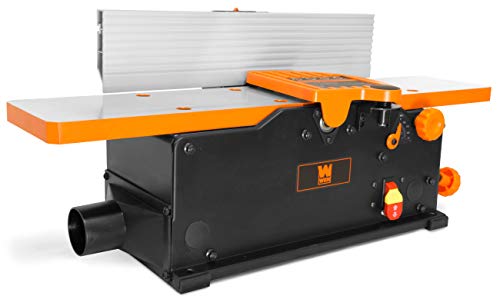
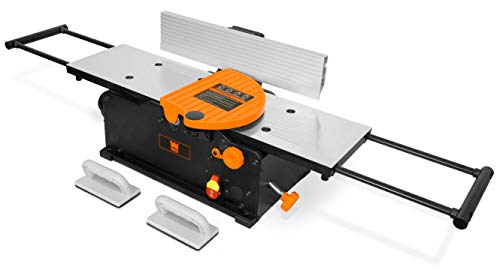
Two groups face this choice: furniture makers whose stock rarely exceeds 6 inches and who value a compact bench tool, and makers who flatten glued-up panels, stair parts and wide single boards that a 6-inch machine simply cannot take in one pass. To keep the comparison concrete, each size class is represented by one verified model from its Amazon listing — the WEN JT630H for 6 inch and the WEN JT833H for 8 inch — chosen from stated specifications. Both are benchtop machines, so the contest is purely about width, bed and supporting details.
Quick Picks
As an Amazon Associate we earn from qualifying purchases
| Product | Best for | Key spec from title |
|---|---|---|
| WEN JT630H 6-Inch Spiral Benchtop Jointer | 6-inch class: everyday furniture boards | 30-inch cast-iron bed, 12 spiral blades |
| WEN JT833H 8-Inch Spiral Benchtop Jointer | 8-inch class: wider boards and panels | Table extends from 33 to 51 inches, 16 spiral blades |
How to Choose
Start With Your Widest Board, Not Your Average One
A 6-inch jointer handles the bulk of furniture stock — drawer sides, rails, legs and most single boards — in one pass. The moment your projects include 7 or 8 inch boards, wide glue-ups or stair treads, that machine forces you to rip stock narrower or use awkward partial-pass techniques. Audit the projects you actually build over a year. If wide boards appear even a few times, the 8-inch class removes a recurring workaround; if they never appear, the smaller machine’s compact footprint is the smarter spend. Be honest in that audit; wishful thinking about future projects cuts both ways.
Bed Length Controls Long-Board Results
Width gets the headlines, but bed length decides how straight a long board becomes. The 6-inch WEN works over a 30-inch cast-iron bed; the 8-inch model’s table measures 33 inches and extends to 51 inches with its support arms, giving long stock somewhere to register before and after the cutterhead. For boards approaching the length of a dining table top, that support reduces the rocking that causes uneven passes. Short stock forgives a short bed; long stock does not. Support is the specification that separates a jointer that flattens from one that merely shaves.
Spiral Cutterheads: Blade Count and Upkeep
Both machines here use spiral cutterheads with staggered high-speed steel blades — 12 on the 6-inch, 16 on the 8-inch — spinning at up to 11,000 RPM from a 10-amp motor. A spiral head shears rather than chops, which generally means a quieter cut and simpler upkeep: a nicked blade section affects one small segment, not a full-width knife. The extra blades on the wider head exist because it covers more width per revolution; either way, confirm replacement blades are easy to source before you commit. Count blades as a running cost as well as a cutting feature.
Fences, Depth Scales and Dust Ports
The supporting details differ between these two. The 6-inch model includes an onboard depth-of-cut scale and a single 2-1/2-inch dust port; the 8-inch model adds a fence sized 19-3/4 by 4-1/4 inches that bevels to 45 degrees, plus dual dust ports in 2-1/2 and 4 inch sizes for a stronger extraction connection. Both remove up to about 1/8 inch per pass and include two push blocks. If you joint bevels or chamfers often, the stated fence behaviour deserves weight in the decision. None of these details sells a jointer alone, but together they decide how pleasant the daily work is.
The 2 Best Options
WEN JT630H 6-Inch Spiral Benchtop Jointer
The 6-inch case rests on this machine’s cast-iron table: a 30-inch bed in a benchtop tool weighing 36.82 lb, light enough to move when the bench is needed for something else. Its 10-amp motor drives a spiral cutterhead with 12 staggered HSS blades at up to 11,000 RPM, and the maximum cutting depth is 0.13 inches per pass. An onboard depth-of-cut scale, two included push blocks and a 2-1/2-inch dust port cover the daily essentials. For stock at or under 6 inches wide, nothing about this specification asks you to compromise. It asks nothing extra of the workshop around it.
Specs
- Size class: 6-inch benchtop jointer
- Motor: 10 amp; maximum speed 11,000 RPM
- Cutterhead: spiral, 12 staggered HSS blades
- Table: cast iron, 30-inch bed
- Maximum cutting depth: 0.13 inches per pass
- Included: onboard depth-of-cut scale and two push blocks
- Dust port: 2-1/2 inch
- Weight: 36.82 lb
- UPC: 044459006305
Best for: Furniture makers whose boards stay at or under 6 inches wide and whose bench space is shared.
Watch out for: Boards wider than 6 inches cannot be face-jointed in one pass, so be honest about your widest regular stock before choosing the smaller class.
WEN JT833H 8-Inch Spiral Benchtop Jointer
The 8-inch case is about reach in both directions. Across, the JT833H flattens stock a full 2 inches wider than its sibling; along, its 33 by 8 inch table extends to 51 inches on support arms, so long boards stay registered instead of tipping mid-pass. The spiral cutterhead carries 16 HSS blades under the same 10-amp, 11,000 RPM drive, removing 0 to 1/8 inch per pass. A 19-3/4 by 4-1/4 inch fence bevels to 45 degrees, dual dust ports accept 2-1/2 or 4 inch extraction, and two push blocks are included. That reach is the whole argument in one specification.
Specs
- Size class: 8-inch benchtop jointer
- Motor: 10 amp; maximum speed 11,000 RPM
- Cutterhead: spiral, 16 HSS blades
- Table: 33 x 8 inches, extendable to 51 inches with support arms
- Material removal: 0 to 1/8 inch per pass
- Fence: 19-3/4 x 4-1/4 inches, bevels to 45 degrees
- Dust ports: dual, 2-1/2 inch and 4 inch
- Included: two push blocks
- Table material: aluminum, per listing-based data
- UPC: 044459008330
Best for: Makers flattening wide single boards, panels and long stock that a 6-inch bed cannot support or accept.
Watch out for: The listing-based data describes an aluminum table where the 6-inch model uses cast iron; if table material matters to you, confirm it on the listing.
Which One Fits Your Situation
Your Stock Rarely Exceeds 6 Inches Wide
Buy the 6-inch WEN JT630H. Rails, legs, drawer parts and most project boards pass in one go, the cast-iron bed is the more traditional surface, and at under 37 lb the machine can be lifted off the bench when space is needed for assembly instead. It also leaves more of the budget for the planer that partners it.
You Flatten Glued-Up Panels and Wide Boards
Buy the 8-inch WEN JT833H. Panels and wide single boards are exactly the work the smaller class cannot accept, and the extendable table supports the length that usually comes with that width. This is the class that removes the rip-it-narrower workaround from your workflow. This is the purchase that ends the workaround for good.
Long Boards Are Your Real Problem
Width aside, choose the 8-inch model for its bed: 33 inches extending to 51 inches keeps a long board flat against the tables through the pass, which is where straightness is won or lost. The 6-inch machine’s 30-inch bed asks for roller stands and patience on the same stock. Bed length, not width, is the deciding figure in this situation.
The Jointer Shares a Small Bench
The 6-inch JT630H is the easier housemate: smaller footprint, lighter body, one dust port to connect. If your wide-board work is occasional rather than weekly, the compact machine plus a workaround on rare panels usually beats a larger tool that crowds every other job. Compactness is a genuine feature when the bench has other jobs.
Common Mistakes
- Buying the 6-inch size for a workshop that regularly produces 8-inch boards, then ripping good stock narrower to fit the machine.
- Judging the two sizes on motor power, which is identical here, instead of on width and bed length where the real difference lives. Everything else in this comparison is a supporting detail.
- Taking the full 1/8-inch pass on hard or wide stock, overloading the cut and tearing the surface instead of making two lighter passes.
- Expecting a jointer to make boards a uniform thickness; it flattens one face and one edge, and a planer does the parallel work afterwards. That misunderstanding wastes more good boards than any dull blade.
- Working without the push blocks both machines include, especially on short or thin pieces where fingers drift toward the cutterhead. The blocks are in the box for a reason.
Frequently Asked Questions
Can an 8-inch jointer handle a board wider than 8 inches?
Not in a single full pass. Wider boards call for partial-pass techniques with the guard removed, which many woodworkers reasonably avoid, or for flattening by other means first. That limit is the heart of this comparison: if boards over 8 inches are routine in your shop, neither benchtop class is the final answer, and a floor-standing machine belongs on the list instead.
Is a spiral cutterhead worth choosing over straight knives?
Both models here are spiral machines, so the question is settled within this pair — but the design has practical effects: the staggered blades shear the wood, individual segments can be addressed when nicked, and the cut tends to be quieter. With 12 blades on the 6-inch head and 16 on the 8-inch, upkeep is a matter of small blades rather than full-width knife setting.
How much material should I remove per pass?
Both listings put the ceiling at about 1/8 inch per pass — 0.13 inches stated for the 6-inch model, 0 to 1/8 inch for the 8-inch. Treat that as a maximum for rough, twisted stock, not a default. Fine flattening work usually goes better at half that depth or less, with the final pass light enough to leave a surface the planer can finish quickly.
Do I need a floor-standing jointer instead of a benchtop?
Only if your stock outgrows benchtop beds and widths. These two machines cover 6 and 8 inch widths with beds of 30 and up to 51 inches respectively, which serves most furniture-scale work. Floor-standing jointers earn their floor space when boards get longer, heavier and wider than benchtop tables can support safely — a volume and size question, not a quality one.
Related guides
More from Amazon
Programs that pair well with the guide above. Offers and eligibility are set by Amazon and may change.
A free business account with business pricing and bulk-buying tools for work, shop or home office.
Create a business accountFree shipping on eligible items, Prime Video and more. Eligible new members can start with a free trial.
Start a Prime free trialAudiobooks and podcasts to listen to on the go. Eligible new members can start with a free trial.
Try Audible freeAd-free music streaming. Eligible new subscribers can start with a free trial.
Try Music Unlimited freeAs an Amazon Associate we earn from qualifying purchases.









