What's inside
As an Amazon Associate I earn from qualifying purchases. This post may contain affiliate links at no extra cost to you.
What CADR measures
An air filtration unit’s clean air delivery rate (CADR) is the volume of filtered air it supplies over time, usually given in cubic feet per minute (CFM). Room volume tells you how much air is in your shop; CADR tells you how quickly a filter can clean it. You need both figures to judge whether a unit is suitably sized.
For example, a 20-by-24-foot garage with an 8-foot ceiling contains 3,840 cubic feet. A unit rated at 400 CFM has a theoretical clean-air rate of about 6.25 room volumes per hour: 400 × 60 ÷ 3,840. This is often called air changes per hour (ACH), though it does not mean every particle disappears neatly after one cycle.
As an Amazon Associate we earn from qualifying purchases at no extra cost to you.

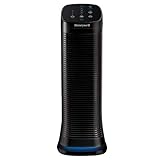


Choose a practical target
For general background dust in a small workshop, roughly 4–6 ACH is a useful starting point for comparing units. At 3,840 cubic feet, that calls for about 256–384 CFM of actual clean-air delivery. Fine sanding, frequent routing, or work with dusty materials may justify aiming higher, but an ambient filter is not a substitute for capturing dust at the tool.
To estimate the required CADR, multiply room volume by your target ACH and divide by 60. For a shop measuring 16 × 20 × 8 feet, the volume is 2,560 cubic feet. At 5 ACH, the target is about 213 CFM. If the ceiling is 10 feet rather than 8, volume rises to 3,200 cubic feet and the same target becomes about 267 CFM.
These are planning estimates, not guarantees of exposure control. A unit’s published maximum may apply only at its loudest speed, and airflow falls as filters load with dust. Check the rating at a speed you can tolerate and expect to clean or replace filters regularly.
Room volume and CADR examples
| Shop dimensions | Room volume | CADR for 4 ACH | CADR for 6 ACH |
|---|---|---|---|
| 12 × 16 × 8 ft | 1,536 cu. ft. | 102 CFM | 154 CFM |
| 16 × 20 × 8 ft | 2,560 cu. ft. | 171 CFM | 256 CFM |
| 20 × 24 × 8 ft | 3,840 cu. ft. | 256 CFM | 384 CFM |
| 24 × 30 × 10 ft | 7,200 cu. ft. | 480 CFM | 720 CFM |
The figures assume the full space is open and use rated CADR, not a guessed value based on fan size. A partition, loft, or large connected room can change how well the air circulates. If the filter serves a shop plus an open storage area, include that connected volume in your estimate.
CADR is not dust collection
An ambient filtration unit cleans particles that have already escaped into the room. A dust collector or extractor pulls chips and dust from a tool before they spread. For a table saw, planer, or sander, use the tool’s dust port with an appropriately sized collector or extractor first, then use room filtration to catch residual airborne dust. A ceiling unit rated at 400 CFM cannot compensate for a poorly fitted hood or an open machine port.
Fine particles are the main reason to care about filtration performance, but ratings are not always directly comparable. Look for a stated airflow or CADR and a clear description of the filter efficiency. A generic “HEPA-style” label does not establish the same performance as a properly specified HEPA filter. Also check whether the quoted airflow applies with the filter installed.
Buying and placing a unit
For a small, enclosed shop, a workshop air filtration unit with a published CFM rating makes sizing straightforward. Compare delivered airflow, filter replacement cost, noise, and the availability of replacement filters—not just the largest number on the box. A cheaper unit can be adequate for occasional DIY work if its real operating speed meets your target and you keep up with maintenance.
Hang a ceiling unit where its intake and outlet are not blocked by lights, shelving, or a tall machine. Leave the clearances specified by the manufacturer. Place it to encourage circulation through the work area rather than short-circuiting air directly from outlet to intake. In a long, narrow shop, one central unit may leave the far end poorly served; a second smaller unit or a different mounting position can improve mixing.
A portable HEPA air scrubber can be useful when you need to filter one area or move equipment between spaces. The trade-off is that its rated flow may be lower, and a ducted inlet or outlet can add resistance. Follow the manufacturer’s configuration and do not assume a ducted setup retains the advertised CADR.
Common sizing mistakes
The first mistake is using floor area alone. A 300-square-foot shop with a 12-foot ceiling contains 3,600 cubic feet, 50 percent more air than the same floor area with an 8-foot ceiling. Measure length, width, and average ceiling height; include connected open areas that share air with the shop.
The second is treating maximum speed as the everyday rating. High speed can be noisy enough that people switch the unit off. If the unit has several speeds, look for airflow and sound information for more than one setting. A quieter unit that runs consistently may clean more air over the day than a louder one left off during work.
Finally, do not ignore filters. A loaded prefilter can reduce airflow and raise operating noise. Inspect it on the schedule in the manual, and keep spare filters available if the unit is used often. If you work with hazardous dust, use suitable source extraction and respiratory protection; room-volume arithmetic alone cannot establish that the air is safe to breathe.