What's inside
As an Amazon Associate I earn from qualifying purchases. This post may contain affiliate links at no extra cost to you.
Small hardware is easy to underestimate. A box of screws may cost less than a power tool, but losing the right fastener can stop a project just as effectively. Good parts bins make hardware visible, accessible, and separated by type or size. The best setup depends on whether you want maximum storage density, quick access during assembly, or a portable system you can carry to a workbench or job site.
As an Amazon Associate we earn from qualifying purchases at no extra cost to you.



What to look for in a parts bin
Start with the hardware you actually use. A bin for 1/4-inch bolts needs more usable depth than one for brads or drywall screws. Measure the largest items and allow at least 1 inch of extra height so you can remove them without spilling the contents. For small screws, bins around 2 to 4 inches wide are easier to sort than large containers where everything settles into one pile.
Look for bins made from thick polypropylene or similar impact-resistant plastic. Thin plastic can crack when a cold shop makes it brittle, or when a bin is dropped while full. A reinforced front lip matters on stackable bins: without one, the front edge can bow and the bin may slide out under load.
Transparent fronts are useful when bins are mounted above a bench. If the bin is opaque, you will spend time pulling containers down to check the contents. That is not a major issue for rarely used hardware, but it becomes irritating for washers, anchors, and common screws used every day.
The main parts-bin types
| Bin type | Best use | Advantages | Limitations |
|---|---|---|---|
| Open-front wall bin | Frequently used screws and fasteners | Fast access, good visibility, easy one-handed use | Collects dust and can spill if overloaded |
| Stackable tilt bin | Mixed workshop hardware | Good density, bins tilt or pull forward for access | Labels and contents can be harder to see from a distance |
| Drawer cabinet | Small parts and less-used items | Protects hardware from dust, keeps many sizes together | Slower access; shallow drawers can be cramped |
| Portable organizer case | Taking fasteners to the work area | Closed storage, carry handle, removable compartments | Compartment dividers may leak small screws between sections |
| Reused jars or food containers | Low-cost storage for bulky hardware | Very cheap, easy to replace, often already available | Consumes shelf space and is less convenient to sort |
Wall bins and stackable bins
For a permanent workshop, open-front bins mounted on a rail or panel are usually the most convenient choice. Put the most-used sizes between waist and eye level. Bins above shoulder height are awkward and increase the chance of dropping hardware while reaching. Keep heavy items such as lag screws, masonry anchors, and bolts in lower positions.
Stackable bins are a good compromise when wall space is limited. Buy a compatible system rather than mixing random bins; small differences in the stacking ledge can make a tower unstable. A stack four or five bins high is generally manageable, but taller stacks should be secured to a wall or cabinet. A loaded stack that tips forward can scatter hundreds of parts across the floor.
For a straightforward wall setup, compare wall-mount parts bins with stackable models before buying. The important specification is not the advertised outside size; check the interior width, depth, and opening height. A bin that claims to hold a pound of screws may become difficult to search once it is filled past about two-thirds of its capacity.
Drawer cabinets and portable organizers
Small drawer cabinets work well for machine screws, nuts, washers, electrical terminals, and drill bits. Choose drawers with stops so they cannot pull completely out when opened. Clear drawers help, but labels are still necessary because two adjacent drawers of similar-looking screws are easy to confuse.
Drawer depth is more important than total drawer count. A drawer only 1 inch deep may hold small washers neatly but will not accept a handful of wood screws without jamming. For mixed hardware, drawers about 1.5 to 2.5 inches deep are more practical. Avoid putting heavy bolts in lightweight desktop cabinets; the cabinet can flex, and the bottom drawers become difficult to open.
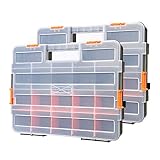
A portable organizer is better when you work on projects in different parts of the shop. Select one with a positive latch, a gasket or reasonably tight lid, and fixed dividers that cannot lift when the case is tipped. For a useful portable hardware organizer, check whether the smallest compartments have molded bottoms. Flat-bottom compartments let tiny screws collect in corners; sloped or rounded bottoms are easier to empty.
Labeling and layout
Label every bin, including bins containing common hardware. Write the diameter, length, drive type, and material where relevant: “#8 x 1-1/4 in. zinc wood screw” is more useful than “wood screws.” For metric hardware, include pitch when it matters, such as M6 x 1.0. A label maker produces clean labels, but painter’s tape and a marker work fine if you replace damaged labels promptly.
Separate fasteners by function before separating them by size. Keep wood screws, machine screws, self-drilling screws, and masonry fasteners in different groups. Mixing them creates common failure modes: using a coarse-thread screw where a machine screw is needed, choosing a screw that is too short for the joint, or grabbing a hardened construction screw for a job requiring a softer, shear-rated fastener.
Leave one spare bin or drawer in each group. Hardware inventories change, and an overcrowded bin becomes harder to use than two half-full bins. Store matching nuts, bolts, and washers together only when the combination is used as a set; otherwise, separate bins make counting and restocking easier.
Dust, moisture, and workshop safety
Parts bins do not need to be sealed for most woodworking shops, but open bins near a sander or table saw will fill with dust. Fine dust can pack into screw threads and make small bearings or electrical contacts unreliable. Keep open bins away from the dustiest machines, or use drawers and lidded organizers in that area. A quick wipe during routine workshop storage cabinet maintenance is easier than cleaning every fastener individually.
Moisture is a bigger problem in unheated garages. Rust can begin on ordinary steel hardware even when the bin does not look wet. Use zinc-plated or stainless hardware where appropriate, add a small desiccant pack to closed organizers, and avoid storing bins directly on a concrete floor. Do not put oily rags, solvents, or flammable liquids in a plastic parts cabinet unless the cabinet is specifically rated for that use.
A practical buying decision
If you are starting from nothing, buy a small selection rather than a wall of bins: four to eight medium open bins for everyday screws, one drawer cabinet for small hardware, and one latching organizer for mobile work. Reused jars or food containers are perfectly adequate for bulky, infrequently used parts, so the cheaper option is fine there. Spend more on bins used daily, where smooth access, strong lips, reliable labels, and stable mounting save time every week.
Before loading the system, sort out duplicates and discard badly rusted or unidentified fasteners. Then fill each container only as high as you can search with your fingers. Parts storage works when every item has a predictable location; the most expensive cabinet is still a poor system if the bins are unlabeled, overloaded, or arranged without regard to how often you use them.