What's inside
As an Amazon Associate I earn from qualifying purchases. This post may contain affiliate links at no extra cost to you.
Standing comfort in a workshop is not just a matter of avoiding sore feet. Fatigue changes how you handle lumber, position a chisel, climb a step stool, and react when a board kicks back. The floor also affects dust collection cleanup, tool stability, rolling cabinets, lighting, and how safely you move around the shop. Rubber flooring and sealed concrete can both work well, but they solve different problems.
As an Amazon Associate we earn from qualifying purchases at no extra cost to you.


The basic choice
Sealed concrete is hard, durable, inexpensive, and easy to sweep. It is often the right choice for a garage shop where the budget is limited, heavy machines are moved regularly, or vehicles still use the space. Its weakness is unchanging hardness: your shoes, knees, hips, and lower back absorb nearly every impact and vibration.
Rubber flooring adds resilience underfoot. It reduces peak impact and feels warmer in winter, particularly over a cold slab. The improvement is most noticeable at stationary work areas such as a workbench, assembly table, sharpening station, or drill press. It does not make a poorly arranged shop comfortable by itself. If your bench is too high, your lighting causes squinting, or you stand in one position for four hours, rubber only reduces one part of the problem.
| Factor | Rubber flooring | Sealed concrete |
|---|---|---|
| Standing comfort | Better impact absorption and less fatigue | Hard; depends heavily on footwear and anti-fatigue mats |
| Cost | Moderate to high, depending on thickness and coverage | Low if the slab is already sound |
| Rolling tools | Works well when dense and level; soft tiles can resist casters | Excellent rolling surface |
| Dust and cleanup | Seams and textured surfaces can hold fine dust | Fast to sweep and vacuum |
| Heavy machinery | Can dent or compress under concentrated feet | Best for extreme point loads |
| Moisture tolerance | Depends on the product and slab below | Good with a properly prepared coating |
Rubber flooring options
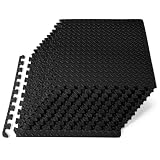
For a workshop, dense rubber rolls or interlocking tiles are more practical than soft exercise mats. Look for flooring around 3/8 to 1/2 inch thick for general standing comfort. Thicker material can feel better but may interfere with doors, thresholds, cabinet toe-kicks, and the height of a mobile tool base. A 3/4-inch product is useful at a dedicated bench, but it is not automatically better across the whole floor.
Interlocking tiles are easier to install and replace. They suit renters or a shop where machines may be rearranged. The failure mode is separation at the seams, especially if a cabinet wheel catches an edge. Rolls produce fewer seams but are harder to cut, transport, and install flat. Rubber also has a noticeable odor when new, and some products can stain or react with certain adhesives, oils, or rubber wheels. Check the manufacturer’s chemical guidance before placing a lathe or compressor on it.
Avoid very soft foam tiles in areas where you use sharp tools or roll heavy equipment. Foam can tear, compress permanently, and make a benchtop feel unstable. Dense rubber workshop flooring tiles are a safer category for a permanent shop.
What sealed concrete does well
Sealed concrete is usually the better foundation for dust collection and mobile storage. Fine sawdust is visible, a shop vacuum nozzle glides easily, and a wheeled dust collector or tool cabinet rolls without climbing over soft flooring. A smooth coating also prevents spilled finishes and cutting fluids from soaking into the slab.
Do not assume “sealed” means any paint will work. Concrete must be dry, clean, and free of curing compounds, oil, and loose dust. A coating that fails at the slab will peel under tool casters and create chips that enter drawers or dust collection equipment. Test for moisture if the floor is below grade or has a history of dampness. Moisture vapor can blister coatings from underneath.
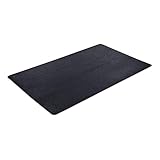
The economical solution is often sealed concrete plus targeted anti-fatigue mats. Put them only where you stand: in front of the main bench, miter saw, assembly table, and sharpening station. A heavy-duty anti-fatigue mat can deliver much of the comfort benefit without raising the entire floor. Choose beveled edges and a surface that will not become dangerously slick with finish or oil.
Safety, storage, and layout effects
Flooring should not create a trip hazard. Keep transitions below roughly 1/2 inch where possible, and use a beveled reducer if rubber meets bare concrete. Do not place a mat where it can catch a cabinet caster or curl near a table saw. Tape is a temporary fix; it eventually collects dust and loses adhesion.
Rubber can reduce vibration from a compressor or benchtop machine, but it is not a substitute for leveling and anchoring. A machine on an overly soft surface may rock, especially when you feed stock through a planer or router table. For heavy stationary equipment, install rubber around the machine and use firm leveling pads under its feet if the manufacturer permits.
Floor color also affects lighting. A medium-light gray surface reflects more useful light than black rubber, helping you see pencil lines, dropped hardware, and dust on the floor. Glossy concrete can create glare under LED shop lights. A satin or matte finish is generally easier on the eyes. Good linkable LED shop lights and adequate task lighting at the bench usually improve safety more than changing from one acceptable floor to another.
Which option makes sense?
Choose sealed concrete with targeted mats if the shop includes a vehicle, you frequently move heavy tools, you need the lowest cost, or dust cleanup is the priority. This is also the sensible choice when the existing slab is smooth and sound. Replace worn mats when their edges curl or their surface becomes slick.
Choose rubber across the main working zone if you stand for long periods, work in a cold garage, have joint discomfort, or are building a dedicated shop that will not need frequent equipment changes. You do not need to cover every square foot. A 3-by-5-foot mat or a strip along a bench may be enough; full flooring pays off mainly when several workstations share the same standing path.
Before buying, mark the proposed coverage with painter’s tape for a week. Roll your tool cabinet across it, open every door, and check whether the added height affects bench ergonomics. If the floor makes your bench effectively higher, a 1/2-inch change can be noticeable during precision work. The best result is often a sealed, clean concrete floor for rolling equipment, combined with durable rubber only at the stations where your feet and back need the help.