What's inside
As an Amazon Associate I earn from qualifying purchases. This post may contain affiliate links at no extra cost to you.
Tool storage has two jobs: keep equipment easy to reach and keep it out of the way when you are working. Slatwall and French cleat systems both do that, but they suit different shops. Slatwall is a finished, modular retail-style system with hooks, baskets, shelves, and cabinets that can move without rebuilding the wall. French cleats are simple wooden rails that let you hang custom boxes, shelves, and tool holders wherever you need them.
The better choice depends less on appearance than on how often your storage layout changes, how much weight you need to support, and whether you want a ready-made system or a shop-built one.
As an Amazon Associate we earn from qualifying purchases at no extra cost to you.


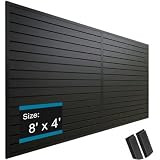

How slatwall storage works
Slatwall panels have horizontal grooves, commonly spaced about 3 to 6 inches apart. Matching hooks and brackets lock into those grooves. A panel may be made from MDF, plywood, PVC, or a composite material, and many versions have a decorative laminate or painted surface.
The main advantage is speed. Install the panels over studs or a properly secured backer, add the hardware, and you can rearrange storage in minutes. Hooks are useful for clamps, squares, cords, and hand tools. Baskets hold sanding discs and fasteners, while shelf brackets support small cases or finish supplies.
Slatwall hardware is not universally interchangeable. Groove dimensions and bracket designs vary, so check compatibility before buying extra accessories. Also check the panel’s load rating rather than assuming the wall can hold anything that fits. A hook may support 20 pounds while a shelf bracket supports 50, but the panel and fasteners still have to transfer that load into the wall.
For a typical garage workshop, mount panels to studs or to at least 3/4-inch plywood fastened securely to studs. Do not rely on drywall anchors for a row of heavy tools. A loaded storage section can exert significant downward and outward force, especially when a tool is pulled off a hook.
How French cleat storage works
A French cleat uses a board ripped lengthwise with a 45-degree bevel. One half is fastened to the wall with the bevel facing outward and upward. The matching half is attached to a shelf, cabinet, or tool holder with the bevel facing down and toward the wall. The two pieces interlock when the accessory is lifted onto the rail.
Use 3/4-inch plywood for most cleats. A 4-inch-wide strip gives a useful 2-inch bearing surface after the bevel is cut, but the exact dimensions are less important than solid construction and adequate wall attachment. Screw the wall cleat into studs whenever possible. If you use a continuous cleat, add screws every 8 to 12 inches and use washers where needed to prevent pull-through.
French cleats are especially good for custom storage. You can build a holder for a router, a rack for measuring tools, or a small cabinet for drill batteries, then move the entire unit without patching the wall. The downside is that every accessory must be built or adapted. A poorly glued box, thin plywood, or short screws can fail even when the wall cleat itself is strong.
Slatwall vs. French cleat at a glance
| Factor | Slatwall | French cleat |
|---|---|---|
| Initial setup | Fast once panels and compatible hardware are available | Requires ripping cleats and building holders |
| Rearranging | Very quick; move hooks and brackets directly | Quick for finished units, slower if new holders are needed |
| Custom sizes | Limited by panel grooves and accessory dimensions | Excellent; build nearly any shelf, rack, or cabinet |
| Appearance | Clean and finished | Workshop-built, unless carefully painted or trimmed |
| Cost | Higher, especially with many accessories | Low if you have plywood and basic tools |
| Best use | Frequent layout changes and mixed small tools | Heavy, custom, or specialized equipment |
Choosing for tool weight and failure modes
Neither system automatically makes a weak wall strong. A compact benchtop planer, large router, or loaded battery shelf needs a holder designed around its center of gravity. Keep heavy items low, and avoid placing a deep load high on the wall where it can lever the fasteners loose.
With slatwall, the common failure is an accessory that disengages when a tool is lifted at an angle. Use locking hooks or brackets for items that are bumped regularly. With French cleats, the common failure is a holder that is too shallow or has no bottom stop. Add a lower ledge, retaining lip, or side blocks so the tool cannot slide or swing out.
For hand tools and light accessories, slatwall tool hooks and brackets are convenient. For custom cleat holders, use glue plus screws rather than brad nails alone. Test each new holder with more weight than you expect to store before putting it above a workbench.
Plan around dust, lighting, and the bench
Do not cover every inch of wall with storage before planning dust collection and electrical access. A dust collector hose, cyclone, or shop vacuum needs room for routing and service. Keep abrasive supplies and electrical tools away from the area where dust is discharged or cleaned out.
Storage should also work with lighting. Wall-mounted panels can cast shadows across a bench, particularly when loaded with shelves. Put task lighting slightly in front of the worker and above eye level, rather than directly behind a deep storage rack. Leave enough clearance to remove a tool without hitting the light or a dust hose.
For a workbench wall, reserve the most accessible zone between about 36 and 60 inches above the floor for tools used constantly. Put infrequently used equipment higher, but keep heavy items below shoulder height. A clear strip behind the bench is often more valuable than maximum storage density.
Which system should you buy?
Choose slatwall if you want a finished appearance, expect to move hooks often, and prefer buying rather than building accessories. It is also a sensible choice for a shared garage where several people need to change the layout without woodworking skills. Budget for panels, end trim, brackets, and the accessories themselves; the hardware can cost more than the panel.
Choose French cleats if you already have plywood, a table saw, or a track saw, and your storage needs are unusual. It is the cheaper option for a practical shop, particularly when you can make holders from offcuts. A continuous cleat system is also easier to extend one section at a time.
Many workshops benefit from using both. Put slatwall near the bench for hand tools, measuring equipment, and frequently rearranged accessories. Use French cleats for cabinets, clamp racks, battery shelves, and heavier custom holders. If you need a ready-made starting point, compare garage slatwall panels; if you are building your own system, shop for French cleat wall hardware only where it solves a specific mounting problem.
Whichever system you use, label storage zones, leave room to put tools back, and inspect fasteners after the first month. Adaptability is useful only when the holders stay secure and the layout makes the next job easier.